Photo by Artem Beliaikin on Unsplash
A fashion email list isn’t one audience. Advanced Klaviyo segmentation for fashion brands uses purchase history, browsing behaviour, cart activity, signup details and predictive signals to distinguish what shoppers want and the value they may bring. Build segments around these five signals, then tailor each message to the group’s intent and relationship with your brand.
A first-time browser needs a different message from a loyal customer or someone who has just abandoned a basket. The challenge is turning that common sense into useful, responsive segments without adding unnecessary complexity. These signals give you a clear starting point for deciding who receives which message, and when.
This article breaks down five ways to structure segments in Klaviyo. Use purchase patterns to identify repeat and high-value shoppers, browsing and cart behaviour to respond to current interest, signup signals to welcome new subscribers, and predictive insights to spot customers who may be ready to buy or at risk of lapsing. Each approach connects a signal to a practical marketing decision.
Key Takeaways
- Use order history and recency to distinguish repeat buyers, high-value customers and shoppers whose interest may be fading.
- Match abandoned-cart messages to the products shoppers considered, with timing shaped by their recent activity.
- Use category browsing and collection interest to make product recommendations more relevant to each shopper.
- Separate new subscribers from first-time buyers so welcome messages reflect whether they’ve purchased before.
- Predictive signals helps prioritise customers who may be ready to buy or need a timely winback message.
1. Klaviyo segmentation using purchases, UTM clicks, collection interest and recency
Start with signals that show what someone bought and what they considered. In Klaviyo, combine order history, campaign engagement and recent browsing to distinguish a first-time buyer from a repeat customer. For example, a segment might include shoppers with at least 2 orders over all time. A suggested VIP segment can use at least 3 orders over all time, alongside a revenue threshold measured over the last 365 days.
Collection interest adds context. Create an audience of people who viewed winter jackets at least 3 times without purchasing. UTM clicks can add campaign context, such as shoppers who clicked a link promoting knitwear. UTM clicks gives a useful clue about the promotion that brought someone to a product category, while purchase data shows whether they converted. Recency helps distinguish active interest from older behaviour.
Use these groups to tailor flows. A welcome flow can distinguish subscribers with no orders from customers who have already bought. Match the first group’s message to their signup intent or clicked product category, then tailor the buyer’s version around their purchase. A cart flow responds to checkout activity, while browse abandonment responds to product views without a purchase. Post-purchase messages can vary by product category and customer type, such as a first-time coat buyer versus a repeat shopper.
Shopify customer segments are useful for store-side groupings, while Klaviyo segments connect audience criteria to email campaigns and flows. Choose based on where the segment needs to activate. Klaviyo conditions can use events and profile properties, then combine criteria to define an audience; segments can have a maximum of 100 conditions.
For UK marketing, retain each profile’s consent and permission status, and exclude people who aren’t eligible for the intended message. Keep GDPR and PECR considerations specific to the data and channel used. Seasonality, size, fit and availability can refine targeting: combine a shopper’s preferred category or size with current product availability, then tailor seasonal messages to relevant collections.
Too many small audiences create operational friction. Start with a few useful groups, such as recent category browsers, repeat buyers and unengaged subscribers. Refine them when performance or customer behaviour warrants it. Klaviyo segments update dynamically as people browse, buy or go quiet, so review overlapping criteria and suppress recent purchasers where appropriate.
Common mistakes include relying on stale or inconsistent product data, treating one click as lasting intent, and sending the same campaign to overlapping segments. These errors can reduce relevance and harm deliverability. Check event tracking, product-category labels and consent records before activating a flow. Then monitor engagement and suppress inactive profiles from broad sends.
2. Abandoned-cart timing and dynamic product content
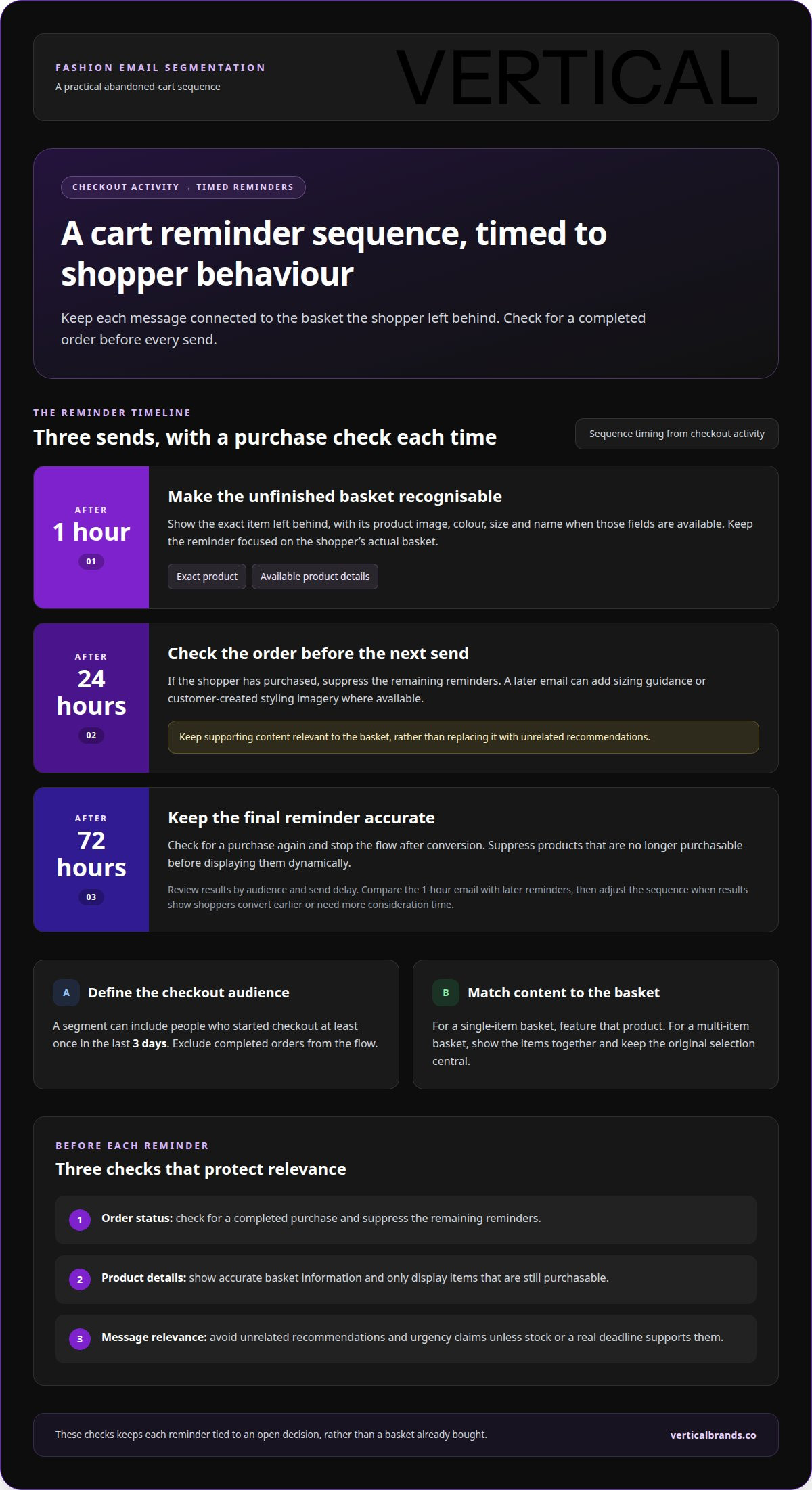
A cart reminder should reflect the shopper’s latest checkout activity. A practical sequence sends the first email after 1 hour, followed by reminders after 24 hours and 72 hours. Check for a completed order before each send. If the shopper has purchased, suppress the remaining reminders. This keeps the message tied to an open decision, rather than a basket already bought.
Build the audience from a clear event and time window. For example, a Klaviyo segment can include people who started checkout at least once in the last 3 days. Exclude completed orders from the flow, and use a separate branch for shoppers who return to checkout. Advanced Klaviyo segmentation for fashion brands links these actions to distinct follow-ups, so each campaign reflects the customer’s latest behaviour.
Dynamic content should make the reminder recognisable at a glance. Show the exact item left behind, including its product image, colour, size and name when those fields are available. A shopper who left a black jacket in their basket should see that jacket, not a generic new-arrivals panel. Accurate cart details help customers recognise the purchase they paused.
Shape supporting content around the basket. A single-item cart can feature that product and its relevant details. A multi-item basket can show the items together, keeping the original selection central. If the shopper browsed another category after leaving checkout, don’t replace the cart with unrelated recommendations. Make the unfinished purchase easy to recognise and resume.
Timing should account for what happens between sends. Check for a purchase before each reminder, and stop the flow after conversion. Review performance by audience and send delay, not just total campaign revenue. Compare the 1-hour email with later reminders, then adjust the sequence when results show shoppers convert earlier or need more consideration time. Advanced Klaviyo segmentation for fashion brands makes this comparison more actionable by separating audiences according to checkout behaviour.
Keep the message useful, not repetitive. The first reminder can focus on the exact basket; a later email can add sizing guidance or customer-created styling imagery where available. Don’t make urgency claims unless stock or a real deadline supports them. Product availability can change, so suppress items that are no longer purchasable before displaying them dynamically.
Cart-flow strategy works best when event tracking, product data and suppression rules align. A structured cart-flow strategy can connect those moving parts to the right campaigns. Review the flow after changes to checkout, product feeds or catalogue organisation. Even a small data mismatch can show the wrong colour, omit a selected size or send a reminder after purchase.
3. Browsing behaviour and category affinity
Klaviyo segments can combine product views, category browsing and cart activity to identify interest before a purchase. For example, a shopper who views dresses, then adds shoes to a basket, has shown interest in linked categories. A segment can reflect both actions, helping campaigns respond to current consideration rather than relying only on past orders.
Start with a clear category structure. Group products consistently, such as dresses, knitwear, denim and outerwear, then map site-view events to those categories. If product pages use inconsistent labels, the same shopper’s activity may split across several segments. A clean taxonomy makes browsing signals easier to interpret and supports relevant recommendations across campaigns.
Set a meaningful activity window for each segment. A person who viewed a category during the previous 180 days may still show interest, but their latest activity should guide message priority. Pair category views with email engagement or recent site visits. Separate active browsers from customers whose interest is older, and adjust content accordingly.
For fashion ecommerce, combine browsing, cart and product-view data to identify what shoppers are considering, then tailor recommendations to the relevant category. A product view without a cart action can support a browse-abandonment message; a cart event signals stronger purchase intent and belongs in a checkout flow. Suppress completed orders from both audiences.
Category affinity can also inform outfit recommendations. A visitor exploring dresses could receive complementary accessories, while a denim browser sees related tops. Club L uses browsing behaviour and preferred fabric colours to recommend outfits to subscribers. Keep the viewed category prominent so additional suggestions support, rather than replace, the original interest.
Measure engagement by segment, not only across the whole list. A fashion retailer reported a 47% increase in email revenue after implementing category-based segmentation in Klaviyo. Another fashion retailer reported a 32% improvement in click-through rates and a 15% reduction in unsubscribe rates after category-based segmentation. These results show why relevance merits measurement, but each brand’s results depend on its own audience and execution.
Review segment performance against a defined control audience. Compare clicks, conversions and unsubscribes for category-led campaigns. If a broad category performs unevenly, split it only when the data supports a useful distinction, such as colour preference or product type. Too many narrow groups can fragment engagement and make campaign decisions harder.
Before activating a browse segment, check that product events carry accurate category and product identifiers. Confirm that sold-out products don’t dominate recommendations, and exclude shoppers who have already purchased the item. These signals help keep each message aligned with live behaviour, catalogue data and the customer’s next likely decision.
4. New subscriber and first-time buyer targeting
A signup alone doesn’t reveal a shopper’s purchase intent. Separate subscribers with zero orders over all time from customers with exactly 1 order over all time. Then use signup source, selected preferences or the landing-page category to shape the welcome message. Someone joining through a denim launch can receive denim-focused content, whilst a general newsletter signup may need broader product discovery.
Build welcome-flow branches around these differences. For a new subscriber, lead with the product category or style they showed interest in. For a first-time buyer, acknowledge the item purchased and introduce relevant care, styling or complementary product content. Keep the first message consistent with the signup promise. If a shopper signed up for new-season dresses, an unrelated sale message creates a poor first impression.
Signup intent can come from a preference form, quiz result or tagged campaign link. Use this as a starting signal, not a permanent label. If a subscriber later browses trainers or buys knitwear, update the message direction to reflect that behaviour. Each flow branch should have a clear purpose and adapt as the customer relationship develops.
Club L’s welcome flow converts 11% of subscribers, with a conversion rate five times the industry benchmark for the sector. That example makes the welcome journey a commercial priority, not merely an automated greeting. Review each step for a clear next action, such as exploring the category that prompted signup or viewing products aligned with expressed preferences.
First-order incentives need careful alignment. Marine Layer offers online subscribers a 10% discount in its online welcome series. For a UK fashion brand, any offer should match its own commercial strategy and signup terms. A discount isn’t the only route: product education, customer reviews or styling ideas can help a new subscriber make a decision without immediately reducing price.
After the first order, move the customer into a post-purchase path. Segment by product category and customer type, such as a first-time occasionwear buyer or a returning denim customer. A dress purchase could trigger styling suggestions, while a first order could prompt brand and product guidance. Exclude messages that no longer fit after another purchase.
Track each branch separately. Compare welcome-flow engagement and conversion for subscribers grouped by signup intent, then assess first-time buyer performance against repeat customers. If one category attracts signups but few orders, adjust its product selection or message. Keep the underlying criteria clean: inaccurate signup tags or missing order events can send people into the wrong flow.
In Klaviyo, a new-subscriber segment can identify people who have placed zero orders over all time, giving the welcome journey a practical audience definition. Pair that group with signup-source or preference signals, and keep its message focused on the interest that prompted registration. Club L's welcome flow conversion rate is 5x the industry benchmark for the sector, reinforcing the value of treating this audience as a distinct journey. Reassess the branch as purchases and browsing provide stronger evidence of what each customer wants.
5. Predictive churn risk and customer lifetime value
Past orders show value already created; predictive signals help prioritise what happens next. In Klaviyo, combine purchase recency, order frequency and predicted customer lifetime value where available. A customer with several orders and recent browsing may merit different treatment from someone whose last purchase was long ago. Tie each segment to a clear action, such as retention, replenishment or a winback message.
Start with a recency rule. A suggested lapsing-customer segment can identify people with no order in the last 60 days. Fashion buying cycles vary by category, so interpret that interval alongside the customer’s order history. A coat buyer may shop seasonally, while a customer purchasing basics may return more often. Use category context before treating inactivity as lost interest.
For a stronger winback signal, customers who have not returned 90 or more days after a purchase are candidates for a winback flow. Exclude recent purchasers and people who have already re-engaged. Then tailor the message to their last category, such as denim or occasionwear. A relevant new-season selection may give a lapsed shopper a reason to reconsider.
Customer lifetime value helps distinguish retention priorities. Top customers spend 3-4 times more than the average shopper. That makes order frequency and revenue useful alongside predicted value. Build a high-value segment from customers with repeated orders and strong spend, then give it early access or more personalised recommendations. A near-VIP group can receive a different journey, designed to encourage another purchase without treating every subscriber as a VIP.
Predictive metrics are directional inputs, not campaign instructions on their own. Check whether a prediction aligns with observable behaviour, such as recent product views, email engagement or a new order. If a supposedly high-risk customer has just browsed a relevant collection, a timely product-led message may fit better than a discount-led winback. Segment criteria should reflect the decision the campaign is meant to support.
Use a controlled review process. Compare winback engagement and repeat orders across lapsed, active and high-value groups. Check whether a segment changes after purchases, engagement or new predictive data arrive. If its members remain static despite new activity, review event tracking and criteria. These signals help teams focus on meaningful patterns rather than a single score.
Connect predicted value to practical customer treatment. Reserve premium styling content or new-arrival previews for customers whose behaviour supports that investment. Use broader product education for shoppers with lower or uncertain predicted value. Build a predictive retention strategy around clean purchase data, relevant segments and distinct campaign actions.
Combine campaign choices with other customer evidence. For more precise segmentation, request customer profiles, purchase history, engagement data, customer feedback and social media data. Customer feedback can include reviews, survey responses and customer service interactions. Developing a new segmentation strategy without customer metrics is challenging because metrics provide insights into customer behaviour and preferences. In the 2024 survey, 80% of apparel and accessories consumers valued access to product reviews.
Suggested Klaviyo email segments include engaged and unengaged subscribers, subscribers who haven’t received an email recently but can receive marketing, customers expected to purchase soon, and near-VIP customers. Club L uses loyalty data to create campaign segments, including inviting its highest-value customers to a secret sale.
Vertical Brands: Klaviyo Email Marketing
Vertical Brands helps fashion brands turn purchase, browsing and predictive signals into structured Klaviyo campaigns. Its Klaviyo Email Marketing and Email Marketing & CRM Management services support segmentation, flow planning and customer communications. This is a practical next step when audience criteria overlap, data needs organising or campaign messages don’t match shopper intent.
The right segments depend on reliable customer data and clear campaign goals. Vertical Brands can connect those inputs to relevant email activity, alongside paid social or paid search when they support the wider strategy. To discuss Klaviyo segmentation for your fashion brand, contact Vertical Brands.
Turn segmentation into a working growth system
Treat advanced Klaviyo segmentation for fashion brands as an operating system, not a one-off campaign task. Set a clear review rhythm around changes in customer behaviour, product launches and the trading calendar. This gives each audience a defined purpose and helps keep messages relevant as your range and priorities shift.
Start by deciding what each segment should change: the message, timing, product selection or customer journey. Then assign ownership for reviewing its criteria and performance. Without that discipline, even a well-built segment can become stale, overlap with another audience or trigger messaging that no longer fits the customer.
Vertical Brands can support that work through Klaviyo Email Marketing and Email Marketing & CRM Management. Paid Social can also align audience strategy across channels. If you’re ready to make segmentation more deliberate, contact Vertical Brands to plan your strategy. A focused next step can turn customer signals into clearer decisions and stronger marketing foundations.