Photo by Andrew Bright on Unsplash
The strongest direct-to-consumer marketing doesn’t end at the sale. Building a direct-to-consumer marketing strategy means promoting and selling directly to customers, without relying on retailers or wholesalers to own the relationship. That direct connection helps brands learn from customer behaviour and make each interaction more relevant.
But direct access alone doesn’t create loyalty. Customers expects useful experiences across the channels they choose, with consistent communication at every stage. This guide explains how reviews, referrals and user-generated content can build trust, how influencer partnerships can extend a brand’s reach, and how email and digital channels support ongoing relationships. It also shows how to connect these channels into a practical approach, rather than treating each as a separate campaign. Every channel has a role, but the strategy works best when they reinforce the same customer experience.
Key Takeaways
- Use reviews and customer-created content to identify what builds confidence and where the customer experience can improve.
- Direct sales give brands a closer relationship with customers and more opportunities to learn from their behaviour.
- Choose influencer partnerships and community activity that fit the brand, then connect them with content customers can return to.
- Segment email around customer interests and interactions to make messages more relevant.
- Coordinate digital channels around a clear customer journey. A consistent experience help each interaction support the next.
1. Customer reviews, referrals and user-generated content
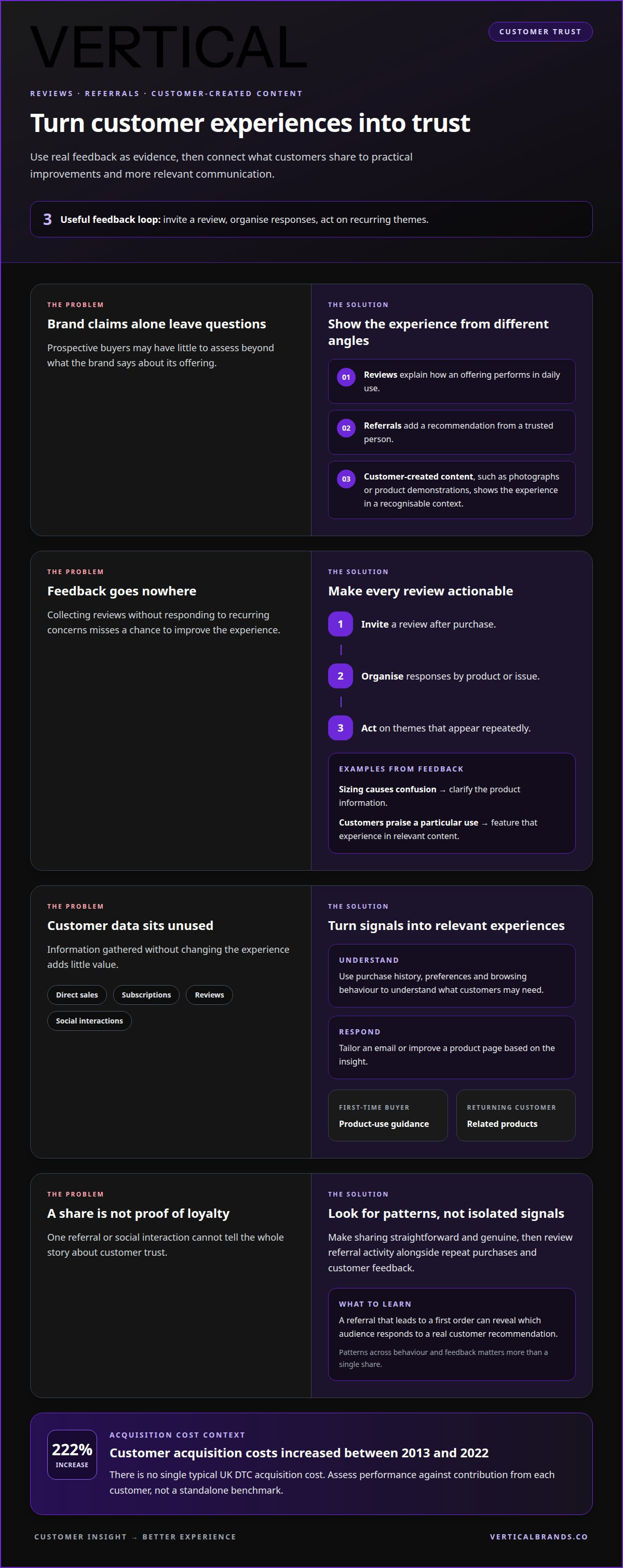
Reviews, referrals and customer-created content turns individual experiences into evidence for the next purchase. A review can explain how an offering performs in daily use; a referral adds a trusted person’s recommendation. User-generated content (UGC), such as a customer photograph or product demonstration, shows the experience in a recognisable context. Together, these tactics strengthen an online presence by giving prospective buyers more than brand claims to assess.
Make feedback useful with a clear three-step process: invite a review after purchase, organise responses by product or issue, then act on recurring themes. If several reviews mention confusing sizing, clarify the product information. If customers praise a particular use, feature that experience in relevant content. Reviews also give a direct view of customer expectations and friction points. Responding constructively shows customers that feedback informs decisions, not just promotional material.
Referrals work best when the next step is simple and the message feels genuine. Give existing customers a straightforward way to share the brand with someone who may value the offering. Then review referral activity alongside repeat purchases and customer feedback. A referral that leads to a first order can reveal which audience responds to a real customer recommendation. Don’t treat every share as proof of loyalty; look for patterns across behaviour and feedback.
Direct sales, subscriptions, reviews and social media interactions can provide first-party data. Use it to understand customer preferences, purchase history and browsing behaviour. For example, a customer who repeatedly views a product category may need different content from someone who has already bought from it. Tie each insight to a useful action, such as tailoring an email or improving a product page. Collecting information without changing the experience adds little value.
There is no single typical UK DTC acquisition cost: it depends on the channel, audience, product economics and repeat purchasing. Customer acquisition costs increased 222 percent between 2013 and 2022, so assess performance against contribution from each customer, not a standalone benchmark.
Personalisation turns those insights into more relevant communication. Segment customers by meaningful signals, such as first purchase, repeat purchase or stated interests, then adapt the message to their needs. A first-time buyer might receive guidance on using a product, while a returning customer sees related products. Use feedback to refine each segment rather than assuming every customer in it has identical preferences.
Customer experience connects these tactics to loyalty. Track review themes, referral behaviour and repeat purchases together to see where trust grows or weakens. When customer-created content highlights a practical benefit, use it in the relevant part of the journey. This creates a feedback loop: customers share experiences, the brand responds, and future communications reflect what people value.
2. What is direct to consumer (DTC) marketing?
Direct-to-consumer marketing promotes and sells products straight to end customers, without retailers or wholesalers acting as intermediaries. DTC is one route within business-to-consumer (B2C): B2C brands can sell through retail partners, whilst DTC brands manage the direct sale and customer interaction. That distinction shapes the customer experience, from product discovery to post-purchase communication.
UK shopping preferences give brands a reason to develop this route. 47% of UK consumers said they wanted to shop directly from their favourite brands online more often. Among consumers aged 25 to 45, more than 60% wanted to do the same. These preferences signal an opportunity, not a guarantee of demand. A direct store still needs clear product information, a friction-free purchase journey and a reason to return.
Use a simple budget framework across paid, owned and earned media. Paid campaigns create reach or capture active demand; owned channels, such as a website and email, support ongoing communication; earned attention comes through recommendations and customer-created content. Set spend according to each channel’s role, then assess acquisition alongside repeat purchasing and customer value. The right mix depends on margins, sales patterns and where customers interact.
UK DTC campaigns also need a deliberate compliance process. Before launch, map advertising claims, cookie use, email marketing and customer-data handling against the relevant UK requirements. Build checks for transparency, permissions and data use into each channel, rather than treating direct sales as an exemption.
Common risks include relying too heavily on paid acquisition, overlooking repeat customers and treating every audience segment alike. A weak product page can waste campaign traffic; an irrelevant follow-up can undermine the customer experience. Review the journey from advert to delivery, identify friction, then prioritise changes with a clear commercial rationale.
Competition comes from both established companies and newer brands. Established names may bring brand recognition and broad distribution, but those strengths don’t automatically create a coherent direct experience. Emerging brands can sharpen their offering for a defined audience and use customer insights to refine campaigns. Larger brands, meanwhile, must connect teams, channels and customer data without adding unnecessary complexity.
Performance marketing and brand building need to work together. Measure short-term campaign response, but also assess whether brand messaging gives customers a reason to remember and return. 51% of UK consumers supported taking a more active role in developing products and services with favourite brands. Invite useful feedback and show how it informs decisions. A direct customer relationship create value only when the brand listens and responds.
For a practical channel plan, align customer data, messaging and retention activity through email and CRM planning. That helps connect campaign outcomes with the customer experience beyond the first purchase.
3. Influencer partnerships, owned media and community engagement
Social media can introduce a DTC brand to potential customers, but reach alone doesn’t build a relationship. Almost half of the world’s population uses social media, making channel selection and relevance central to the plan. Start by identifying where the intended audience spends time, then match the format to the message. A product demonstration may suit short-form video, while a detailed comparison may work better as a blog post.
Influencer partnerships add a trusted voice to that journey. Prioritise alignment with the brand’s values, product and audience over follower count alone. A smaller creator with an engaged community may offer a closer fit than a broad account with little relevance. Before a collaboration, agree on the audience, content format, key product details, timing and how results will be assessed. Clear direction protects the brand message without making the creator’s content feel scripted.
Build each collaboration around a useful customer question. For example, a skincare brand might work with a creator to demonstrate how a product fits into a routine. Another partnership could show how a household product works in a real setting. These examples make the offering tangible and give potential customers useful context. Track meaningful actions, such as product-page visits or purchases attributed to the campaign, alongside reach and engagement.
Owned media gives the brand a place to continue the conversation beyond a creator’s post. A website, email newsletter and social profile can each serve a distinct purpose. Use the website for product details, email for ongoing communication and social channels for discussion and discovery. Repurpose collaboration content with permission, then connect each asset to a relevant next step. A viewer interested in a demonstration should reach the product information, not a generic homepage.
Community engagement requires a response system, not occasional posting. Assign responsibility for answering questions, acknowledging useful suggestions and directing product concerns to the right team. If customers repeatedly asks how an item works, create a short explainer and make it easy to find. These relationships give the brand a practical source of insight and help customers feel heard throughout the purchase journey.
Measure partnerships and community activity against a shared objective. For awareness, assess relevant reach and audience interaction; for consideration, examine product-page visits and questions; for sales, review attributed purchases and repeat behaviour. Compare creators using consistent measures while accounting for different formats and audience fit. Then invest in collaborations that connect social discovery with a useful owned-media experience. A joined-up approach makes each channel reinforce the next, rather than leaving customers with disconnected campaign messages.
4. Segmented, personalised email marketing
Relevant email starts with useful segmentation, not a first name inserted into a generic message. Group customers by meaningful signals, such as purchase history, browsing behaviour or stated interests. A first-time buyer and a repeat customer may need different product guidance. These distinctions help a retail brand make communications more useful throughout the commerce journey.
Buyer personas can help organise those insights. A persona is a semi-fictional representation of an ideal customer, shaped by research and observed behaviour. For example, a skincare brand might distinguish customers seeking a simple routine from those exploring specialist products. Use personas to guide messaging, then refine them using actual customer interactions. They are planning tools, not substitutes for customer data.
Personalised product recommendations should match customers’ demonstrated needs. Someone who has bought a coffee machine may value compatible accessories, while a browser who viewed several models may need a comparison. Use purchase history and browsing signals to select relevant recommendations. The aim is to make the next step clearer, not to display the largest possible product range.
In the UK, 48% of consumers said they wanted recommendations better tailored to their likes and interests. AI-powered website personalisation can help adapt product suggestions or page content to observed behaviour. Set a defined purpose for each change, such as surfacing relevant products for returning visitors. Review whether the experience remain clear and useful, and avoid personalisation that feels intrusive or obscures choices.
Personalised subscriptions can support repeat commerce when customers have recurring needs. A household buying a replenishable product, for instance, may value delivery timing that reflects its actual usage. Explain the subscription’s contents and terms clearly, and make account controls easy to find. The customer experience depends on practical flexibility, not just a personalised offer. Subscription messaging should reflect what the customer selected, rather than assuming every buyer wants repeat delivery.
An ecommerce website must make product discovery, evaluation and purchase straightforward. Use clear navigation, detailed product pages, visible delivery information and a simple checkout. Then identify where visitors leave and test one change at a time, such as clearer product details or a more prominent purchase button. Track conversion alongside customer experience so a short-term lift doesn’t come at the expense of clarity.
Email and website personalisation should reinforce one another. If a customer clicks a recommendation in an email, the destination page should reflect that product and its relevant details. Keep audience segments manageable, set a clear purpose for each campaign and review engagement alongside purchases and repeat behaviour. Poorly maintained segments can make outdated assumptions feel personal. The strongest recommendations are relevant, explainable and easy to act on.
5. Direct-to-consumer marketing through digital channels
Digital channels work best as a connected customer journey, not separate campaign destinations. A search advert can introduce a product, a social post can demonstrate it, and the website can complete the purchase. Email can then support the relationship after delivery. Give each channel a defined role, consistent messaging and a clear next action.
A multi-channel marketing report states that 72% of customers prefer connecting with DTC brands using a multi-channel strategy. Use that insight to plan continuity, not to appear everywhere at once. For example, align paid search terms with the landing page, then ensure follow-up content reflects the customer’s interest. Each transition should make the next step easier.
Start with the customer actions that matter. Map discovery, product evaluation, purchase and repeat engagement across the website, search, social media and email. Website visits, social interactions and purchase history can reveal where customers engage or drop away. If visitors reach a product page but leaves before checkout, investigate the information, navigation and purchase process before increasing campaign reach.
Use analytics to assess the complete path, not one channel in isolation. A social post might introduce a product, while a later search or email interaction prompts the purchase. Reviewing these touchpoints together gives a more useful view than assigning all value to the final click. As a DTC business grows, analytics and market research can broaden customer insight beyond direct feedback.
Set a clear objective for every digital campaign. For awareness, assess relevant reach and engagement; for consideration, examine product-page visits and return behaviour; for sales, track completed purchases and subsequent customer activity. Compare results with the campaign’s purpose and the customer journey stage. A high volume of clicks isn’t a successful outcome if the landing experience fails to meet expectations.
Keep the channel experience consistent. A customer moving from a paid advert to a product page should see the same offering, language and details. Make the page useful on mobile, show relevant product information and remove unnecessary steps before checkout. Then use customer behaviour to refine the next action, such as a relevant email or clearer product content. Coordinated channels build relationships through repeated, coherent interactions.
Review performance regularly and make one purposeful adjustment at a time. If search brings qualified visitors but few purchases, examine the landing page and product information. If social engagement doesn’t lead to further interaction, clarify the route from content to product. These checks keep channel decisions tied to customer experience, rather than platform activity alone.
To align your digital channels around a measurable customer journey, plan a connected growth strategy.
Vertical Brands
Vertical Brands can help connect the channels and customer relationships in a direct-to-consumer marketing plan. Turn to the team when campaigns, email and customer data need clearer strategic direction, or when separate activities aren’t supporting the same growth objectives.
Its work includes Paid Social, Paid Search, Klaviyo Email Marketing and Email Marketing & CRM Management. These capabilities support customer acquisition and ongoing communication, with channel priorities shaped around the business and its audience. The focus is on aligning activity with the customer journey, rather than adding channels without a defined role.
Contact Vertical Brands to discuss how to strengthen your direct-to-consumer marketing approach. The right priorities depends on your objectives and how customers currently find, choose and return to your brand.
Turn customer insight into your next growth decision
The next stage is to identify the constraint that matters most. Is growth limited by customer acquisition, inconsistent follow-up or a customer journey that loses momentum? Set that priority first, then align channel activity and measurement around it. Building a direct-to-consumer marketing strategy becomes more effective when each decision supports a clear commercial objective, rather than adding activity for its own sake.
Vertical Brands can help businesses bring that direction into sharper focus through Paid Social, Klaviyo Email Marketing and Email Marketing & CRM Management. These capabilities supports acquisition and customer communication as part of a connected growth plan. The right starting point is the problem your business needs to solve and the customer action you want to encourage.
Contact Vertical Brands to discuss your strategy and identify a practical next step. With a clear priority and a focused plan, you can build stronger customer relationships as your business grows.
Frequently Asked Questions
What is direct to consumer (DTC) marketing?
Direct-to-consumer marketing is how a brand attracts and serves customers through sales channels it controls, rather than relying entirely on retail intermediaries. For example, a furniture maker might sell through its own online shop and use email to support customers after purchase. The approach gives the brand a direct route to communicate, learn from customer interactions and shape the buying experience.
What is the difference between DTC and B2C marketing?
B2C describes a business selling to consumers; DTC describes a direct route for that sale. A consumer brand selling through department stores is B2C, while a brand selling through its own shop is using a DTC model. Some businesses uses both routes. The practical distinction is who manages the customer relationship, sales experience and access to customer information at each point of purchase.
How to build a DTC brand?
A sound approach to building a direct-to-consumer marketing strategy starts with a defined customer need and a credible product proposition. Identify what makes the offering relevant, build a straightforward route to purchase, then establish consistent messaging across the website and campaigns. Set measures for acquisition, conversion and repeat purchasing. Use customer feedback and sales patterns to refine the proposition, rather than expanding channels before the model is working.
How to conduct a DTC marketing assessment?
Assess the full customer journey, from first discovery through purchase and repeat activity. Review channel performance, product-page clarity, checkout friction, customer feedback and follow-up communication. Compare campaign outcomes with commercial objectives, and identify where potential customers disengage. A practical audit includes data quality and attribution, since incomplete tracking can distort channel comparisons. Prioritise changes by likely customer impact and operational effort, then reassess after implementation.
What does DTC marketing mean?
DTC marketing means promoting a brand’s products directly to end customers and supporting the sale through direct channels. It describes a commercial approach, not a specific platform or campaign format. A brand could use search, social media, its website and email to reach customers. The defining feature is the direct customer relationship, not whether a particular digital channel is involved.
How do you define target audiences and positioning for a DTC brand?
Define an audience using customer research, purchase patterns, product use and the needs the brand can address. Separate observable behaviours from assumptions. Then position the brand around a clear difference customers can understand, such as a particular use case or product benefit. Test that message on product pages and in campaigns. Customer questions, conversion patterns and repeat behaviour can reveal whether the positioning is relevant.
Which channels work best for DTC marketing in the UK?
The most useful channels depends on the product, audience and buying journey. Search can reach people actively looking for a solution; social media can introduce products and demonstrate their use; email supports ongoing customer communication. A website provides the purchase experience, while influencer partnerships can add relevant creator perspectives. In addition, physical channels such as targeted door drops via providers like leafletprouk.com can help direct-to-consumer businesses reach local households effectively. Choose channels by their role and assess how well they connect, rather than assuming one channel works best for every brand.
How can DTC brands use email, SMS and loyalty programmes to improve retention?
Use email for relevant product guidance, replenishment prompts or updates based on customer activity. SMS can support concise, timely messages where customers have agreed to receive them. A loyalty programme can recognise repeat purchases through clear, useful benefits. Coordinate the three so customers don’t receive duplicate prompts. Review repeat purchasing, unsubscribes and redemption behaviour, then adjust the timing and content. These channels work best when each message offers a distinct reason to engage.