Photo by Musemind UX Agency on Unsplash
A redesign is not approved because it looks newer. Getting buy-in for a website redesign project starts with evidence: show what the current site prevents, connect proposed changes to business priorities, and define how success will be measured. That gives stakeholders a clear case to assess and approve.
You may already know where the website is falling short. The harder task is turning that view into shared priorities, a credible budget discussion and a plan stakeholders can support. Different teams often focus on different outcomes, making alignment harder.
This article explains how to define the need for a redesign using website performance and user feedback, then translate it into clear goals. You’ll learn how to involve stakeholders early, discuss budget in relation to scope, and keep decision-makers informed as work progresses. It also covers when incremental improvements may be a stronger option than replacing the whole site. The result is a practical framework for presenting the decision, addressing concerns and building momentum.
Key Takeaways
- Connect redesign priorities to business objectives, user needs and measurable website performance.
- Use UX research and prototype feedback to decide whether the site needs a full redesign or targeted changes.
- Bring stakeholders into planning early and frame budget discussions around scope, resources and priorities.
- Keep decision-makers aligned with concise updates, clear milestones and visible progress.
- Break larger changes into manageable improvements, then use what you learn to guide the next steps.
Defining redesign needs, goals and current website performance
Start with evidence from the current website, then connect each proposed change to a business objective. Redesign risks include lost traffic, broken journeys and weaker conversion; reduce them by recording current performance and checking 301 redirects before launch.
-
Identify redesign needs and performance gaps
Review audience behaviour, engagement and conversion data to locate specific friction. For example, if visitors reach a service page but rarely complete its enquiry form, investigate the page content, form journey and mobile experience before proposing a redesign. Separate evidence-backed problems from preferences about visual style. The case is stronger when it shows what the current website cannot do.
-
Set measurable goals and success measures
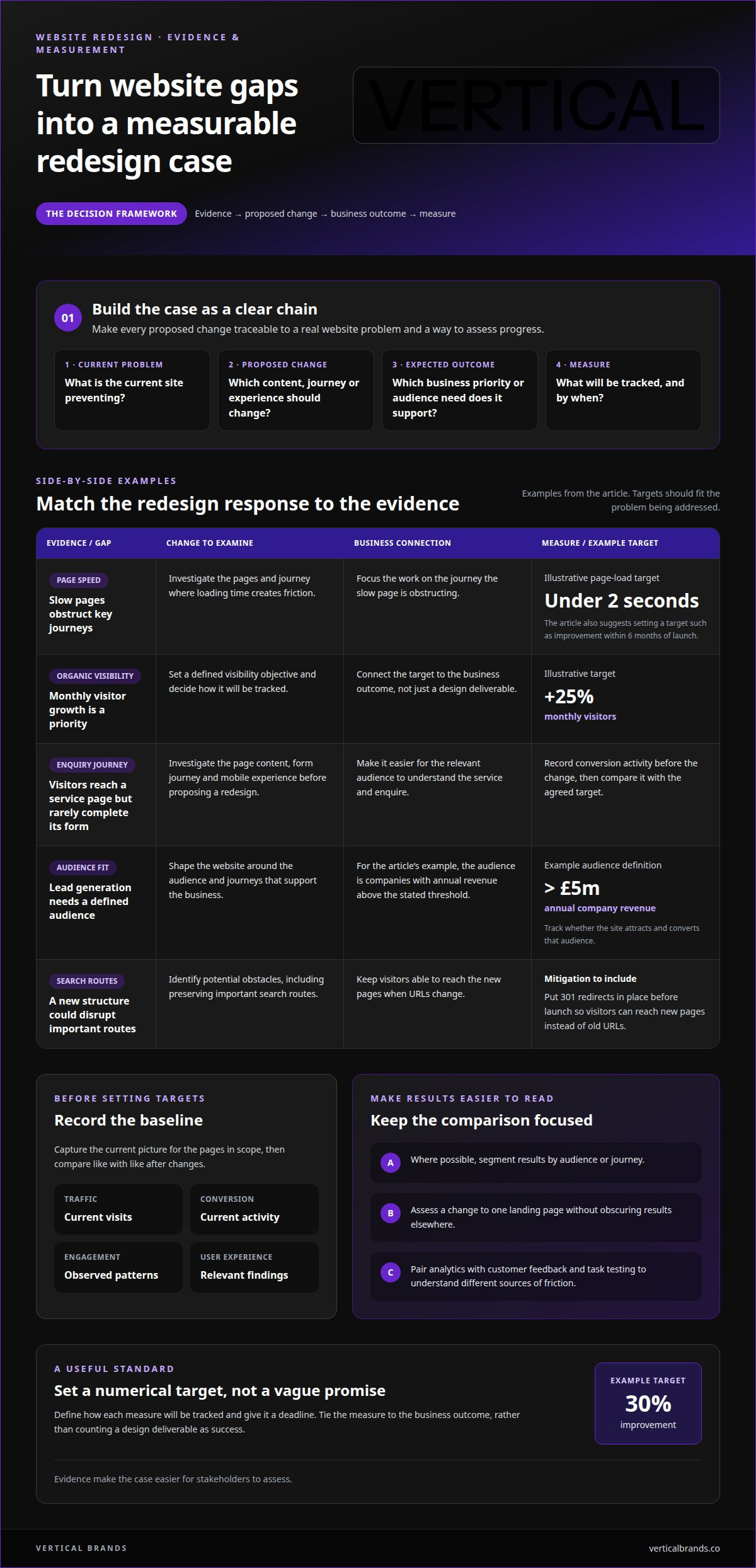
Turn each identified gap into an objective with a measure and deadline. If slow pages obstruct key journeys, set a target to reduce page load time to under 2 seconds. For organic visibility, one example is increasing monthly visitors by 25%. Define how each measure will be tracked and use a target such as improvement within 6 months of launch. Avoid goals like “make the site better”.
- Connect objectives to business priorities and audience needs. List the products or services that drive revenue, then identify the journeys that support them. A B2B organisation might prioritise clearer service information for technical buyers and a more direct enquiry route for purchasing managers. This gives stakeholders a practical reason for each change. It also keeps the proposed scope focused on business outcomes, not a long list of design preferences.
- Record a baseline before setting targets. Capture current traffic, conversion activity, engagement and relevant user experience findings for the pages in scope. Where possible, segment the data by audience or journey, so you can assess a change to one landing page without obscuring results elsewhere. This baseline provides a consistent comparison and helps show whether the redesign addressed the original performance gap.
- Present the case as a clear chain: current problem, proposed change, expected outcome and measure. For example, show how a confusing service page affects the route to an enquiry, then explain which content or navigation changes could address it. Include potential obstacles, such as preserving important search routes, and name the mitigation. Keeping 301 redirects in place before launch helps visitors reach new pages instead of old URLs.
A useful pitch links each proposed change to a wider business objective and states how success will be measured. For lead generation, for example, a team could define its audience as companies with annual revenue of more than £5 million, then track whether the new site attracts and converts that audience. Make objectives numerical: a target such as a 30% improvement gives stakeholders a clearer way to assess progress than a general promise to improve performance. Tie the measure to the business outcome, not just a design deliverable.
Research can also expose requirements that are easy to miss in an internal discussion. The Americans for the Arts website redesign team spent 4-5 months researching goals, statistics, user feedback, audience needs, technology, and stakeholders. For B2B planning, identify critical products or services, revenue drivers and key SEO keywords. Many organisations consult digital marketing agencies such as Social: Managed. to evaluate how organic traffic and online campaigns align with these commercial goals. Explain what the proposed website can provide that the current one cannot; visual appeal alone does not establish a business case.
Using a UX audit and research to identify redesign needs
Use behaviour, engagement, conversion and usability evidence to identify where the website falls short. Compare analytics with customer feedback and task testing, since each can reveal different sources of friction.
-
Audit existing website content
Inventory key pages and record each page’s purpose, audience and next action. For example, check whether a service page answers common customer questions and clearly guides visitors to enquire. Flag outdated claims, duplicate information and content that no longer supports a business objective. Decide which pages to retain, revise, combine or remove, and preserve valuable content when changing the site structure.
-
Use data to identify redesign needs
Compare analytics with observed behaviour to pinpoint problems. Look for pages where visitors leave before completing a form, search journeys that lead to irrelevant content, and navigation that makes key information difficult to find. Pair each pattern with customer feedback or task testing. A usability problem supported by analytics and research makes a stronger case than a single opinion.
- Test representative journeys with users before committing to development. Ask a customer to find a service, understand its value and take the next step. Observe where they hesitate, choose the wrong link or abandon the task. Record the page and action involved instead of relying on general comments such as “the site feels confusing”. Specific observations point to practical improvements.
- Review technical and search performance alongside usability. Check whether important pages load reliably, internal links lead to the intended destinations, and search visitors land on useful content. For example, if a page attracting high-intent search visits offers no clear route to relevant information, investigate its content and structure. Distinguish an isolated technical fault from a wider experience problem.
- Use a UX audit to determine the right scale of change. If research identifies one obstructive form or confusing menu, a focused adjustment may solve the problem. If several journeys fail for related reasons, the underlying information architecture or page templates may need broader work. Link each audit finding to evidence, affected users and a proposed response.
- Turn findings into a concise evidence record for stakeholders. Note the affected page, observed behaviour, customer feedback and the change worth testing. Prototype that change before development, then invite team members and customers to complete the same task. Their feedback can expose usability issues early. Where search findings point to wider structural issues, search engine optimisation can inform the audit.
Building internal alignment and discussing budget ranges
Map decision-makers, delivery teams and affected departments before proposing scope or funding. Getting buy-in for a website redesign project means connecting each group’s priorities to a realistic plan.
-
Identify stakeholders and decision-makers
List everyone who owns, uses or approves part of the website. Include marketing, sales, finance, IT, customer service and senior leadership where relevant. Ask each team what the current site obstructs and what a successful launch must achieve. Distinguish contributors from budget holders and final approvers. For a B2B site, include technical buyers and purchasing decision-makers in research. Record who makes the final call if priorities conflict.
- Form a cross-functional team with authority to progress agreed improvements. Give each member a defined role: marketing owns audience and content priorities, while IT assesses integrations and technical constraints. Finance reviews investment, and senior sponsors resolve strategic trade-offs. Name one project lead to coordinate decisions and escalate unresolved issues. Without clear ownership, routine choices can stall while teams wait for approval from people who are not involved day to day.
- Set the decision process before work begins. Record who approves scope, functionality, content and launch readiness, then agree how the team will resolve competing requests. For example, if sales wants more lead forms but IT flags integration work, compare both requests against the project’s objectives and delivery implications. Give the delivery team authority over agreed changes, while reserving significant scope or budget decisions for sponsors. This makes accountability clear from the outset.
-
Estimate costs and return on investment
Build the estimate around the work required, not visual ambition alone. Page volume, custom functionality, content migration, integrations, testing and specialist input all affect the resources needed. To assess return, compare project investment with expected business value, such as improved lead quality or more completed enquiries. State the assumptions and measures used, and never present projected gains as guaranteed. Explain which outcomes can be measured directly and which depend on wider business factors.
-
Plan the budget and procurement
Prepare a UK budget covering internal time, tools, external expertise, development, content and launch testing. Get finance or management approval for the planned allocation before procurement starts. Whether evaluating internal resources or seeking support from external web design agencies such as New Wave Digital Designs, define required outputs, decision criteria, responsibilities and payment milestones in the procurement brief. Account for scope changes so stakeholders know which decisions require renewed approval. Compare proposed approaches against the agreed requirements, not just the initial scope summary.
- Present options that link investment to scope. A phased plan might prioritise essential journeys and functionality first, then schedule lower-priority enhancements separately. Show the consequences of removing each item, including risks to content, integrations or launch readiness. A practical way to get buy-in for a website redesign project is to show leaders what each option enables, what it leaves unresolved and how progress will be judged. This helps decision-makers set priorities without treating the lowest initial estimate as the only goal.
Keeping stakeholders informed and showing progress
Use a clear communication plan to connect every decision with evidence, ownership and progress. A concise business case links the user experience problem to business outcomes, delivery needs and a way to measure results.
-
Respect stakeholders’ time and expertise
Ask each stakeholder for input relevant to their role, then use it to resolve specific decisions. A sales lead can assess enquiry quality, while an IT lead can identify integration constraints. Send focused pre-reading before meetings and state what decision is needed. Avoid asking senior leaders to review every design detail; use their time for priorities, trade-offs and approvals.
-
Tailor messages to stakeholder interests
Shape each update around the audience’s concerns. Finance needs the scope, costs and assumptions; marketing needs the content plan and search implications; executives need the business case and delivery risks. Open a presentation with the problem, proposed response and intended result. Keep slides concise and supporting detail available for anyone assessing functionality or user experience.
- Build the business case around a traceable chain: evidence of a user problem, its business impact, the proposed change and the measure of success. For example, show how confusing navigation interrupts a priority customer journey, then explain how a revised structure could address it. Leaders are more likely to support the work when they can see why action matters, what it requires and how the outcome will be assessed.
-
Show progress and secure executive buy-in
Set a regular rhythm of email updates and meetings, with a named owner for each action. Report completed work, upcoming decisions, risks and scope changes. Americans for the Arts’ redesign team used regular executive meetings to gather perspectives and build support. Keep updates brief and escalate decisions that could affect delivery rather than letting them drift.
- Make progress tangible with prototypes, mock-ups and clearly labelled versions. Show what changed since the previous review, which feedback informed the change and what decision remains open. Ask stakeholders to respond to a defined task, such as whether a customer can locate a key service. This turns subjective reactions into useful input and makes iteration visible.
- Close each meeting by recording decisions, owners and next actions. Written updates keep stakeholders aligned on the current version and prevent old feedback from reopening settled choices. A short summary also gives absent decision-makers a reliable record. Use it to raise unresolved concerns early, while the team can still adjust scope without undermining agreed objectives.
Benefits of incremental website improvements
Compare a full redesign with targeted improvements against the same user problem, scope, disruption and success measure. Paul Boag argues that no website is entirely terrible, so avoid discarding 100% of existing elements by default.
- Separate the website into components before choosing the scale of change. Review navigation, page templates, forms, content and integrations individually. If research identifies a confusing menu but effective service pages, improving navigation may solve the problem without replacing every page. This approach preserves useful elements and directs effort towards the parts that obstruct user journeys.
- Prioritise improvements by user impact and business importance. Start with a journey that supports a key objective, such as finding a service or completing an enquiry. Record the current problem, proposed change and measure that will show whether it helped. A defined test gives stakeholders evidence to decide whether to continue, adjust or pause further changes.
- Use week-long Scrum sprints to break larger development work into manageable increments. Set one clear outcome for each sprint, such as simplifying a priority page or testing a revised navigation structure. Review the result before planning the next sprint. This creates regular decision points instead of asking stakeholders to approve a large set of untested changes at once.
- Protect elements that already support user experience and search performance. Before changing a strong landing page, identify the content, links and structure that make it useful. Then test a focused revision, such as clearer calls to action, against the existing version. A controlled change helps reveal which element influenced behaviour, rather than changing several features and losing a clear comparison.
- Keep design, content and technology adaptable where the site structure allows. Separating these elements makes future updates more independent: a team could revise service copy without rebuilding the page layout. Reusable modules can also support consistent changes across multiple pages. This staged approach makes it easier to refine a component when new feedback points to a better solution.
- Set a review point after each release and use the agreed measures to decide what follows. If the change improves the intended journey, retain it and identify the next priority. If users still struggle, revisit the design or test a different adjustment. For a structured approach to incremental website design and development, define the next improvement around evidence and a specific user need.
For a structured approach to incremental website development, break large, multi-month projects into week-long Scrum sprints. Keep each stage manageable and review progress before moving on to the next sprint.
Vertical Brands: Website Design & Development
Vertical Brands can turn an evidence-led redesign plan into a clear website structure and user experience. Its Website Design & Development service is a fit when research points to changes in site architecture, page design or functionality, rather than isolated content adjustments.
Bring agreed objectives, audience needs and priority improvements into the project discussion. This helps shape a scope around the issues stakeholders need resolved, whether the plan involves a broader redesign or staged changes. Clear priorities keep decisions connected to the original business case.
If your next step is turning redesign goals into a practical website project, contact Vertical Brands to discuss your requirements.
Make approval the start of sustained progress
Getting buy-in for a website redesign project should create a mandate for better decisions, not a brief moment of agreement. As priorities shift, use the original business objectives to assess new requests. This keeps future changes connected to approved outcomes, rather than letting the site become a collection of disconnected preferences.
Think of the website as part of a wider growth system. Vertical Brands can connect Website Design & Development with Klaviyo Email Marketing, Email Marketing & CRM Management and Paid Social when those channels support the same customer journey. Clear goals and shared ownership give the work direction beyond launch.
When you’re ready to turn the agreed direction into action, explore your redesign with Vertical Brands. A focused next step can move the project from approval to meaningful progress.
Frequently Asked Questions
How can you involve staff and customers in website redesign planning?
Involve staff and customers through focused research tied to real website tasks. Ask customer service staff to identify recurring questions, then invite customers to find delivery details or compare service options. Record where they hesitate and what information they expect. Share anonymised findings with the project team and explain how feedback will influence decisions. Record staff and customer feedback separately, since each group sees different parts of the experience.
How should you present website redesign goals, scope and timeline?
Present goals, scope and timeline in a decision brief that separates outcomes from deliverables. State the business objective, pages or journeys included, functionality excluded, key dependencies, decision owners and launch assumptions. Use a milestone view for discovery, design, build, testing and launch, with approval points marked. For example, show how late product copy affects content population rather than hiding that dependency behind one launch date. Ask executives to approve scope boundaries, not just the visual concept.
How do you set measurable KPIs for a website redesign?
Pair each redesign objective with a defined calculation, data source and review period. For lead generation, track qualified enquiries against visits to relevant landing pages. For content, measure visits to priority pages and the actions that follow. Separate leading indicators, such as task completion, from business outcomes, such as qualified leads. Document exclusions and tracking ownership before launch so the team can distinguish a genuine shift from a tagging or reporting change.