Photo by Bench Accounting on Unsplash
A certificate can support a candidate’s case, but it won’t prove they can grow an online business. When hiring an e-commerce marketing consultant, prioritise practical e-commerce or digital marketing experience, supported by platform, analytics and commercial skills. In the UK, e-commerce consulting is generally a progression from e-commerce management, rather than a typical first job after education.
Look for someone who understands both marketing channels and the mechanics of online sales. A strong candidate brings both: the ability to attract customers and the judgement to identify where the platform, conversion journey or reporting needs attention.
This guide explains which qualifications matter, how to assess platform and analytics skills, and what marketing experience to look for. You’ll also learn how to connect those skills to business priorities, so you can distinguish a credible consultant from someone who only presents well on paper. Focus on practical evidence: what they have done, how they measure performance and how their expertise fits the work you need.
Key Takeaways
- Prioritise relevant e-commerce or digital marketing experience alongside qualifications; practical evidence matters more than credentials alone.
- Assess whether candidates can work across your e-commerce platform and interpret analytics to identify performance issues and opportunities.
- Define the consultant’s responsibilities around measurable business priorities, including traffic, conversion, sales and customer satisfaction.
- Online sales accounted for 28.3% of all retail in Great Britain in December 2025, according to the Office for National Statistics. Use your own commercial goals to shape the strategy.
- Check how a candidate would connect SEO, paid search, email and social media into a coherent plan. The strongest fit is the one whose experience aligns with your priorities.
Digital marketing, analytics and e-commerce platform skills
Assess how a consultant connects digital marketing activity with the e-commerce platform and commercial performance. Use the steps below to test practical skills, not just polished presentations.
-
Review qualifications and SEO, SEM expertise
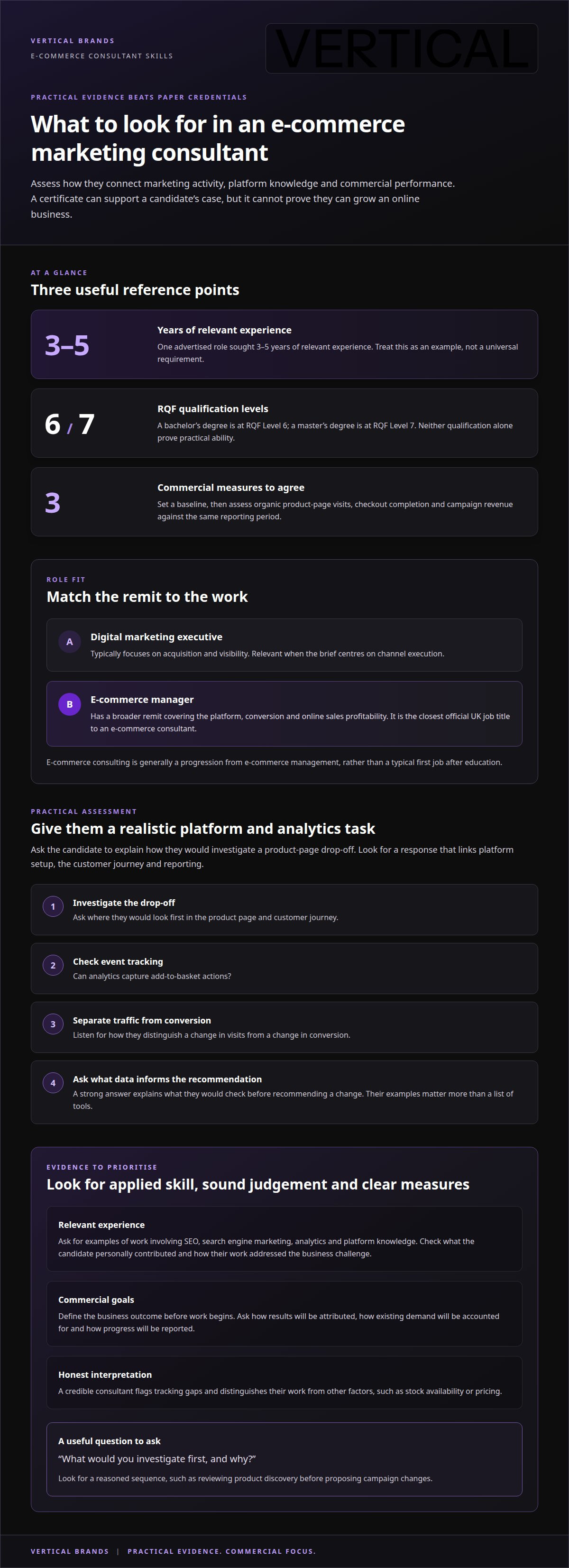
Check qualifications alongside evidence of applied work. A degree or digital marketing certificate can show structured learning, but examples should demonstrate SEO, search engine marketing (SEM), analytics and platform knowledge in practice. Ask how the candidate improved product-page visibility or interpreted campaign data. In the UK, e-commerce consulting is generally a progression from e-commerce management, and one advertised role sought 3-5 years of relevant experience.
- Map the role to the work your business needs. A digital marketing executive typically focuses on acquisition and visibility. An e-commerce manager has a broader remit covering the platform, conversion and online sales profitability. E-commerce manager is the closest official UK job title to an e-commerce consultant. Use this distinction to decide whether you need channel execution, wider trading oversight or both.
- Test platform and analytics skills with a realistic task. Ask the candidate to explain how they would investigate a product-page drop-off, check whether analytics events capture add-to-basket actions, and distinguish traffic changes from conversion changes. A strong response connects platform setup, the customer journey and reporting, then identifies which data they would use before recommending a change. Their examples matter more than a list of tools.
-
Set goals and measure ROI
Set a baseline and define the business outcome before work begins. For example, agree to assess organic product-page visits, checkout completion and campaign revenue against the same reporting period. Ask how the consultant will attribute results, account for existing demand and report progress. Avoid goals such as “more engagement” unless they connect to a defined commercial measure.
- Compare a freelance consultant with an agency based on your delivery needs. A freelancer may suit a focused brief requiring direct specialist input; an agency may fit work spanning several channels and disciplines. For organisations seeking to streamline conversion and marketing automation, specialist agencies like XcellentDigital show how dedicated teams coordinate these complex channels. Assess both by the named people doing the work, relevant examples, reporting approach and division of responsibilities.
- Set out the contract terms before approving work. Include the scope, deliverables, timetable, fees, payment arrangements, reporting, confidentiality, access to accounts, ownership of work and termination terms. For UK work, make responsibilities and approval points explicit, especially who controls advertising accounts and customer data.
- Ask for a written proposal to understand the cost. The price depends on the project and is provided after a quote request; scope, specialist skills, duration and delivery responsibilities all affect it. Proposals may use hourly or daily rates, fixed project fees, retainers or performance-linked arrangements. Compare what each model includes, not just its label.
- Reduce risk by agreeing access controls, decision rights and reporting before launch. Check that the consultant explains assumptions, flags tracking gaps and distinguishes their work from factors such as stock availability or pricing. Find candidates through professional referrals, relevant industry networks and documented case studies, then assess the named team and evidence against your brief.
Consultant qualifications and experience
Choose a consultant whose experience matches your commercial priorities, not just their job title. These steps help you assess evidence, judgement and fit before agreeing on a brief.
-
Review qualifications and experience
Compare formal learning with relevant work. A bachelor’s degree is at RQF Level 6, while a master’s degree is at RQF Level 7. Neither of these qualifications prove practical ability on its own. Ask candidates to explain their contribution to projects involving product discovery, customer acquisition or online conversion. Look for clear examples of decisions they made and how those decisions addressed the original business challenge.
- Check whether the candidate’s career path supports your requirements. The UK National Careers Service treats e-commerce consulting as a progression from e-commerce management, rather than a typical first role after education. When hiring an e-commerce marketing consultant, consider whether their experience covers the decisions your role requires. A digital marketing specialist should explain how their channel expertise relates to the wider online operation.
-
Choose a consultant and prepare questions
Choose against a written brief that names your priorities, platform and in-house capabilities. When hiring an e-commerce marketing consultant, compare relevant project examples, the candidate’s individual contribution and their approach to analysis. Ask, “What would you investigate first, and why?” A strong answer should outline a reasoned sequence, such as reviewing product discovery before proposing campaign changes.
- Ask questions that reveal judgement, not rehearsed claims. Request an example of a project that missed its target, what the candidate learned and what they changed. Explore external factors such as stock availability or product information. Their explanation can show whether they distinguish their contribution from wider trading conditions and communicate setbacks clearly.
- Validate case studies by checking the objective, actions, measurement method and outcome. Clarify which work the candidate personally delivered, and ask a former client about communication and follow-through. Compare this evidence with your brief instead of relying on a recognisable brand name or polished presentation.
- Agree how the consultant will work with your team. Specify who approves recommendations, supplies product information and publishes changes. For example, the consultant may recommend a product-page update while your team provides specifications and implements it. Clear ownership helps both parties understand the scope before work begins.
Consultant responsibilities and day-to-day work
Define the consultant’s working rhythm before the project starts. A clear remit links analysis, recommendations and delivery to specific business priorities.
- Agree which performance indicators the consultant will monitor. A UK e-commerce role identifies traffic, conversion rates, sales and customer satisfaction as performance indicators. Use these measures to build a shared view of trading health, then specify which matter most to your business. For example, a traffic increase means little if product views do not lead to purchases.
- Set a regular review process with clear outputs. Ask for a written summary showing what changed, what the data indicates and what action comes next. A useful update might flag a fall in mobile conversion, identify the affected product pages and propose a test. Keep recommendations tied to evidence, not a stream of disconnected activity.
- Clarify where analysis ends and implementation begins. A consultant may identify a checkout issue, while your internal team controls development access or product content. Record who supplies data, approves changes and publishes them. This avoids a common operational gap: a strong recommendation that stalls because nobody owns the next action.
- Connect marketing work to the customer journey. Ask the consultant to map how a shopper moves from an advert or search result to a product page, basket and purchase. For example, if paid traffic reaches a page with unclear delivery information, the consultant should distinguish an acquisition issue from friction on the site. That diagnosis directs effort to the right part of the operation.
- Make reporting useful for decisions. Agree how the consultant will explain changes in traffic, conversion and sales, including any tracking limitations. A weekly dashboard can show movement; a review meeting should explain causes and priorities. These indicators give your team a clearer basis for deciding whether to adjust creative, landing pages or campaign allocation.
- Build collaboration into the working plan. Name a contact for marketing, e-commerce operations and technical changes, then establish how decisions move between them. If a campaign depends on new product imagery, for instance, assign an owner and approval point. Clear handovers help the consultant coordinate work without taking over responsibilities that sit with your team.
- Review progress against the agreed remit, not activity volume. Record completed analysis, approved changes and resulting movement in the selected indicators. If the consultant recommends a product-page test, note the change, measurement method and resulting decision. This creates a practical record of work and helps refine priorities as trading conditions change.
E-commerce strategy and online sales
Build the strategy around the commercial levers your business can change. According to the Office for National Statistics, online sales accounted for 28.3% of all retail in Great Britain in December 2025.
- Set a clear commercial priority before choosing tactics. Decide whether the immediate focus is profitable growth, improving conversion, launching a product range or reducing reliance on one acquisition channel. For example, a retailer with strong product views but few completed orders should investigate the buying journey before increasing traffic. A precise priority helps the consultant recommend work that supports online sales.
- Connect the strategy to the economics of each product category. Review selling price, product costs, fulfilment, returns and promotions together. A product generating substantial revenue may contribute less profit after discounts and delivery costs. Ask the consultant to identify which categories deserve investment, which need stronger merchandising and where paid promotion could undermine profitability.
- Map customer demand against stock and operational capacity. A campaign can create demand, but unavailable sizes, delayed fulfilment or limited inventory can constrain sales. For example, prioritise products with reliable stock and clear delivery information when planning a promotion. Ask how the consultant will align campaign timing with merchandising and fulfilment, rather than treating marketing as a separate operation.
- Assess the complete path from discovery to purchase. Review how a shopper moves from a search result or advert to a category page, product information, basket and checkout. If customers reach product pages but leave before buying, inspect image quality, sizing guidance, delivery details and payment steps. The consultant should identify the point of friction before recommending a change.
- Separate demand creation from demand capture in the plan. Search activity can reach people already looking for a product, while content and social campaigns can introduce a brand to potential customers. For instance, a seasonal range may need informative content before launch, followed by product-focused promotion. Ask how each activity contributes to a defined stage of the customer journey.
- Use customer and product data to prioritise decisions. Compare repeat purchases, product-page engagement and sales by category, then investigate meaningful differences. If returning customers favour complementary products—a trend often observed with online retailers like Beauty Supplements—the strategy could improve product recommendations or post-purchase communication. Avoid broad conclusions from a single metric; consider stock changes, promotions and seasonality before adjusting investment or range priorities.
- Turn the strategy into decisions your team can execute. Document the priority, rationale, owner, measurement approach and next review point for each initiative. For example, a product-page improvement should specify which information will change and what customer behaviour the team will monitor. Each category has different commercial constraints, so connect recommendations to its customers, margin and fulfilment needs.
Marketing channels including SEO, PPC, email and social media
Assess how the consultant will make each channel support a shared commercial objective. Ask for a practical plan, not a disconnected list of tactics.
- Review SEO knowledge through a specific product or category example. Ask how the consultant would improve a page targeting a clear search need, from its title and product copy to internal links. Strong SEO connects search intent with useful page content. It should also account for technical access, indexability and how customers browse the range.
- Test paid search judgement with a realistic PPC scenario. Ask how the consultant would structure campaigns around product categories, search terms and landing pages. They should explain how they would distinguish relevant clicks from traffic unlikely to purchase. For example, a campaign for premium running shoes needs search terms and product pages that match that buying intent.
- Ask how the consultant will connect paid activity with organic search. If a product category attracts relevant searches but generates weak sales, the response might examine page content, offer clarity and campaign targeting together. Look for a clear rationale behind budget allocation, keyword selection and landing-page choices. Avoid plans that treat click volume as the final measure of performance.
- Assess email expertise through a customer journey example. Ask how welcome, browse and post-purchase communications would support discovery and repeat orders. A useful plan explains the purpose of each message, the audience it serves and the behaviour it aims to encourage. The consultant should also show how email activity fits the wider marketing calendar.
- Evaluate social media planning beyond posting frequency. Ask how the consultant would adapt a product message for paid and organic social, then connect creative choices to the intended audience. For example, a short product demonstration can clarify how an item is used, while customer-led content can show it in context. Each format needs a defined role and measurement approach.
- Check whether the candidate can coordinate channels without forcing every customer through the same path. A shopper may discover a product on social media, compare options through search and later respond to email. Ask how reporting will distinguish these touchpoints, identify overlaps and inform the next campaign decision.
- Use a short planning exercise to compare candidates. Give them a product range, a business objective and a current channel challenge. Ask for the first actions across SEO, PPC, email and social media, with reasons for their order. To align channel strategy and delivery, discuss your e-commerce marketing priorities.
Vertical Brands: Klaviyo Email Marketing
Vertical Brands can support priorities involving email performance, customer relationship management or paid acquisition. Its Klaviyo Email Marketing and Email Marketing & CRM Management services help businesses strengthen customer communications. Paid Social and Paid Search support acquisition priorities when channel execution is part of the brief.
Turn to Vertical Brands when your assessment identifies a need for specialist support in these areas or for marketing activity aligned with your e-commerce priorities. Start with the work you need delivered and the outcomes you are targeting.
Contact Vertical Brands to discuss your e-commerce marketing requirements.
Turn the right expertise into your next move
Treat the appointment as an operational decision, not a quick fix. The consultant should fit your priorities, work effectively with your team and explain their reasoning clearly. A focused brief gives both sides a practical basis for deciding what to tackle first.
Before you commit, identify the business constraint that matters most. It might be inconsistent customer communication, fragmented CRM processes or paid social activity that needs closer alignment with your commercial goals. A clear brief and shared priorities make it easier to establish where specialist support can contribute.
Hiring an e-commerce marketing consultant should lead to a defined working relationship, with responsibilities and success measures understood from the outset. Vertical Brands offers Klaviyo Email Marketing, Email Marketing & CRM Management and Paid Social. These services suit businesses seeking support with customer communications, CRM management or paid acquisition.
Start a conversation about the priorities you want to address and the expertise your team needs. Contact Vertical Brands to discuss your needs, and take the next step with a clear direction.
Frequently Asked Questions
What qualifications does it take?
There is no single degree that qualifies someone to consult on e-commerce marketing. Relevant study can support a candidate’s knowledge, but assess whether they can apply it to commercial work. Review examples of campaigns, platform projects or customer journeys they have worked on. Ask what they personally delivered and how they developed their expertise. The strongest evidence connects learning with practical judgement and clear communication.
What does an e-commerce marketing consultant do?
An e-commerce marketing consultant helps a business make informed decisions about attracting customers and selling online. For a product launch, they might coordinate channel priorities, identify gaps in product information and explain how the team will assess performance. Their remit can be strategic, hands-on or a mix, depending on the brief. Define which decisions and deliverables the role owns before work begins.
How do I check an e-commerce marketing consultant’s experience and results?
Ask for a case study that explains the original business challenge, the consultant’s specific contribution and how the outcome was measured. Check whether the example resembles your business model or sales cycle, rather than relying on a recognisable client name. A useful case study shows the reasoning behind the work, including what changed after reviewing results. Ask for a reference who can speak to collaboration and delivery.
What services should an e-commerce marketing consultant provide?
The right services depend on the gap you need to address; a consultant does not need to cover every channel. Your brief might focus on SEO for product discovery, paid search for capturing active demand, or email and CRM work for customer communication. Vertical Brands offers Klaviyo Email Marketing, Email Marketing & CRM Management, Paid Social and Paid Search. Specify the required outcomes and delivery responsibilities in the scope.