Photo by Neal E. Johnson on Unsplash
A TikTok advertising strategy for e-commerce in the UK starts with a controlled test, not an open-ended spend.
Those figures offer a planning baseline, but they cannot predict what your campaign will return. Results depend on the creative, audience, offer and buying journey. Set a test budget based on what you need to learn and how much you can spend before reviewing performance.
This guide explains how to estimate costs, set a disciplined test budget and decide when to use organic content or paid promotion. It also covers how shoppable videos and live shopping can fit into an e-commerce plan. You’ll get a practical framework for testing, measuring and scaling without mistaking views for sales.
Key Takeaways
- Build ads around native, creator-style content that feels at home in the feed, rather than relying on polished product shots alone.
- Use shoppable videos and live sessions to connect product discovery with a direct route to purchase.
- Shape your creative and targeting around the audience you want to reach, and consider when people are most active on TikTok.
- Use organic posts to identify promising ideas, then put paid support behind the strongest creative. A clear test plan help keep spending focused.
- Track campaign outcomes against your e-commerce goals, not views alone, before deciding what to scale.
How much does TikTok advertising cost?
TikTok costs depend on your campaign objective, audience, creative and buying format. Follow these steps to estimate the full investment, not just the media spend.
- Compare platforms by objective. For UK online retailers, TikTok, Instagram and Meta can support product discovery and paid social, while Google Ads can reach people actively searching. Many e-commerce brands work with paid search and social specialists like Rozee Digital to coordinate these channels effectively. Their costs are not directly comparable without matching the objective, audience and conversion measure. Compare cost per click or impression alongside orders and revenue, rather than treating one platform’s cheapest metric as the best result.
- Budget for creative as well as delivery. Make platform-native videos that demonstrate a product, answer a buyer’s objection or show it in use. A skincare seller could film a simple application routine, then test a clear opening, product demonstration and action. User-generated content can make the execution feel native to TikTok. Test different creative approaches, then use engagement and sales signals to guide optimisation.
- Structure creator partnerships around value. Agree the deliverables, usage permissions, attribution method and payment model before a creator publishes. A commission-based arrangement links payment to attributed sales, so set the rate against product margin and fulfilment costs. There is no single commission rate that suits every seller. Track creator videos separately, and assess whether sales came through TikTok Shop or after leaving the app.
- Keep policy and claims in the production process. TikTok reviews ads against its advertising policies, including restrictions that can apply to particular product categories. Keep product claims accurate, supportable and consistent with the destination page. For UK campaigns, assess the relevant advertising standards alongside platform rules. Build a review step into the workflow for claims, category eligibility, creator scripts and any required disclosures.
- Design tracking and creative for accountable testing. For UK GDPR, PECR and cookie consent, map the data each tracking tool collects, explain its purpose and configure consent controls before using TikTok tracking. Check the setup across the advert, pixel and checkout journey. Spark Ads let brands promote eligible organic posts with the creator’s authorisation. Test that route against brand-produced videos, then review performance using consistent attribution settings.
Allow for attribution gaps and brand safety, too. A customer might discover a product on TikTok and purchase later through another channel, so platform reporting may not capture the full journey. Review TikTok results alongside wider store performance. Check placements, creator content and comments regularly, as the context around an advert can shape how people perceive your brand.
Shoppable videos and live shopping
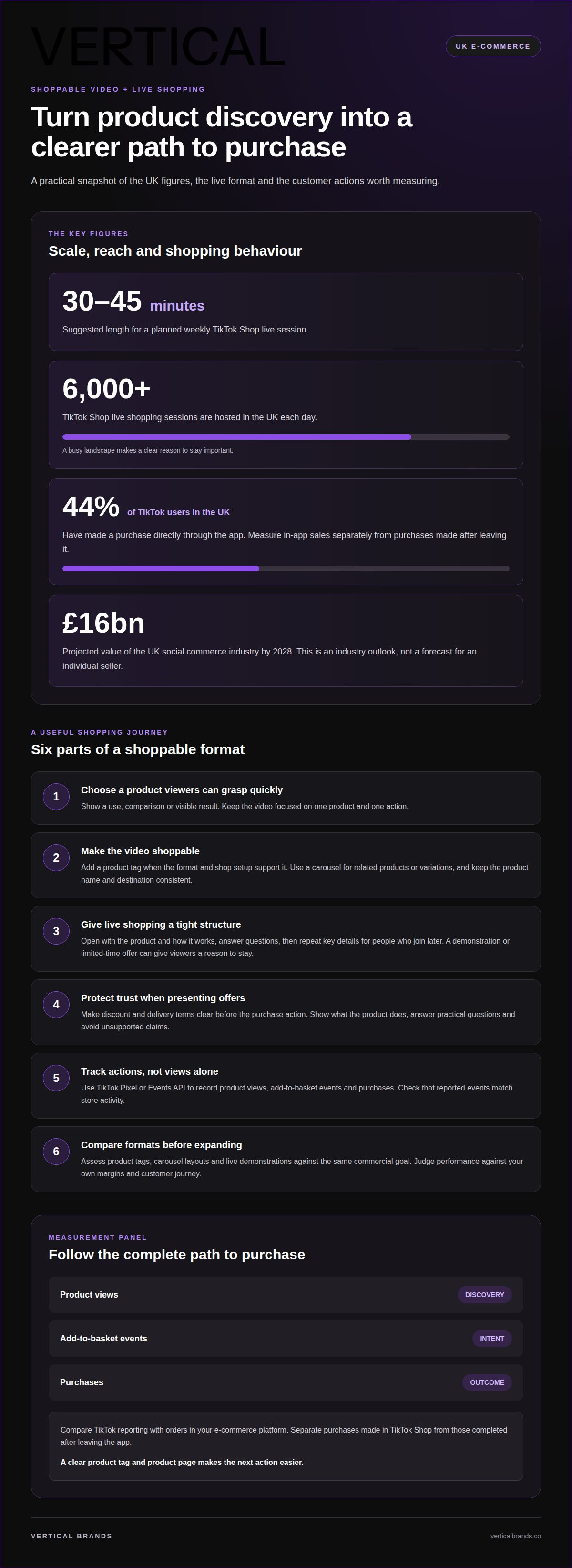
Set up TikTok Pixel or Events API to record key customer actions, such as product views, add-to-basket events and purchases. Check that the reported events match activity in your store, then compare attributed conversions with orders in your e-commerce platform.
- Choose a product with a clear demonstration. Start with an item viewers can understand quickly through use, comparison or a visible result. A clothing seller could show fit and fabric movement; a homeware seller could demonstrate an item in its intended setting. Keep the video focused on one product and one action. A direct route to shopping matters more than a long catalogue tour.
- Make the video shoppable. Add a product tag where the format and shop setup support it. Use a carousel to present related products or variations, rather than crowding one video with unrelated offers. Make the product name and destination consistent. That reduces friction between discovery and conversion, especially for TikTok users who want to move from a social media video to product details.
- Run live shopping with a tight format. Plan a weekly TikTok Shop live session lasting 30 to 45 minutes. Open with the product and its use, answer questions, then repeat the key details for people joining later. More than 6,000 TikTok Shop live shopping sessions are hosted in the UK each day, so give viewers a clear reason to stay, such as a product demonstration or limited-time offer.
- Protect trust while using offers. Make any discount or delivery terms clear before the purchase action. Demonstrate what the product does, address practical questions and avoid claims the product cannot support. Authenticity comes from useful detail, not exaggerated urgency. A seller showing how a product works can earn attention without implying that every viewer needs to buy immediately.
- Measure the complete journey. Track product views, basket additions and purchases, then compare TikTok reporting with store orders. Review which videos and live segments generate meaningful actions, not just views. Forty-four per cent of TikTok users in the UK have made a purchase directly through the app, so distinguish in-app sales from purchases made after leaving the app.
- Refine the format before expanding it. Compare product tags, carousel layouts and live demonstrations using the same commercial goal. The UK social commerce industry is projected to reach £16 billion by 2028. That outlook makes disciplined testing useful, but each seller still needs to judge performance against its own margins and customer journey. A product tag and clear product page makes the next action easier.
How can marketers use TikTok?
Use TikTok audience data to define who you want to reach and what action you want them to take. Match your targeting and creative to that objective.
-
Define the audience and marketing goals
Start with the customer group and commercial outcome, such as product awareness, site visits or sales. TikTok users aged 25-34 make up 35.3% of the platform’s user base; those aged 18-24 account for 30.7%, and ages 35-44 account for 16.4%. These figures describe platform users, not your likely buyers. Compare them with your customer profile before setting a target.
Set one primary goal for each campaign. A new range may need awareness; a proven product may need conversion. TikTok users spend an average of 34 hours and 56 minutes on the platform each month. Use that behaviour as context, not as proof that every audience will engage or buy.
-
Build audience segments and targeting
Build distinct segments around meaningful differences, such as product interest, purchase history or stage in the customer journey. TikTok Ads Manager lets advertisers create Custom Audiences and Lookalike Audiences based on existing customers. Use these tools to compare a defined group with a broader audience. Avoid mixing unrelated customer types, which makes results harder to interpret.
Tailor the message to the segment, not just its demographic label. For example, show first-time visitors how a product works, while returning customers see relevant new arrivals. Keep the offer aligned with the destination page. A relatable video should address a real customer need, rather than forcing a trend onto every audience.
- Use discovery signals to refine reach. Seventy-four per cent of TikTok users in the UK have discovered a new brand or product through the app. Treat discovery as a chance to introduce your offer, then measure whether attention leads to a useful action. Review comments, saves and clicks alongside sales. Engagement can indicate interest, but it does not prove purchase intent.
- Separate awareness from conversion campaigns. For awareness, lead with a product benefit or a recognisable customer problem. For sales, make the next action clear and link the video to a relevant product page. A retailer launching reusable bottles could test a relatable demonstration with new audiences, then show a more direct product message to shoppers already familiar with the range.
- Evaluate segments against the same measures. Compare audience groups using consistent creative, campaign goals and measurement periods. Check reach and engagement for discovery campaigns, then review visits and orders for sales campaigns. These signals help distinguish a creative issue from a targeting issue. Adjust one variable at a time so each result gives you clearer direction.
Choosing between organic content and paid advertising
Use organic posts to test ideas, then add paid support when the creative and commercial objective align. Keep each test focused on a measurable result.
- Set a distinct role for each format. Organic content helps brands explore topics, formats and audience responses without starting with paid distribution. Paid advertising adds controlled targeting and reach to a selected message. For example, a clothing retailer could post styling videos organically, then promote a video that attracts relevant product-page visits. Don’t treat organic reach as a forecast of paid results.
- Build a repeatable posting rhythm. Buffer’s analysis of 11.4 million TikTok posts found that increasing frequency from one post to two to five posts per week delivered a 17% lift in views per post. Use a sustainable schedule to test different openings, demonstrations and creator perspectives. Record each post’s format and purpose, so performance comparisons remain useful.
- Judge content against its intended outcome. For awareness, examine reach, views and engagement. For store traffic, assess clicks and product-page behaviour. For sales, compare purchases and revenue with campaign spend. A video with strong views but few product visits may need a clearer action. A product listing that receives visits but few orders may need a stronger offer or clearer product information.
- Use trends selectively. A trend can help a brand join a conversation, but it should fit the product and audience. Adapt the format to show a real use case, rather than copying a trend without a commercial connection. For example, a homeware seller could use a familiar transition to show a room before and after styling. Review the result against the goal, not just the trend’s visibility.
- Give user-generated content a defined test. Brief creators or customers around a product benefit, audience and action, while leaving room for a natural delivery. Compare generated content with brand-produced videos using the same campaign objective. If an influencer’s post earns relevant engagement, test paid distribution separately and track its contribution to visits or orders. Followers alone don’t establish commercial value.
- Scale only the signal that matters. Keep the strongest organic concepts in rotation, and use paid promotion where targeting can reach a relevant audience. Change one element at a time, such as the opening or call to action. These comparisons gives clearer evidence about what to expand. Pause formats that attract attention but fail to move the intended audience towards a useful next step.
Advertising costs, CPM, CPC and test budgets
Plan spend around your objective, format and test conditions. A TikTok advertising strategy for e-commerce UK retailers should treat cost benchmarks as planning inputs, not promises of reach or sales.
-
Review ad reach, formats and costs
Choose a format that fits the campaign’s purpose, then assess delivery costs against meaningful outcomes. In-Feed Ads can support discovery in the feed.
Use CPM to assess impression costs and CPC to assess traffic costs. Neither tells you whether orders were profitable. Calculate CPA by dividing campaign spend by attributed purchases. Compare campaigns using consistent attribution settings and sales objectives, rather than treating a low impression cost as proof of strong performance.
-
Set test budgets and bidding options
Set a total test budget before launch. Treat it as a planning constraint, not a forecast. Keep the test focused on one objective and a manageable set of creative variations.
In TikTok Ads Manager, match your bidding approach to the objective and the acquisition cost your margins can support. The right control depends on whether the campaign prioritises delivery, traffic or conversions. Avoid changing bids, audiences and creative at the same time, as this makes results harder to interpret.
- Estimate spend using an actionable metric. For awareness, divide your budget by expected CPM, then multiply by 1,000 to estimate impressions. For a traffic test, use expected CPC to estimate clicks. These calculations help structure a TikTok advertising strategy for e-commerce UK brands, but auction conditions and audience response affect delivery.
- Set a decision rule before launch. Define what would justify continuing, revising or stopping each test. A product with limited margin cannot support the same acquisition cost as one with repeat purchases. Include creative production and landing-page performance in your review. The algorithm can optimise delivery, but it cannot fix a weak offer or a confusing product page.
- Separate learning spend from scale spend. Use the initial campaign to identify which format, message and audience produce useful signals. Once results indicate a credible route to conversion, increase investment in controlled increments and monitor CPA. These comparisons give clearer evidence about what to expand. For a structured UGC content test plan, connect creative variations to a clear measurement framework.
Vertical Brands
Vertical Brands helps e-commerce businesses turn TikTok campaign decisions into a structured growth plan. If your costs, creative testing and sales measurement need to work together, its Paid Social service can align those priorities with your wider acquisition activity. The process is clear: define the objective, assess performance and decide what to refine or scale. These decisions become more useful when campaign results connect to the broader customer journey, including follow-up through email and CRM management. To bring more structure to your TikTok advertising, contact Vertical Brands to discuss your goals.
Turn campaign learning into your next growth decision
A TikTok advertising strategy for e-commerce in the UK should connect acquisition with what happens after the click. Use campaign insights to decide which customer groups to prioritise, what creative to develop next and how to build stronger follow-up. That creates a clearer path from discovery to repeat purchase.
Vertical Brands can bring these decisions into a wider growth plan. Its Klaviyo Email Marketing and Email Marketing & CRM Management services support customer communication beyond the first visit, alongside Paid Social for campaign planning and execution. Focus on where your current process loses momentum, whether that is creative testing, campaign measurement or follow-up.
Take the next step with a defined objective and a clear view of what you need to improve. Contact Vertical Brands to discuss your TikTok strategy. A focused plan gives your next test a stronger commercial purpose.
Frequently Asked Questions
What brands use TikTok well?
Brands can use TikTok effectively when their content suits the platform and gives viewers a reason to respond. UK fitness apparel brand Gymshark is one recognisable example of an established TikTok presence. The lesson is not to copy another brand’s style. Identify what makes your products demonstrable, distinctive or useful, then create videos that show those qualities in a natural, recognisable way.
How does TikTok influence consumer purchasing decisions?
TikTok can influence purchases by putting products in front of people as they discover them, then showing how those products work. A creator’s demonstration, customer reaction or comment thread can help viewers assess fit and usefulness. For example, a kitchenware seller could show a product solving a common cooking problem. That exposure may prompt consideration, but assess sales alongside engagement rather than treating views as purchase intent.
What are TikTok audiences?
TikTok audiences are the groups of people reached by a brand’s organic posts or paid campaigns. They can be described by characteristics such as age, interests, location and interactions with a business. An audience may be broad, based on delivery signals, or specific, such as previous site visitors. For planning, define the group by its relationship to the product and the action you want it to take.
What are the best practices for promoting products on TikTok?
Show the product in a credible context, make its benefit clear and give viewers one relevant next step. For example, a skincare brand could demonstrate texture and application while avoiding claims it cannot substantiate. Use captions to make key details easy to follow, and ensure the landing page matches the product shown. Review comments for recurring questions, then use them to shape future content and clarify product information.
How should UK e-commerce brands define TikTok advertising goals and target audiences?
Choose the business outcome first, then define the audience most likely to support it. A new product launch may prioritise qualified discovery, while an established range may focus on orders or repeat purchases. A useful audience definition combines customer needs, product relevance and purchase stage. Avoid targeting by broad demographics alone. A shared problem or use case can offer a more actionable basis for creative and measurement.
What TikTok ad formats and placements are available to UK advertisers?
Common TikTok formats include In-Feed Ads, TopView, Brand Takeover, Branded Hashtag Challenges and Branded Effects. Spark Ads can amplify eligible organic posts with creator authorisation. E-commerce campaigns may also use product tags, carousels and live shopping when the account and format support them. Each option has a different role, from feed discovery to high-impact visibility, so match the placement to your campaign objective and customer journey.
How can UK e-commerce advertisers structure campaigns, test creatives and optimise performance?
Organise campaigns around distinct objectives, then keep audience groups and creative variations easy to compare. Test one meaningful change at a time, such as the opening, product demonstration or call to action. Track the metric that matches each campaign’s purpose, and assess the path from advert engagement to store activity. Consider clicks, product-page behaviour and orders together, rather than in isolation.
What are TikTok’s UK advertising policies for products, claims and restricted categories?
TikTok reviews ads under its advertising policies, which may restrict certain product categories. Keep product claims accurate, supportable and consistent with the destination page, and consider relevant UK advertising standards alongside platform rules.