Photo by Sora Sagano on Unsplash
A vague brief creates vague work. Knowing how to write a marketing agency brief means setting out the business problem, intended audience, measurable objectives, scope, budget and timing, then explaining which assets and evidence the agency needs. A clear brief aligns decisions before delivery begins and gives the work a purpose without prescribing every tactic.
Goals and audience belong in the brief, but the missing context is often just as important: why the work is happening now, what previous marketing achieved and what those results taught you. This guide shows how to turn that history into useful direction, define deliverables and boundaries, share brand materials, and set a clear process for feedback and approval. Your past campaigns, website performance and current constraints give an agency a stronger starting point. The result is a brief that clarifies what needs to change, how the work will be judged and what information should shape the approach.
Key Takeaways
- Define the project’s deliverables, boundaries, budget and milestones so everyone understands what the work covers.
- Describe the audience through its needs, preferences and pain points, not demographics alone.
- Set measurable objectives and explain how results will be assessed, using realistic benchmarks.
- Share relevant brand guidelines, assets and previous campaign learnings to give the work useful context.
- Name who provides feedback and approval; a clear decision route help prevent avoidable delays.
Defining project scope, timeline and budget
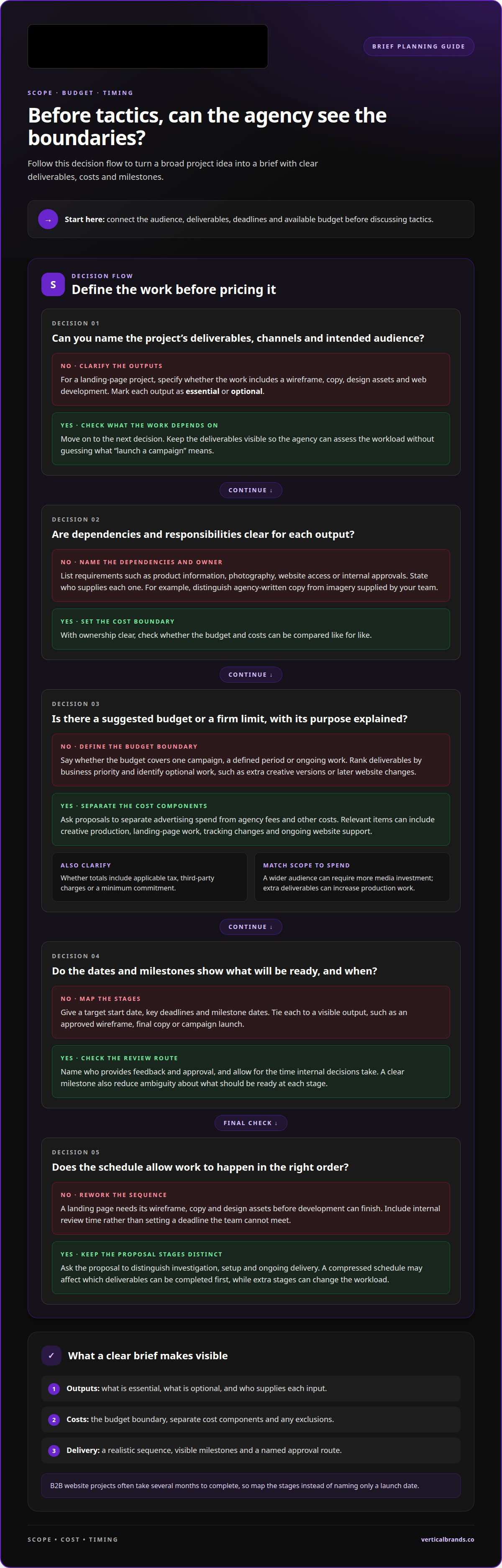
Set boundaries before discussing tactics. Connect the audience, deliverables, deadlines and available budget.
-
Define the project scope
Describe the work by naming its deliverables, channels and intended audience. For example, a landing-page project might include a wireframe, copy, design assets and web development. State which outputs are essential and which are optional. This lets an agency assess the workload without guessing what “launch a campaign” means.
List dependencies that affect delivery, such as product information, photography, website access or internal approvals. Assign each responsibility to the relevant output. If the agency supplies copy but your team supplies imagery, make that distinction clear. Avoid combining separate strategies in one scope. Separate briefs make priorities and progress easier to assess.
-
Set budget and cost boundaries
Give a suggested budget or firm limit rather than leaving the figure open-ended. Explain whether it covers one campaign, a defined period or ongoing work. For standalone initiatives, such as commissioning creative work from LYFE Studio on an ad-hoc project basis, setting clear spending boundaries ensures commercial expectations remain aligned. If the budget varies with audience size or channel reach, describe that relationship. A wider audience can require more media investment, while extra deliverables can increase production work.
Ask proposals to separate advertising spend from agency fees and other costs. Relevant items may include creative production, landing-page work, tracking changes and ongoing website support. Clarify whether totals include applicable tax, third-party charges or a minimum commitment. These distinctions help you compare like with like and avoid treating media spend as the entire project cost.
Set boundaries for optional work. For example, identify whether extra creative versions or later website changes fall outside the initial scope. Match the deliverables to the available budget and rank them by business priority. This gives the agency room to recommend a workable sequence without obscuring the cost implications.
-
Set timelines and milestones
Give a target start date, key deadlines and milestone dates. Tie each milestone to a visible output, such as an approved wireframe, final copy or campaign launch. State who provides feedback and how quickly decisions can be made. If internal review takes longer, include that dependency rather than setting a deadline the team cannot meet.
Allow time for work that must happen in sequence. A landing page needs its wireframe, copy and design assets before development can finish. B2B website projects often take several months to complete, so map the stages instead of naming only a launch date. A clear milestone also reduce ambiguity about what should be ready at each stage.
Connect timing to budget and scope. A compressed schedule may affect which deliverables can be completed first, while extra stages can change the workload. Ask the proposal to distinguish investigation, setup and ongoing delivery. This shows when spending supports initial preparation and when it funds continued work.
Target audiences, personas and pain points
Define who the campaign must reach before choosing messages or channels. Use evidence from customer conversations, enquiries and existing audience data.
-
Identify the target audience
Name the audience the project is intended to reach, then distinguish it from people who may see the campaign but are unlikely to act. For example, a business selling to organisations might target decision-makers rather than every employee. Describe the audience’s role in the purchase, such as researching options, comparing suppliers or approving a decision.
Check that the chosen audience connects to the project objective. A campaign designed to generate enquiries needs a defined group with a relevant need, not simply a broad category such as “business owners”. If the project aims to reach new buyers, do not treat existing customers as the only possible audience.
-
Describe the target audience
Build a practical persona around characteristics that influence the buying decision. Include relevant demographics, motivations, preferences and pain points. For a service aimed at busy teams, limited time to assess providers could be a useful insight. That detail can guide message priorities more directly than a long list of traits that do not affect behaviour.
Explain what the audience needs, what creates friction and what evidence could build confidence. Separate observed customer insight from assumptions, and use specific examples from enquiries or feedback where available. These details help an agency develop relevant messaging without turning a persona into a fictional biography.
- Prioritise the audience if the project spans several groups. State which group matters most, which are secondary and why. For example, a campaign might address a buyer first, then provide supporting information for colleagues involved in approval. This distinction helps the agency structure messages without trying to speak to everyone at once.
Describe meaningful differences between segments. Two audiences may need the same service but respond to different proof points, language or formats. A first-time buyer may need a clear explanation of the process, while an experienced buyer may focus on comparison criteria. Give the agency these distinctions instead of grouping both audiences under one broad persona.
- Connect each audience insight to the campaign response you want. If customers struggle to understand a product’s value, identify the barrier and where it appears. Then state what the communication should clarify. Avoid prescribing a finished slogan. Explain the audience problem and the change in understanding the campaign should support.
Use relevant channels as context, not as a substitute for defining the audience. If the intended audience engages with email or social media, say what role each channel should play. Channel choices should follow audience behaviour and the project objective, not habit or personal preference.
- Record what the agency should learn or test about the audience. Identify unresolved questions, such as which objection prevents action or which message resonates with a specific segment. Tie these questions to a campaign decision. This gives the agency a clear basis for research, creative development and later evaluation.
Finally, check that the audience, pain point and intended outcome align. If the brief targets prospective customers but describes only existing-customer needs, correct the mismatch before work begins. A precise target audience keeps campaign decisions focused and gives each deliverable a clear role.
So, what is a marketing brief and why is it important?
A marketing brief is a structured document that explains the business problem, objectives and expected work. It gives an agency direction, defines how success will be assessed and records decisions in one place.
For UK campaigns, flag relevant data-protection and advertising considerations, including GDPR-related data use and ASA expectations. State who reviews audience-data use and public-facing claims. A brief does not replace compliance review.
Ask agencies to explain their proposed approach, deliverables, timings, responsibilities and measurement plan. Also ask what information or approvals they need and how they will report progress against your objectives. When collaborating with an outsourced team such as Marketing Angels, establishing these communication workflows early ensures both sides remain aligned on deliverables and strategic outcomes.
Common mistakes include vague goals, several competing priorities and unsupported numerical targets. Avoid prescribing every creative detail, omitting previous context or measuring activity without connecting it to the business outcome.
- Set one clear objective. Describe the business result the project should support, then connect it to a communications objective. For example, if the business needs more qualified enquiries, explain what makes an enquiry suitable. Avoid combining unrelated aims, such as awareness, sales and recruitment, in one brief without setting priorities.
- Choose measurable indicators. State the KPI, its starting point and the period for reviewing progress. UK Government guidance suggests measures such as website visits, registrations and email open rates. Match each measure to the objective: visits can indicate reach, while registrations record a defined action.
- Make success independently assessable. UK Government guidance says objectives need a measure against which delivery can be judged. Explain the data source and reporting method, then distinguish outputs from outcomes. Published posts are an output; audience engagement or enquiries indicate a response.
- Keep the writing human-focused. Use plain language and define technical terms that shape the work. Replace “improve engagement” with a clear description of the audience response you want. Give a concrete example of the intended message, but leave room for the agency’s creative development.
- Structure the brief for decisions. Put the project context, objectives, audience, scope, measures and approval route in distinct sections. Keep supporting reports or detailed product information in linked files. This makes key information easier to find and prevents essential decisions from being buried in background material.
Sharing brand guidelines and existing assets
Give the agency usable brand materials and clear rules for applying them. Separate fixed requirements from creative preferences.
-
Share brand identity and guidelines
Provide a concise business overview, then explain the brand’s purpose, values and position in its market. State the product or service’s unique selling point and support it with evidence, such as a distinctive process or customer benefit. Avoid unsupported claims that could lead to inaccurate campaign messages.
Include current brand guidelines and identify which rules are mandatory. For example, clarify whether a logo must keep its original proportions or whether colours can vary by campaign. This distinction helps the agency apply the identity consistently without treating every preference as fixed.
-
Specify tone and visual style
Describe the brand’s tone using practical contrasts. It might be direct rather than playful, or expert rather than technical. Add examples of phrases that fit and language the brand avoids. A short sample headline can show the intended personality more clearly than abstract adjectives.
Define visual direction with examples of approved colours, typography, imagery and layouts. Explain whether existing guidelines are mandatory or serve as a reference. If a campaign needs a different treatment, identify what can change and what should remain recognisable.
- Share the primary message and supporting proof points. State what the audience should understand about the offer, then provide evidence for the claim. For example, a product benefit might need a verified specification or a customer insight. Do not ask an agency to polish an unsubstantiated claim into creative work.
Clarify the difference between brand positioning and campaign messaging. Positioning describes the place the business wants to hold in its market; a campaign message focuses on one audience need or action. This distinction keeps individual assets aligned without forcing every execution to repeat the same line.
- Organise assets so the agency can identify the latest approved versions. Include relevant logos, photography, design files, product information and existing campaign examples. Use clear file names, such as “logo-approved” or “product-image-current”, rather than leaving similar versions unexplained.
For each item, explain its intended use and any publication restrictions. Mark assets that need approval before release and identify claims still under review. These assets give the agency direction while reducing the risk of outdated material appearing in public-facing work.
- Show examples of creative work the business likes, then explain what works in each one. You might point to concise writing, a restrained colour palette or a clear product demonstration. Pair every reference with a reason, so the agency understands the principle rather than simply copying another brand’s execution.
Also include examples that miss the mark, with a specific explanation. “Too formal” is less useful than “the wording sounds distant from our usual customer conversations”. Focus feedback on tone, visual style or message clarity, not personal taste alone.
- Set a process for reviewing brand-led work. Name who consolidates feedback, which stages require approval and how decisions fit the project deadlines. If several stakeholders comment separately, conflicting edits can weaken an execution. A single coordinated response gives the agency a clear route to action.
Keep detailed brand files separate from the main brief, using an organised shared folder or clearly labelled attachments. Refer to each file by name in the relevant instruction. This keeps the brief readable and makes it easier to replace outdated assets without rewriting the whole document.
Business background and previous marketing efforts
Past performance is useful context, not a verdict. Explain what the business has tried, what changed and why this project is happening now.
- Explain the business context. Summarise what the company does, who it serves and how it makes a difference. Include relevant history, mission or market changes only when they affect the project. A new product launch or a shift in customer demand, for example, may explain why the strategy needs attention now.
Then connect that context to the requested work. If enquiries have slowed, describe when the pattern began and which customer groups it affects. Avoid listing company facts that do not shape the decision. The agency needs to understand the business problem, not read a full corporate history.
- Record previous marketing activity. Name the campaigns, channels and audiences involved. Explain the intended objective, messages and deliverables. If an earlier email campaign promoted a seasonal offer, note its timing and audience alongside the outcome. This is more useful than simply saying email performed well.
Include what was learned, even when a campaign missed its objective. A message may have attracted attention but generated enquiries from the wrong audience, for example. Separate the observed result from your interpretation. This helps the agency identify what the evidence supports and what still needs testing.
- Provide performance information with context. For website activity, share useful measures such as top-performing pages, traffic sources and bounce rate. State the reporting period and note relevant changes, including a site redesign or major campaign. Without that context, an apparent rise or fall may reflect a measurement change rather than audience behaviour.
Where practical, use the same period when comparing like-for-like activity. Explain changes in tracking, landing pages or audience targeting that could affect the figures. Records show more than a headline total when the agency can see how measurement and activity changed together.
- Share market and competitor context. Identify relevant competitors and describe what their offers, audiences or positioning mean for your project. Add market trends or customer insights that shaped earlier decisions. Be specific: explain why a competitor’s pricing structure, product range or message matters to your strategy.
Distinguish known evidence from assumptions. An agency can investigate competitor strengths, weaknesses and customer insights, but your brief should state what the business already observes. This creates a realistic starting point without presenting an untested belief as fact.
- Turn lessons into direction. Close the history with what to continue, change or stop. If a campaign reached the intended audience but failed to prompt action, for instance, clarify whether the offer, message or customer journey needs review. Link each lesson to a decision the agency can use rather than asking it to repeat past activity automatically.
Use the history to establish a baseline for the next evaluation. Share relevant reports through an organised file, with each report labelled by channel and reporting period. If you want a specialist to translate past campaign evidence into practical next steps, discuss a strategy shaped by your marketing history.
Vertical Brands
Vertical Brands helps translate a clear brief into focused digital marketing activity. If your priorities point towards email or paid campaigns, its Klaviyo Email Marketing, Email Marketing & CRM Management, Paid Social and Paid Search services can support delivery. Your objectives and previous campaign evidence give the work a stronger starting point.
Turn to Vertical Brands when you have defined the business challenge but need support putting the plan into action. A well-structured brief aligns the audience, measures and channel priorities, keeping the work connected to the result you want to achieve.
Contact Vertical Brands to discuss how your brief can inform your next marketing activity.
Put your brief into action
A strong brief is not a document to file away. Treat it as the starting point for decisions, testing and learning. As you consider how to write a marketing agency brief, focus on making the next decision easier: what should happen first, what evidence will guide it, and who will act on the findings?
Once priorities are clear, the right support can help turn direction into delivery. Vertical Brands offers Klaviyo Email Marketing, Email Marketing & CRM Management and Paid Social. These services help businesses connect campaign priorities with practical digital marketing activity. A clear brief makes that conversation more focused from the outset.
Contact Vertical Brands to discuss your marketing brief and the work you want it to guide. Your next step can be clear, considered and grounded in the needs of your business.
Frequently Asked Questions
What does a useful brief look like in practice?
A useful brief is a working document that lets an agency make decisions without guessing. For example, a retailer might explain that repeat purchases have slowed, identify returning customers as the priority and ask for a plan to improve retention. Add a short project summary, relevant evidence and links to supporting files. Keep background material separate so readers can quickly find the information needed to make decisions.
What should a marketing agency brief include?
Include the business challenge, desired outcome, audience, deliverables, budget, deadlines, brand references and previous activity. Add operational details that could affect delivery, such as analytics access or who supplies product information. If a new range launches after photography is ready, for example, note that dependency. The agency can then distinguish project requirements from useful context and identify where planning depends on your team.
How do you write a marketing agency brief step by step?
Start by stating why the work is needed, then define the outcome and audience. Add the required outputs, timing, budget boundaries and relevant background. Attach brand materials and performance records, then name those responsible for feedback and approval. Before sending, read the document as if you were new to the business. This makes gaps easier to spot before they affect planning.
What business goals and KPIs should a marketing brief specify?
Choose goals that describe a business change, then select measures that show progress towards it. A retention project might track repeat purchases, while an awareness campaign could assess relevant reach and audience response. Set out the data source and reporting period alongside each KPI. Do not choose a metric just because a platform reports it; it should help assess whether the underlying business objective is being achieved.
How should you define the target audience in an agency brief?
Describe the audience by its relationship to the decision, not just by age or job title. For instance, distinguish the person researching a service from the colleague who approves the purchase. Note what triggers their search, what information they need and what may prevent action. If customer groups behave differently, identify the priority group and explain why the campaign should focus there first.
How do you set a marketing budget and timeline in a brief?
State the available budget or spending ceiling and explain what it needs to cover. Separate planned advertising spend from production or other project costs. For timing, work backwards from a meaningful launch date and list dependencies that affect readiness, such as internal approvals or product details. If timing or budget is flexible, identify what can move and what remains fixed. This gives proposals a clear planning framework.
What brand guidelines, assets and research should you provide to an agency?
Provide current logos, colour and typography guidance, approved imagery, tone examples and relevant audience or performance research. Add a short note explaining how to use each item. For example, label an older campaign as a reference for photography only, not messaging. Keep files organised and mark outdated versions clearly. This helps prevent an obsolete offer or visual identity from appearing in new creative work.
How should you describe deliverables and scope in a marketing brief?
Describe each deliverable by format, purpose and intended channel. Instead of asking for “social content”, specify whether you need short-form video, written posts or creative variations, and where each will appear. State what the initial project includes and what would require a separate decision. Identify dependencies, such as supplied product details, so expectations stay clear as work moves from planning to production.