Photo by Cody Manning on Unsplash
A Reel isn’t a paid ad just because it performed organically. Effective Instagram Reels advertising for D2C brands starts by identifying the creative idea that earns attention, then testing how its hook, message and call to action work in a campaign built to drive purchases.
It makes sense to reuse content that already resonates. But paid creative needs a clear job: introduce the product, explain its value and give viewers a reason to act. A disciplined test plan makes those decisions measurable, rather than relying on views alone.
This guide explains how to adapt Reels for paid use, structure creative tests, and plan a launch and budget without assuming every idea will work. You’ll learn what to test, which performance signals matter, and how to use them to decide what to develop next. It also covers connecting discovery to purchase, so the creative, campaign objective and customer journey work together.
Key Takeaways
- Adapt organic Reels for paid use by matching the creative to a clear campaign goal, then testing its hook, message and call to action.
- Build mobile-first video in a 9:16 format at 1080×1920 pixels, and use a mix of educational, social-proof and direct-response creative.
- Set a test budget around the learning you need. Give campaigns time to gather useful signals before making major changes.
- Track more than views: compare attention, clicks and purchase behaviour to understand where creative or the customer journey needs work.
- Connect discovery to the next step with a clear offer and a smooth path to purchase. A controlled test helps show which elements are worth developing further.
1. Creative choices for short-form video
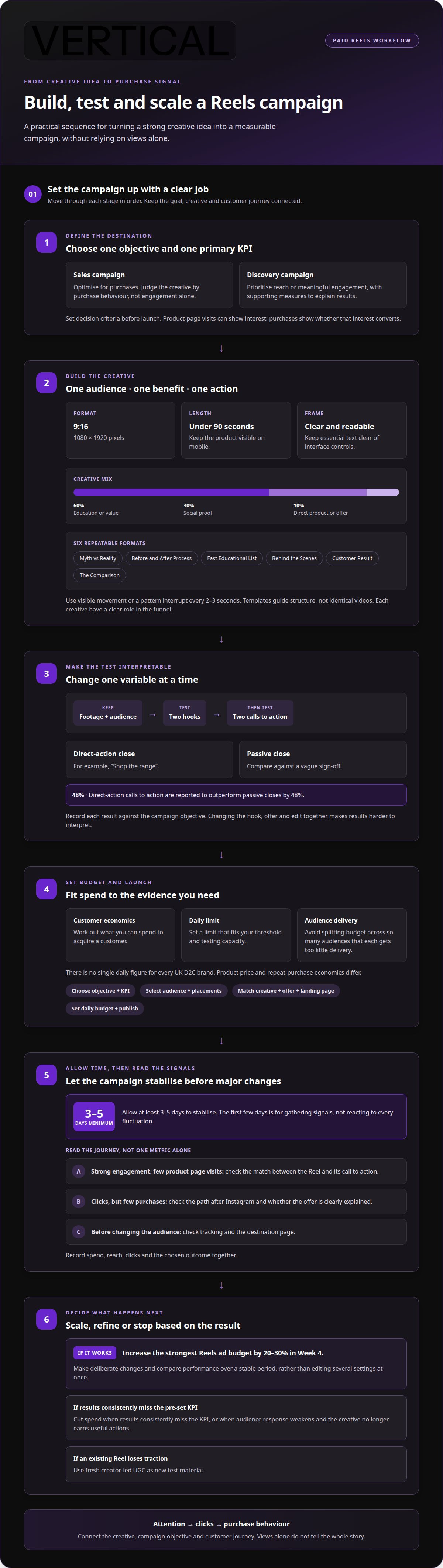
Build each paid Reel around one audience, one benefit and one action. The recommended ad format is vertical 9:16 at 1080×1920 pixels, with video under 90 seconds. Keep the product visible on mobile and place essential text away from interface controls. A clean frame and a specific message give viewers less to decode. A disciplined strategy for Instagram Reels advertising for D2C brands starts with that single, clear proposition.
Use a deliberate creative mix: 60% education or value, 30% social proof and 10% direct product or offer content. An education-led Reel could explain how to use a skincare product before showing its packaging. A customer-result clip can then demonstrate the benefit, while direct-offer creative gives warm viewers a clear next step. This balances discovery with conversion and gives each video a distinct role.
Six repeatable formats give creative production a practical structure: Myth vs Reality, Before and After Process, Fast Educational List, Behind the Scenes, Customer Result and The Comparison. For example, a homeware brand could compare two materials, then show the making process. Use visible movement or a pattern interrupt every 2-3 seconds to maintain pace. Templates should guide structure, not make every video feel identical.
A creator or founder can guide viewers from discovery to purchase. Open with a problem or unexpected result, demonstrate the product in use, then connect its benefit to a clear action. For example: “Struggling to organise a small kitchen? Here’s how this storage set creates space. Shop the set.” Creator-led content needs a genuine connection to the product, not a scripted endorsement that feels detached from the speaker.
Test one variable at a time. Keep footage and audience consistent while comparing two hooks, then test two calls to action against the stronger version. Direct-action calls to action are reported to outperform passive closes by 48%, so compare “Shop the range” with a vague sign-off. Record the result against the campaign objective, not views alone. Changing the hook, offer and edit together makes results harder to interpret. For Instagram Reels advertising for D2C brands, a controlled test links each creative decision to a measurable outcome.
For UK campaigns, make paid creator content clearly identifiable as advertising. Treat the ASA’s expectations for recognisable marketing as a creative requirement: put an unmistakable “Ad” disclosure where viewers can see it, rather than burying it in captions or using ambiguous wording. This is especially important when a creator’s personal style could make a paid recommendation appear independent.
Common risks include a slow opening, unsupported product claims, unclear disclosures and a call to action that doesn’t match the landing page. Check that the opening establishes relevance, the demonstrated benefit is accurate and the destination continues the same offer. A polished format cannot fix a weak proposition. Give each creative a clear role in the funnel, and design the test to identify what drives action.
2. Campaign budgets and launch process
Start with the campaign objective, not the video format. A sales campaign should optimise for purchases, while a discovery campaign may prioritise reach or meaningful engagement. Choose one primary KPI for each campaign, then use supporting measures to explain performance. Product-page visits, for example, can show whether a Reel sparks interest, while purchases show whether that interest converts. Set decision criteria before launch so a high view count doesn’t distract from the commercial goal.
Build a budget around the audience, product margin and amount of evidence needed. Work out what you can spend to acquire a customer, then set a daily limit that fits that threshold and your testing capacity. There’s no single daily figure that suits every UK D2C brand. A higher-priced product and a repeat-purchase offer have different economics. Keep the budget consistent during the initial test, and avoid splitting it across so many audiences that each receives too little delivery.
Use a clear launch sequence. First, choose one objective and define its KPI. Next, select the audience, placements and creative, then check that the visual, offer and landing page match on screen. Set the daily budget and publish. Allow the campaign at least 3-5 days to stabilise before making major changes. The first few days are for gathering signals, not reacting to every fluctuation. Record spend, reach, clicks and the chosen outcome together.
Assess the full journey, not one metric in isolation. Strong engagement but few product-page visits may point to a mismatch between the Reel and its call to action. Clicks without purchases can indicate friction after viewers leave Instagram or an offer that needs clearer explanation. Check tracking and destination pages before changing the audience. If the objective is purchases, judge creative by purchase behaviour, not engagement alone.
Scale only when the result supports it. The recommended approach is to increase the budget for the strongest Reels ad by 20-30% in Week 4. Make deliberate changes, then compare performance over a stable period rather than editing several campaign settings at once. Cut spend when results consistently miss the pre-set KPI, or when the audience response weakens and the creative no longer earns useful actions. Fresh creator-led UGC content can provide new test material when an existing Reel loses traction.
3. How Can You Test and Optimise Reels Ads Effectively?
Test the route from attention to purchase, not just the Reel itself. Start with one audience and one conversion objective, then change a single creative element at a time. For example, keep the footage consistent while testing two opening lines. If the stronger hook earns more clicks but fewer purchases, the offer or destination may be the issue. Isolating variables makes each result more useful.
Write scripts that move quickly from a relevant problem to a product benefit and a clear action. A reusable structure is: show the problem, demonstrate the product, add social proof, then give viewers a specific next step. A kitchen brand might open with a cluttered drawer, show its organiser in use and close with “Shop the organiser”. Keep the claim aligned with the landing page.
Give each test a primary measure. Click-through rate (CTR) shows whether viewers act after seeing the ad; conversion rate shows how many of those visitors complete the intended action. A CTR of 1% or higher is a decent starting point for Reels ads. For e-commerce, a 3:1 return on ad spend (ROAS) is described as a strong target. Treat both as reference points, not substitutes for your margin and customer economics.
Read metrics together. High video engagement with a weak CTR can signal that the Reel entertains but doesn’t make the next step compelling. A strong CTR with few purchases can point to a gap between the ad promise and the product page. Check the audience, offer, page experience and tracking before replacing the creative. A metric without context from the customer journey can mislead.
Stories can extend the conversion path. Follow a Reel with a Story within 24 hours, using a link sticker to take interested viewers directly to the relevant product or offer. For example, a creator’s product demonstration can lead into a Story showing the product details and purchase link. Keep the message consistent across both placements, so the viewer doesn’t have to decode a different promise.
Use a testing log to record the creative version, audience, spend, clicks, purchases and ROAS. Compare results over the same time window, and separate new-customer acquisition from repeat purchases where tracking allows. Social media discovery may precede a direct response, so compare platform results with site analytics. Instagram Reels content draws interaction from two billion people each month, but a broad audience doesn’t prove commercial impact. The strongest version is the one that advances your defined goal. Often, the results point to a specific change: a sharper opening, clearer proof or a more direct route from scroll to action.
4. Video hooks, length, audio and captions
The opening three seconds need to earn attention before a viewer scrolls past. Start with a visible product result, a specific problem or a direct question. For example, a skincare Reel could open on a dry patch, then show the product being applied. Aim for a 60%+ three-second hold rate. If viewers leave early, test a new opening before replacing the entire video.
Keep paid Reels focused. A 15-30-second format gives space for a hook, demonstration and next step without stretching the message. Put the product or outcome on screen early, then use short cuts to show relevant details. A tutorial may need longer to explain its benefit, but every extra moment should support the same claim. Check that the ending gives viewers enough time to read the call to action.
Use captions to clarify the message when sound is off. Write concise phrases that match the spoken words, and keep them clear of Instagram’s interface. For example, a meal-kit brand could caption each preparation step, then show the finished dish. Captions also help viewers follow fast speech. Review the finished video on a phone screen, where small text and busy backgrounds can reduce readability.
Check audio rights before turning a Reel into an ad. A track available for an organic post isn’t automatically cleared for paid use. Choose music or sound licensed for commercial advertising, and keep the relevant licence details. If a creator supplies footage, agree how its voiceover and music can be used in paid placements. Avoid building a campaign around a trending TikTok sound unless its commercial rights cover that use.
Instagram’s music catalogue and ad placements can have different usage conditions. Select audio intended for commercial use, or use original voiceover with appropriately licensed music. Keep a record of the track, licence terms and campaign usage. Replacing audio after launch can change the mood or timing, so test the finished version before publishing. A clean voiceover can also carry a product demonstration without competing lyrics.
For each edit, change one element at a time: opening shot, caption style, voiceover or audio. Compare the three-second hold rate and completion rate, then read those signals alongside clicks and purchases. A hook rate below 50% is a testing red flag, while top-performing Reels typically reach 60-75%. These are creative diagnostics, not proof of sales. The strongest videos connect the opening promise, on-screen demonstration and final action.
5. Instagram’s role in brand discovery and purchasing
Instagram Reels ads place short-form creative in front of an audience selected for the campaign. Viewers can discover a product without following the brand, then act through the ad’s call to action. The Reel earns attention; the destination and offer move that interest towards purchase.
Reels are one touchpoint in a wider funnel, not a standalone sales system. Organic Reels can introduce a product, while paid distribution gives a chosen creative a defined campaign objective. Followers may already recognise the brand, but new viewers need context quickly: what the product does, who it helps and what to do next. Strong creative connects those steps without assuming prior knowledge. Businesses seeking to integrate their paid social efforts into a wider commercial framework often collaborate with an outsourced team like Fireheart Digital to align short-form creative with an overarching marketing strategy.
Instagram’s algorithm influences what people see, but plan for distinct audience stages rather than relying on reach alone. At discovery, show a clear use case or benefit. For people who have engaged, use social proof or a product demonstration to answer objections. At purchase, make the offer and next step explicit. Review performance across these stages: a Reel that introduces a brand may contribute to a later sale without earning the final click.
To connect Reels ads with Shopify or Instagram Shopping, align the call to action with the destination. Send a viewer to the relevant Shopify product page or Instagram Shopping product listing, rather than a generic home page. Keep the product name, price, imagery and offer consistent across the Reel and destination. Use tracking that identifies campaign traffic and purchases, then compare results over a 30-day window to understand how discovery contributes to sales.
Organic Reels can also support acquisition when attribution captures their role. A viewer might watch, visit later and purchase through another channel, making last-click reporting incomplete. Compare platform activity with site analytics, and consider assisted conversions alongside direct purchases. Average results are useful only when you understand the audience, time lag and route to checkout behind them.
Use every second wisely. A short opening can establish the problem, while the rest of the Reel demonstrates the product and directs viewers to a relevant destination. If engagement is strong but product visits are weak, sharpen the call to action. If visits rise without purchases, inspect the landing-page experience and offer. Each stage points to a different test, so don’t treat every drop-off as a creative failure.
For brands that need a consistent stream of creator-style discovery assets, plan your next Reels-to-purchase test. The key is continuity: each video, product destination and follow-up message should advance the same customer journey. That connection is what turns attention into a trackable opportunity, rather than a view without a next step.
Vertical Brands
Vertical Brands helps D2C brands turn Reels testing into a structured growth plan. Its Paid Social work can connect creative decisions, audience strategy and campaign performance, while Email Marketing & CRM Management can support follow-up after discovery. Turn to Vertical Brands when you need a clearer link between paid activity, customer journeys and purchasing signals, rather than treating each Reel as an isolated test.
Define the commercial outcome, identify what the current data reveals and set a focused plan for the next creative test. This gives each campaign a clear role, from discovery through to conversion. Contact Vertical Brands to discuss your Reels advertising priorities.
Turn testing into a growth system
A durable approach to Instagram Reels advertising for D2C brands treats each campaign as an input to the next decision. The opportunity is not simply to produce more videos. It is to build a clearer operating rhythm, where learning from paid activity shapes future creative and customer follow-up. For businesses seeking senior marketing leadership to turn performance insights into long-term commercial strategy, seanbrightman.com provides fractional CMO expertise and strategic roadmapping.
Vertical Brands connects Paid Social with Klaviyo Email Marketing and Email Marketing & CRM Management, linking discovery with communications that support customer relationships. This broader view helps teams plan beyond the initial click and consider how each channel contributes to growth. Start by identifying the decision your current campaign needs to answer, then make it the focus of your next test.
If you want a structured plan for connecting Reels activity with your wider growth priorities, contact Vertical Brands to plan your Reels ads. Bring the campaign objective and the main decision you need to make. From there, you can turn the next creative test into a more deliberate step forward.
Frequently Asked Questions
How do you repurpose Reels as paid creative?
Choose an organic Reel with a clear product story, then adapt it for the campaign’s audience and objective. Remove context only existing followers understand, such as references to an earlier post, and make the product and brand recognisable to new viewers. Check that the footage, creator permissions, music rights and destination suit paid use. A Reel that earned comments organically still needs a distinct commercial purpose as an ad.
How do you write hooks for the first 2 seconds?
Lead with the viewer’s problem, a visible product result or a specific claim you can substantiate. A storage brand could use “Make this cupboard easier to use” over a shot of the finished space. Put the most relevant visual on screen immediately, then use a short caption to clarify the promise. Avoid abstract greetings or logos before the message. The hook should attract the right audience, not attention at any cost.
What are Instagram Reels?
Instagram Reels are short-form videos shared on Instagram, where people can discover content beyond the accounts they already follow. Brands use them to demonstrate products, explain benefits, tell customer stories or introduce offers. A Reel can appear as organic content or paid advertising. For example, a clothing brand might show how one item works across several outfits, giving viewers a practical reason to explore the product.
Why are Reels important for businesses in 2025?
In 2025, Reels offered businesses a way to combine product demonstration, entertainment and discovery within Instagram. A video can show how an item works in context, which is harder to communicate through a single product image. Reels also give brands a format for creator-led stories and customer perspectives. Their value depends on the fit between the content, audience and next action, not simply on publishing videos or chasing platform trends.
Are Reels ads better than Story or Feed ads?
No placement is automatically best for every campaign. Reels can suit discovery and product demonstrations, Stories can support direct follow-up, and Feed ads can present an offer alongside other content. Compare placements using the same campaign objective and a relevant conversion measure. For example, a Reel may introduce a product, while a Story reminder prompts interested viewers to visit its product page. The strongest mix depends on the audience and purchase journey.
How Can You Test and Optimise Reels Ads Effectively?
Start with one hypothesis and decide what result would support it. If viewers watch but don’t visit the product page, test a clearer call to action while keeping the audience and offer steady. If visits happen without purchases, inspect the product page before changing the Reel. Record each version and its outcome in a simple testing log. This makes the next decision evidence-led, rather than a reaction to one day’s performance.
How Do Short-Form Attention Mechanics Influence Creative Choices?
Short-form video rewards clear visual priorities. Give each video one main idea, show the product in a recognisable setting and remove details that don’t support the message. For example, a coffee brand could demonstrate one brewing step rather than catalogue every feature in one clip. Captions help viewers follow the point without sound, while a deliberate shot change can signal a new step. Clear sequencing makes the video easier to process.
How Does the 3-Second Attention Window Work?
The first three seconds are the opening test: viewers decide whether the video feels relevant enough to keep watching. Start with the product, a recognisable need or a visible outcome, then quickly explain why it matters. A slow logo reveal can delay that context. Treat the three-second hold rate as a diagnostic, not a sales result. If viewers leave early, compare alternative openings before changing the rest of the creative.