Photo by Michael Fousert on Unsplash
A polished pitch is not proof of a strong agency partnership. The most useful questions to ask a potential marketing agency reveal how it approaches the work, what outcomes its examples show and how it will measure progress against your business goals. Then clarify what kickoff involves, how communication works, what the deliverables include and who will manage your account.
Creative style matters because the work needs to fit your brand, not just look impressive in a presentation. Look beyond the visuals: a capable agency should explain its reasoning, share relevant examples and connect its proposed approach to your goals.
This guide offers practical questions for agency conversations, along with signals to listen for in the answers. You’ll cover case studies and measurement, research and input at kickoff, updates and points of contact, scope and deliverables, and the people doing the work. These details make it easier to judge whether the relationship is structured for clear, effective collaboration.
Key Takeaways
- Ask for relevant case studies and how the agency links reported outcomes to business goals.
- Clarify what research, access and input the agency needs before work begins.
- Agree how often updates arrive, who your main contact is and how feedback will be handled, so decisions doesn’t stall.
- Define the deliverables, scope, payment terms and process for handling changes before you commit.
- Find out who will work on your account and how your business will retain ownership of its marketing accounts and data.
1. Can You Show Us Relevant Case Studies and Their Outcomes?
One of the most useful questions to ask a potential marketing agency is how its work supports a client’s business objectives. For mid-size organisations evaluating external partners, working with strategic advisors such as Carter Strategies can help clarify overarching commercial priorities before assessing campaign metrics. Request case studies that explain the starting point, activity delivered, period covered and outcome. Examples might include increased engagement, higher sales conversions or improved brand recognition. Ask which measures the agency tracked and how it separated its contribution from other factors. A chart without context does not show how the work supported the client’s goals.
Assess experience by comparing examples with your audience, buying cycle and challenge, rather than relying on an industry label alone. A business serving first-time buyers may have more in common with your customer segment than a company in your sector selling to established specialists. Ask for the client story behind a case study, and look for testimonials that describe the working relationship. Your questions to ask a potential marketing agency should reveal the reasoning behind its results, not just present attractive outcomes.
Ask whether the agency works with companies in your industry and whether any competitive relationship could affect your account. If relevant competitors are clients, clarify how projects are separated, including information access and team responsibilities. If the agency lacks direct sector experience, ask how it will research your market, customers and competitors before recommending activity. For UK audiences, local knowledge should show in its understanding of customer segments and buying behaviour, not just a broad claim of UK experience.
How do UK GDPR and PECR affect marketing campaigns and data handling? They shape how personal data and electronic marketing are planned, used and managed. Ask who handles audience permissions, data access and campaign processes, and how responsibilities between your business and the agency are documented.
Test specialist skills by asking the people who delivered the example about their roles. Who planned the work, who executed it and who interpreted the results? For an email campaign, distinguish strategic planning, audience segmentation, creative production and performance analysis. Ask what relevant training or professional credentials each person brings, and whether that team will work on your account. A pitch led by senior specialists means little if delivery shifts to an inexperienced team without clear oversight.
Common red flags include guaranteed instant results, number-one rankings, vague case studies and pressure to sign before your goals are understood. Ask how the agency markets itself and what it has changed in its own approach. A credible partner connects recommendations to research, evidence and your objectives. If answers rely on broad promises instead of clear examples, you lack a sound basis for evaluating the proposed relationship.
2. Client input and project kick-off requirements
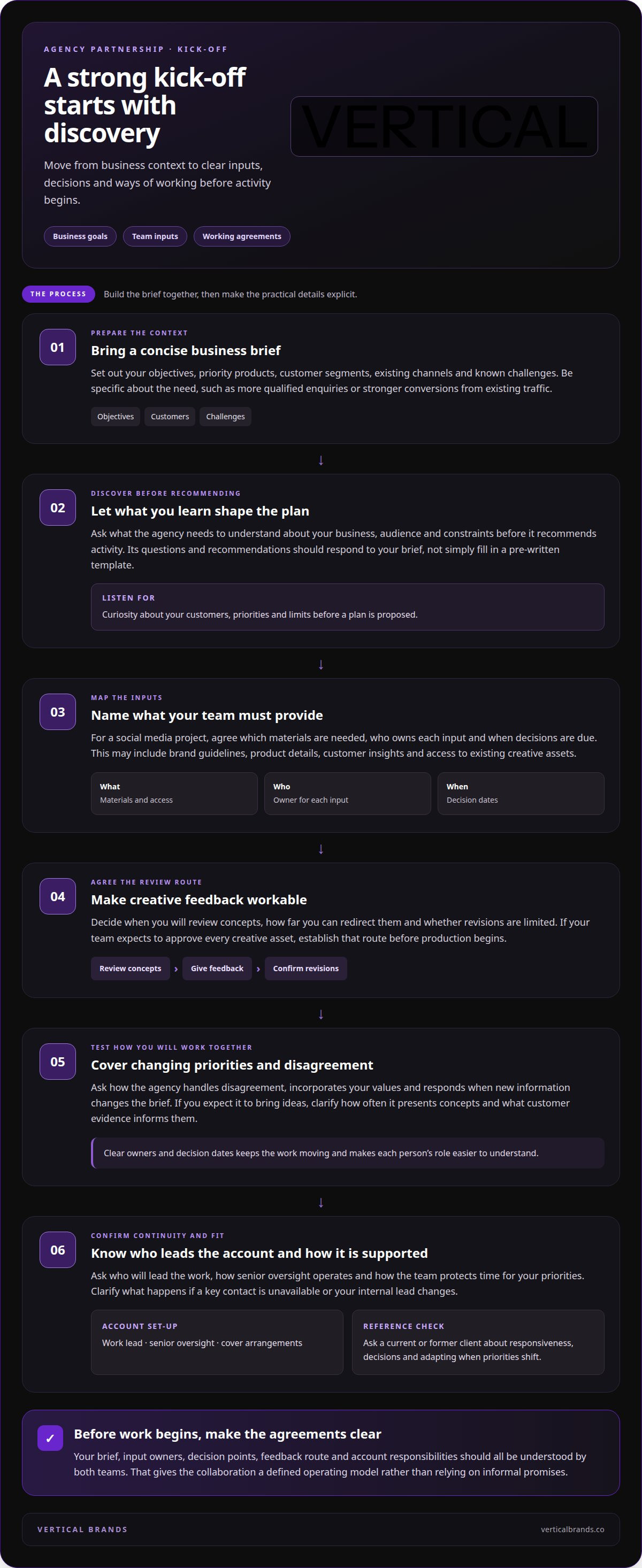
A strong kickoff starts with discovery, not a pre-written plan. Ask what the agency needs to learn about your business, audience and constraints before recommending activity. Prepare a concise brief covering your objectives, priority products, customer segments, existing channels and known challenges. For example, explain whether you need more qualified enquiries, stronger conversions from existing traffic, or dedicated operational support—such as the lead management frameworks provided by marketingsystemsolutions.com—to handle new customer opportunities efficiently. The answers should shape the proposed work, not simply fill in a template.
Clarify what your team must provide, who owns each input and when decisions are needed. A social media project may require brand guidelines, product details, customer insights and access to existing creative assets. Ask when you’ll review concepts, how much you can redirect them and whether revisions are limited. Agreeing on these steps early prevents approval delays and keeps your team involved where its knowledge matters most.
References add useful context to polished testimonials and reviews. Ask to speak with a current or former client about the agency’s responsiveness, decision-making and ability to adapt when priorities shift. If that isn’t possible, request a detailed client story that explains the working arrangements, not just the final output. Compare the account with your needs: a small team requiring close collaboration has different expectations from a business with in-house marketing specialists.
Fit is operational, not just personal. Ask how the agency handles disagreement, incorporates your values and responds when new information changes the brief. For instance, if your team wants to approve every creative asset, establish that process before work begins. If you expect the agency to bring ideas, ask how often it presents concepts and what customer evidence informs them. A clear answer shows how collaboration will work in practice.
Ask where your account would sit among the agency’s client work, given the proposed scope and budget. A useful answer explains who will lead the work, how senior oversight operates and how the team protects time for your priorities. Ask what happens if a key contact is unavailable or your internal lead changes. These arrangements reveal whether your account has a defined operating model rather than relying on informal promises.
For a social media kickoff, agree the audience, creative inputs and approval route before production starts. Social media campaign planning can help frame those decisions around the customer and the intended outcome.
3. Communication frequency and contact arrangements
Who will work on your account, and how will communication be handled? Before work starts, the agency should identify your day-to-day contact, delivery roles and escalation route. Agree whether routine updates will arrive by email, a shared project platform or scheduled calls. For example, one named contact can consolidate questions from specialists and direct urgent decisions to the right person.
Set a check-in rhythm that matches the work, rather than accepting an undefined promise to stay in touch. A campaign launch may need quick approval updates, while ongoing optimisation may suit a regular performance review. Ask what each meeting covers, who attends and what decisions you need to make. Confirm how the agency records actions, owners and due dates after each discussion.
Ask which project management tools the team uses and where your feedback belongs. A shared board can show task status, deadlines and dependencies; an email thread can record approvals. Decide which channel is authoritative so comments are not lost across messages. Agree how the agency flags delays, changing priorities or missing inputs, and who needs to respond to keep delivery moving.
How does the agency approach strategy, campaign testing and optimisation? Each recommendation should connect to a business objective, define a testable hypothesis and explain which metric will guide the decision. For example, an email subject-line test can compare engagement between variations, then inform later campaign decisions. Ask how findings lead to changes in the marketing strategy.
Brand strategy also needs a clear route through communications. Ask how the agency will apply your positioning, tone and values across campaign messages, social content and customer touchpoints. If your wider communications include PR, clarify how that activity relates to the marketing strategy and who owns each deliverable. This helps prevent competing messages and unclear accountability between teams.
Approval rules matter most when several people review creative work. Name one person to consolidate feedback, set a clear review window and agree how conflicting comments will be resolved. For example, a brand lead can make the final decision after product and sales teams provide input. Ask how many revision rounds the agreed scope includes, and how extra changes affect timelines.
Use the agency’s answers to judge whether its communication model supports decisions or creates another layer of administration. Before signing, document contacts, channels, meeting cadence, reporting expectations and approval responsibilities. A reliable process makes responsibilities visible; vague ownership often leaves tasks waiting between teams. The arrangement should fit your internal capacity, not assume your staff can respond instantly.
4. What Will the Final Deliverables Include?
Ask for a written proposal that separates agency work from campaign spend. For a digital campaign, the document should identify the planned activity, audience, platforms and reporting. Clarify which budget covers media and which covers the agency’s work, then ask how changes affect each allocation. If performance data prompts a shift between channels, agree who can approve it and how the revised plan will be recorded. Clear budget controls help you assess results against the work delivered.
Review the statement of work line by line. Ask which tasks, outputs and review stages it includes, and what falls outside the scope. For example, an email campaign might include strategy, copy, design, setup and performance reporting, while new landing-page work could require a separate agreement. Confirm who supplies product details, imagery or customer data. A precise scope gives both sides a shared reference when priorities change or a requested task was not part of the original plan.
Define what “final” means for each deliverable. Ask whether you receive editable files, finished creative assets, templates, brand guidelines or staff training. For a customer email programme, clarify whether handover includes campaign files, audience segments and performance insights. Discuss account access and ownership of websites, analytics tools and marketing platforms before work begins. Include final files, templates and reporting in a clear handover plan rather than leaving them to assumption at project close.
Map delivery stages against decision points. A project timeline should show when the agency provides drafts, when your team reviews them and when approved work goes live. For example, agree how feedback on a landing-page design affects the next production milestone. Ask how the agency handles delays caused by missing assets, changed priorities or unforeseen issues. If the timeline changes, establish how revised dates and responsibilities will be shared. Defined checkpoints make progress visible and expose blockers early.
Before signing, discuss the contract term, cancellation process, payment milestones and any additional fees. If the engagement uses a monthly retainer, ask what activity and support it covers, how unused work is handled and what triggers extra charges. Clarify how scope changes affect the schedule and billing, and how either party can raise a billing dispute. Also agree what post-project support means, such as a handover meeting or staff training. Written terms turn expectations into a practical operating agreement.
5. Collaboration, training and access to the agency team
Ask who will do the work after the pitch, not just who presented it. Request the names or roles of the people managing strategy, production and performance analysis. Clarify whether employees, freelancers or external partners will contribute, and who oversees their work. If an outside specialist handles a task, agree how you’ll communicate with them and who remains accountable. This makes the delivery structure visible before work begins.
Find out how the delivery team is chosen for your account. Ask which skills match your requirements and how senior oversight works in practice. For example, a project involving customer data and creative production may need both technical and content expertise. Establish whether the team that pitched your business will stay involved, and how the agency will manage handovers if responsibilities change. Clear ownership prevents decisions from disappearing between roles.
Good collaboration also depends on how ideas enter the work. Ask whether the agency brings recommendations proactively or works from briefs supplied by your team. Discuss how often it reviews opportunities and uses campaign insights to suggest improvements. For example, a regular performance review could identify a customer segment worth testing. Agreeing on an ideation process keeps growth discussions connected to evidence rather than occasional brainstorming.
Clarify what training or knowledge transfer the relationship includes. If your staff need to manage a platform after launch, ask whether the agency will provide guidance, documentation or a handover session. Define the topics your team needs to understand, such as reviewing reports or making routine content changes. Focus on practical capability rather than a broad promise of support. Record these outputs in the scope so responsibilities stay clear.
Ownership matters across digital marketing accounts and measurement tools. Ask that advertising accounts, websites and analytics access remain under your business’s ownership, with the agency receiving appropriate permissions to work. Confirm who controls administrator access and how access changes when the relationship ends. The account team should know what it owns and which decisions belong to you. This simple distinction protects continuity if staff or suppliers change.
Finally, ask how the agency shares findings with your team and turns them into action. Agree who receives reports, how recommendations are prioritised and which decisions need your approval. A useful partner explains the reasoning behind its next steps, then makes space for your commercial context. If you need strategic support to align teams and priorities, explore growth advisory support as part of a focused digital marketing plan.
Vertical Brands: Klaviyo Email Marketing
Vertical Brands supports businesses seeking a focused partner for email and customer relationship management. Its Klaviyo Email Marketing and Email Marketing & CRM Management services can help teams strengthen customer communications, organise campaign activity and use customer insights more effectively.
If your priorities span several channels, Paid Social and Paid Search can support a broader performance approach. The right starting point depends on your goals, audience and current marketing setup. Clear collaboration starts with agreed responsibilities, access and measures of progress, keeping the work connected to your business priorities.
To discuss your marketing requirements, visit Vertical Brands.
Turn a promising conversation into a clear decision
Use your agency discussions to define what a productive working relationship looks like for your business. A proposal should make the next step clear, with priorities connected to your goals and a way to assess progress. If an answer leaves ownership or expectations unclear, resolve that point before committing. The strongest partnerships start with shared priorities, open communication and a practical view of the work ahead.
Keep your questions to ask a potential marketing agency tied to your current growth priorities. If customer communications need attention, consider whether Klaviyo Email Marketing or Email Marketing & CRM Management fits the work. If paid campaigns are central, Paid Social may be relevant. The right service depends on the challenge you want to address, not a broad promise of growth.
Vertical Brands can discuss these options in the context of your marketing needs. Contact Vertical Brands today to start a conversation and decide on a focused next step.
Frequently Asked Questions
Can You Explain Your Design Philosophy?
A useful design philosophy connects visual choices to the audience and the action you want them to take. Ask how the agency balances brand expression with clarity, accessibility and usability. For example, a product page should make key information easy to find before inviting visitors to buy. Ask what informs its design decisions and how it responds when customer behaviour conflicts with internal preferences. Strong design rationale connects creative choices to a clear purpose.
Can You Show Us Relevant Case Studies and Their Outcomes?
Look for examples with named clients, clearly stated outcomes and enough context to understand the work. Published case studies for FACEGYM report 50% more purchases and 41% more bookings; a Tribal case study reports 74.3% more conversion value. These figures describe reported case outcomes, not a forecast for your business. Ask what challenge each example addressed and which measures were used to assess the result.
How Do You Define and Measure Success?
Success should reflect the commercial result your business needs, not activity alone. For an online retailer, that might mean assessing completed purchases alongside product-page engagement. Agree on the starting point, primary measure and supporting indicators before work begins. Ask how the agency will distinguish useful progress from a temporary change, and interpret results when several campaigns run at once. This makes performance discussions more useful than reviewing clicks in isolation.
How Do You Handle Feedback and Revisions?
A clear feedback process distinguishes a factual correction from a change in direction. Ask how the agency records comments, resolves conflicting feedback and handles a late request that affects approved work. For example, correcting a product detail is different from replacing the campaign concept after production. Agree who can approve each type of change and how the agency will explain its recommendations. This helps your team give actionable feedback without reopening settled decisions.
What Is Your Approach to Brand Strategy?
A sound brand strategy turns research into a practical basis for communication. Ask how the agency will understand your audience, competitors and buying context before defining the brand’s message and values. For example, a business selling to both first-time and repeat customers may need different messages for each group. Ask how strategic choices will guide campaign decisions and what evidence would prompt the team to revisit its assumptions.
What Is Your Creative Process?
A creative process should show how an initial brief becomes work ready for publication. Ask what happens between research, concept development, production and quality checks. For a campaign, clarify how the team tests whether the message is clear across its planned placements. You can also ask how it handles an idea that performs poorly in early testing. A defined process gives your team visibility into decisions, not just the finished creative.
What Is the Cost Structure and Payment Schedule?
Ask whether the agreement charges by project, ongoing retainer or another structure, and what each payment covers. The price depends on the case and is given after a quote request; cost factors include scope, channels, deliverables and the level of ongoing support. Clarify payment milestones, additional fees, billing processes and how a scope change affects charges. A written proposal should let you connect each cost to a defined piece of work.
What Will the Final Deliverables Include?
Deliverables should be described in a form your team can use after the agency completes its work. Ask which files are editable, which platforms hold the finished work and what access your staff retain. For a campaign, you may need final creative, copy and performance documentation. Agree how you’ll judge acceptance, including required formats or handover details. Clear acceptance criteria prevent confusion between receiving a file and receiving a usable outcome.