Photo by Frans Ruiter on Unsplash
The right Shopify marketing agency in the UK combines platform knowledge, relevant channel expertise and a clear plan. Choose a partner whose work matches your priorities, whether you need to improve acquisition, retention or the store experience. The right agency brings these activities together around measurable business goals.
That distinction matters. A broad package can look comprehensive yet leave responsibilities, reporting and priorities unclear. Understand what the agency will manage, how its work connects across marketing channels, and what support continues after launch. For UK retailers, practical details matter more than polished promises.
This guide explains how to assess an agency’s Shopify experience, compare packages and understand the factors that shape costs. It also covers ongoing support and how SEO, paid search, paid social, email marketing and CRM management can work together. Use it to choose a scope that fits your business, rather than paying for disconnected activity.
Key Takeaways
- Assess Shopify platform depth alongside channel expertise, then review recent case studies from 2023-2026 for evidence matching your priorities.
- Compare agency packages by scope, deliverables and responsibilities, not just headline fees. The work involved are a key cost factor.
- Set post-launch support around ongoing priorities, reporting and optimisation, so activity continues beyond the initial launch.
- Connect SEO, paid search, paid social and email to clear commercial goals instead of treating each channel as a separate plan.
- A clear scope and reporting rhythm makes it easier to assess progress and decide where to focus next.
How to select a Shopify Marketing agency in the United Kingdom?
Choose an agency by matching its Shopify experience to your commercial priorities, then examining evidence from comparable projects. Relevant case studies, clear reporting and a defined working relationship reveal more than a broad service list.
Case Studies and Client References
Look for case studies covering work completed during 2023-2026, with the challenge, strategy, activity and outcome explained. A retail business can use these details to judge whether an agency understands its category, customer journey and commerce model. For example, Mama Bamboo’s store rebuild was associated with a 40% conversion-rate increase. The example is useful when assessing project relevance, not as a forecast for another business.
Check whether project examples cover Shopify builds, channel strategy and the agency’s specific role. Partnerships can show how specialists work together, but the scope should make responsibilities clear. Client references add context about communication, decision-making and delivery. Ask for examples relevant to your priorities, such as acquisition, retention or a store rebuild.
Client Results and Reviews
Read results alongside the starting problem and work delivered. Awake Organics’ reported customer lifetime value increase was 72%, while subscription cancellations fell by 65%. Those figures illustrate outcomes a case study can track, but the method and context matter as much as the headline. Reviews can add detail about collaboration, responsiveness and how progress was reported.
Shopify marketing campaigns often need an initial 30-90 days to establish measurement, launch tests and set benchmarks. Results depend on the channel, the quality of tracking, the offer and the store’s conversion journey. A retail business may have ample data to assess agency fit after four months. Set review points around agreed measures, rather than expecting every channel to perform immediately.
Risks of Hiring an Agency
The main risks are unclear ownership, activity without a commercial strategy, and reporting that doesn’t connect work to outcomes. Contracts can leave gaps if they don’t define deliverables, access, approvals and reporting responsibilities. Before work starts, map who controls Shopify, analytics, advertising accounts and creative approvals. Comparisons are more useful when responsibilities are explicit.
Location is a practical consideration, not proof of capability. A London office may suit a retailer that values in-person planning meetings; remote working may better fit its operating rhythm. Decide how often meetings are useful, who needs to attend, and how decisions will be recorded. Include those expectations in the working plan, alongside named contacts and escalation routes.
Use a consistent assessment across agency builds and proposals: relevant Shopify work, evidence of results, client feedback, platform understanding and a transparent delivery model. For UK and EU commerce, include experience with GDPR, VAT, international expansion and multi-market setups. A strong partner can explain its approach clearly, connect each activity to the strategy and show how progress will be reviewed.
Agency packages and pricing
Shopify agency pricing depends on the work, delivery model and level of specialist input. Compare the scope behind each proposal, not just its headline figure. A package is useful only when its deliverables match your priorities and your team understands what falls outside the agreed work.
UK Shopify Agency Pricing
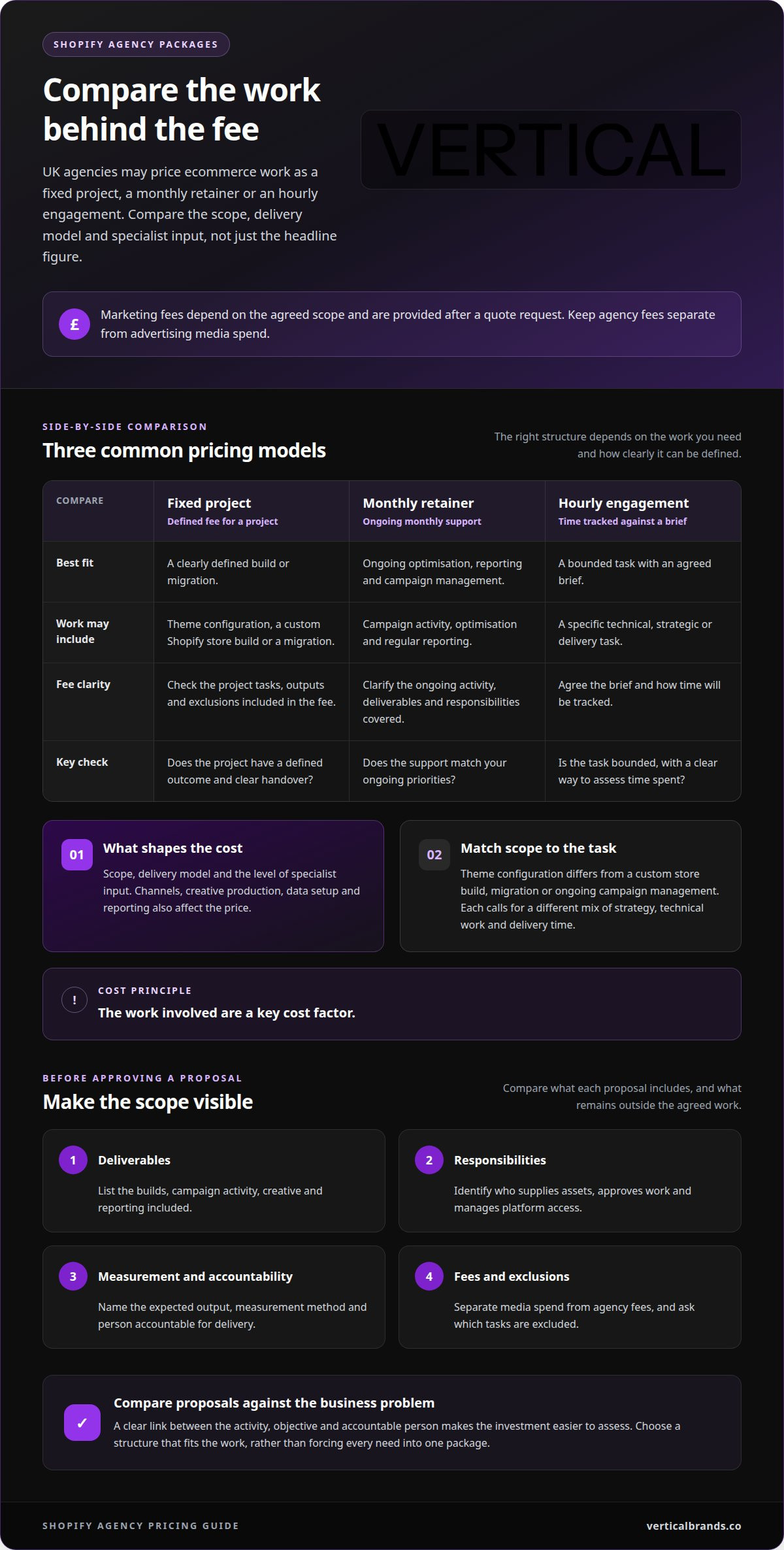
UK agencies may price ecommerce work as a fixed project, a monthly retainer or an hourly engagement. Theme configuration differs from a custom Shopify store build, migration or ongoing campaign management. While simpler web projects for smaller businesses might be handled by web design specialists like Mosster Services Limited, advanced retail setups require a distinct mix of strategy, technical work and delivery time. Ask for a breakdown of tasks, outputs and exclusions to see what the proposed fee covers.
For agency marketing work, the price depends on the scope and is provided after a quote request. Channels, creative production, data setup and reporting all shape the cost. Separate media spend from agency fees in the proposal. This makes the total commitment clearer and prevents management fees from being confused with advertising budgets. Each proposal should show how these responsibilities are divided.
Pricing and Agency Value
Value depends on the business problem being solved, not the number of tasks listed. A growing ecommerce brand may prioritise conversion, often partnering with web design and marketing specialists such as Britecode to refine the store experience, while another needs acquisition activity or stronger creative. Compare each proposal against that priority. Identify the expected output, measurement method and person accountable for delivery. A clear link between activity and objective makes the investment easier to assess.
A conversion-rate target alone is not a complete pricing measure. The agency should explain which work could influence it, such as landing-page testing, campaign structure or customer-led creative. UGC content production can be scoped as a distinct workstream, with clear deliverables and review responsibilities.
Before approving a package, compare the commercial terms with the operating plan. A fixed project can suit a defined build or migration. A retainer can support ongoing optimisation, reporting and campaign management. Hourly work can address a bounded task, but needs an agreed brief and a way to track time. Choose a structure that fits the work, rather than forcing every need into one package.
Use a proposal checklist to expose scope differences:
- Deliverables: list the builds, campaign activity, creative and reporting included.
- Responsibilities: identify who supplies assets, approves work and manages platform access.
- Measurement: define the baseline, reporting cadence and success indicators.
- Change control: establish how additions or revised priorities affect the scope.
For example, two proposals may both include campaign management, but one may also cover strategy, creative testing and performance analysis. Those differences affect workload and business value. Compare the details line by line. A lower fee can leave important work outside scope, while a broader package makes sense only when each component supports a defined objective. Clear scope and ownership make budgets easier to manage and decisions easier to review.
Post-launch support and retainers
A Shopify launch is a handover point, not the end of operational work. Ongoing support can cover platform maintenance, campaign activity, website improvements and monitoring. Define these responsibilities before launch, so the team knows who owns each task and how priorities are managed. A retail business may continue working with an agency for months or years, depending on the work and changing needs.
Separate post-launch support from any warranty or defect-fix terms in the project agreement. The agreement should state which build issues are covered, how they are reported, and what happens when a request falls outside the agreed scope. For example, correcting a feature that doesn’t match the approved build differs from adding a new checkout function. Clear definitions prevent routine development from being confused with maintenance.
For Shopify migrations, post-launch checks should include page titles and descriptions, alongside indexing monitoring. Important old URLs should map to their new destinations through 301 redirects. These steps help preserve the relationship between existing pages and the new website structure. A launch checklist should also assign ownership for reviewing redirects, checking key templates and recording issues that need follow-up.
Retainers suit ongoing work that needs regular prioritisation rather than a single defined handover. A monthly plan might allocate time to platform updates, website improvements, campaign optimisation or reporting. The useful measure is not simply the hours available. It’s whether the retainer sets clear priorities, named responsibilities, agreed outputs and a review process. Ask how unused capacity, urgent requests and new work are handled.
Many teams use the first 30-90 days of an agency engagement to establish measurement, launch initial tests and set benchmarks. That period can create a practical basis for reviewing the relationship. By four months, a retail business may have ample data to assess agency fit. Review delivery against agreed work, the quality of reporting and whether priorities have adapted to what the results show.
- Before launch: document support scope, ownership, escalation steps and any warranty terms.
- After launch: monitor indexing, page metadata, redirects and reported platform issues.
- During the retainer: set priorities, track completed work and review campaigns against benchmarks.
Ongoing maintenance should reflect the store’s operating needs. A business with frequent product changes may prioritise catalogue and page updates; another may focus on campaign landing pages or technical improvements. Record each request, its owner and its status in a shared workflow. This gives teams a clear view of work in progress, while scheduled reviews help surface tasks that are no longer relevant. Launch checks also protect the handover from becoming an informal, untracked support arrangement.
SEO, paid advertising, email, SMS and content marketing
A Shopify marketing agency can coordinate SEO, paid advertising, social media, email and content around store goals. This connects channel activity to customer journeys, from product discovery and shopping to repeat purchases.
The work may include campaign planning, creative development, performance measurement and improving how each channel supports commercial goals.
SEO and Paid Advertising
SEO strengthens the visibility of product and category pages in organic search. The work can include search-intent research, page structure, technical improvements and useful content. Paid search, often called PPC, places adverts against selected searches. Ask how the strategy separates paid and organic activity, and how each is measured.
For example, a brand promoting a new product range might use paid search to reach people actively looking for it, while SEO builds longer-term visibility. Reporting should distinguish paid clicks from organic visits and connect both to store actions. A Shopify store’s product pages, landing pages and tracking all shape what these campaigns can reveal.
Social Media and Content Marketing
Social media campaigns combine audience selection, platform planning and creative suited to each placement. Content marketing can support those campaigns with product demonstrations, buying guidance and customer stories. Ask how each asset serves a defined role, such as introducing a product, answering a purchase concern or supporting a promotion.
For instance, a short product demonstration can introduce an item on social platforms, then support a relevant landing page. Assess whether the creative fits the audience and shopping context, rather than counting posts alone. Social results can inform future campaign choices, but each channel still needs clear measurement.
Email and SMS Marketing
Shopify email integration can support automated marketing, targeted campaigns, mailing lists and abandoned-cart reminders. Klaviyo can organise customer communications around audience segments and campaign objectives. A useful plan separates automated messages, such as a cart reminder, from scheduled campaigns announcing a product or seasonal offer.
Email and SMS serve related but distinct roles. Email can carry more detailed product information; SMS can deliver concise, time-sensitive campaign messages. Define the audience, message purpose and measurement for each. For example, a product launch campaign might use email for detailed information and SMS for a brief announcement. These channels work best when timing, creative and customer experience are coordinated.
To assess an agency’s channel strategy, map each activity to a customer need, a store destination and a measurable action. This makes it easier to see whether SEO, paid campaigns, content, email and SMS form a coherent plan or operate as disconnected tasks.
Selecting a Shopify marketing agency
Choosing well means testing how an agency thinks, not simply comparing service lists. The UK directory lists 89 Shopify marketing agencies, so use a consistent decision framework to narrow the field. Start with your main constraint: stores may need more qualified traffic, stronger conversion, better customer retention or joined-up marketing. A clear priority makes every proposal easier to assess.
Assess Shopify platform depth separately from general marketing capability. Ask how the agency connects store data, customer journeys and channel activity. For a Shopify Plus business, relevant experience might include multi-store architecture, checkout customisation, Shopify Flow automation, B2B or wholesale operations, and high order volumes. Match the agency’s experience to the complexity your store actually has, rather than selecting on platform labels alone.
Then test the proposed strategy against your commercial model. A retailer with repeat purchases may need retention and customer relationship management; a new store may need discovery and acquisition. Ask how the agency will prioritise work, measure progress and adapt campaigns when results change. The strongest agencies explain those decisions in plain language and assign responsibilities clearly.
Review operational fit before signing. Establish who leads the account, who implements work, how approvals happen and which internal teams need to contribute. For a multi-market brand, assess experience with GDPR, VAT, international expansion and market-specific store setups. These capabilities affect planning, customer data processes and campaign execution. A London office can support face-to-face sessions, but meeting format matters less than decision speed and consistent communication.
Use a practical assessment matrix to keep the decision grounded:
- Platform experience: match Shopify projects to your store’s build and operating requirements.
- Strategic alignment: connect proposed activity to your priority, such as traffic or conversion.
- Measurement: identify the data, reporting and review process behind each objective.
- Delivery model: clarify ownership, approvals, communication and change handling.
- Market readiness: assess relevant experience across UK, EU and other target markets.
Finally, test the working relationship with a defined initial scope. Choose a meaningful objective, agree what the agency will deliver, and establish how findings will shape the next phase. This creates a focused way to assess collaboration and execution without confusing activity with progress. A useful assessment includes the quality of decisions as well as completed tasks.
If your next step is to align channel priorities with store growth, plan your Shopify growth strategy.
Vertical Brands
Vertical Brands helps Shopify businesses connect marketing priorities with the channels and customer relationships that support growth. If your store needs a coordinated approach across acquisition and retention, its work can include Paid Social, Paid Search, Klaviyo Email Marketing and Email Marketing & CRM Management.
The right starting point depends on your commercial priorities. A business seeking more qualified visits may focus on paid campaigns, while a store aiming to strengthen repeat engagement may prioritise customer communications. Vertical Brands can shape the channel mix around your objectives and manage the relevant activity. Your priorities determine the right starting point.
Contact Vertical Brands to discuss your Shopify marketing priorities and the support that fits your business.
Turn your priorities into a focused growth plan
The next step is to decide what needs to change in your store’s marketing operation. Choose a commercially important priority, then align the working relationship around it. A clear starting point helps an agency focus its recommendations and gives your team a practical basis for decisions. Your priorities shape the work that follows.
For UK retailers assessing a Shopify marketing agency, the right fit depends on how the partner connects strategy with execution. Vertical Brands offers Klaviyo Email Marketing, Email Marketing & CRM Management and Paid Social. These capabilities can support brands looking to strengthen customer communications or coordinate paid activity with retention efforts.
Bring your current priorities and growth challenges into the conversation. Contact Vertical Brands to discuss a Shopify marketing approach for your business. A sharper plan starts with a clear objective and the right working relationship.
Frequently Asked Questions
Which UK Shopify marketing agencies specialise in ecommerce?
Look for agencies that focus on ecommerce operations, customer journeys and store performance, rather than general promotion alone. A Shopify marketing agency in the UK should understand how acquisition, product discovery and repeat purchasing connect. Vertical Brands serves ecommerce businesses, with capabilities across performance marketing, email and CRM. The right fit depends on your store’s needs and the expertise required to address them.
How much do Shopify marketing agencies in the UK charge?
Agency fees depend on the work involved, the channels covered, creative requirements and reporting needs. Marketing service fees depend on the scope and are provided after a quote request. A proposal may separate ongoing management from campaign setup or production work. Before comparing totals, identify what each fee includes, whether media spend is separate, and how additional requests affect the agreed scope.
What services do UK Shopify marketing agencies offer?
Services can span search engine optimisation, paid search, paid social, email marketing, CRM management, content and website development. The mix should reflect the store’s commercial priorities. For example, a business with strong traffic but weak repeat purchasing may focus on customer communications, while a newer brand may prioritise discovery. Clarify which work is strategic, which is delivered directly, and what your team needs to provide.
How do I compare Shopify marketing agencies in the UK?
Compare agencies against the same brief, objectives and delivery expectations. Assess their relevant Shopify experience, proposed channel mix, reporting approach and account responsibilities. Then examine how clearly each proposal links activity to a business objective. For example, a plan to increase returning customers should explain which customer groups it targets and how performance will be evaluated, rather than relying on broad engagement measures alone.
What results and case studies do UK Shopify agencies show?
Review case studies for the named client, the service delivered and the precise outcome reported. Vertical Brands’ published examples include FaceGym, with 50% more purchases and 41% more bookings, and Canagan, with 900% email revenue growth. These are distinct client results, not a forecast for another store. Look for context about the work and business objective, so you can judge whether an example is relevant.
How do I choose a Shopify marketing agency for my business?
Start with the constraint that most limits your store’s growth, such as weak product discovery, low repeat engagement or an unclear customer journey. Choose an agency with relevant expertise and a working model that fits your internal capacity. A retailer with an in-house creative team, for instance, may need strategic and campaign support more than asset production. Define the first objective and decision-making process before agreeing on a scope.
What questions should I ask before hiring a Shopify agency?
Ask who will lead the work, who implements it and which decisions need your approval. Clarify how reporting connects activity to revenue or customer behaviour, and how changing priorities affect delivery. Ask for a recent example of a problem the team identified and how it responded. These questions reveal how the agency communicates and makes decisions, not just what its service descriptions promise.
Do UK Shopify agencies offer SEO, PPC, email and social media marketing?
Yes, agencies may cover all four channels, either through one integrated team or separate specialists. SEO supports organic discovery; PPC reaches people through paid search; email supports customer communication; and social media can build awareness or drive visits. The combination varies by agency and brief. Check how the channels are coordinated, how their performance is reported, and whether the plan reflects your store’s customer journey.