Photo by Samantha Gades on Unsplash
An agency fee only makes sense in the context of the work it covers. In the UK, e-commerce agency pricing models typically include hourly rates, fixed project fees, monthly retainers and performance-based pricing. The total depends on scope, specialist input and whether you need a defined project or ongoing support.
It’s reasonable to want a clear figure before committing budget. But a headline fee tells you little unless you know what it includes, what continues after launch and how the commercial model fits your store’s priorities. This guide explains common UK ecommerce agency fee structures, ongoing costs to budget for and how to choose a model that suits your needs.
You’ll see how project fees differ from retainers and performance-based arrangements, what can affect costs, and how website, platform and marketing expenses fit into the wider budget. The right model depends on your growth stage, internal capabilities and required deliverables. The aim is a budget you can plan around, with fewer surprises once the engagement begins.
Key Takeaways
- Separate one-off build or project fees from recurring agency retainers so your budget reflects both launch work and ongoing growth activity.
- Hourly, fixed-fee, retainer and performance-based pricing allocate cost and risk differently. Match the structure to the scope and outcomes you need.
- Allow for ongoing platform, hosting, app, maintenance and payment-processing costs alongside agency fees.
- Choose support that fits your store’s scale and priorities. A focused specialist arrangement may suit your needs better than a broad full-service retainer.
- Define the work, deliverables and success measures before agreeing a fee. The right pricing model depend on what your store needs to move forward.
How Much Does an Ecommerce Agency Cost?
There’s no single UK fee for an ecommerce agency project. Work on Shopify, WooCommerce and Magento is priced according to scope: catalogue size, design requirements, integrations, migration and custom functionality. For instance, specialist Shopify partners such as nbedesign.com typically assess theme customisation, app configuration and data migration when defining project deliverables. A template-led store needs a different plan from a multi-site build or wholesale portal, so the estimate should define deliverables and exclusions before setting a fixed fee.
UK agency proposals may state fees excluding or including VAT. The quote should make its VAT basis clear, so you can understand the total payable and compare budgets consistently.
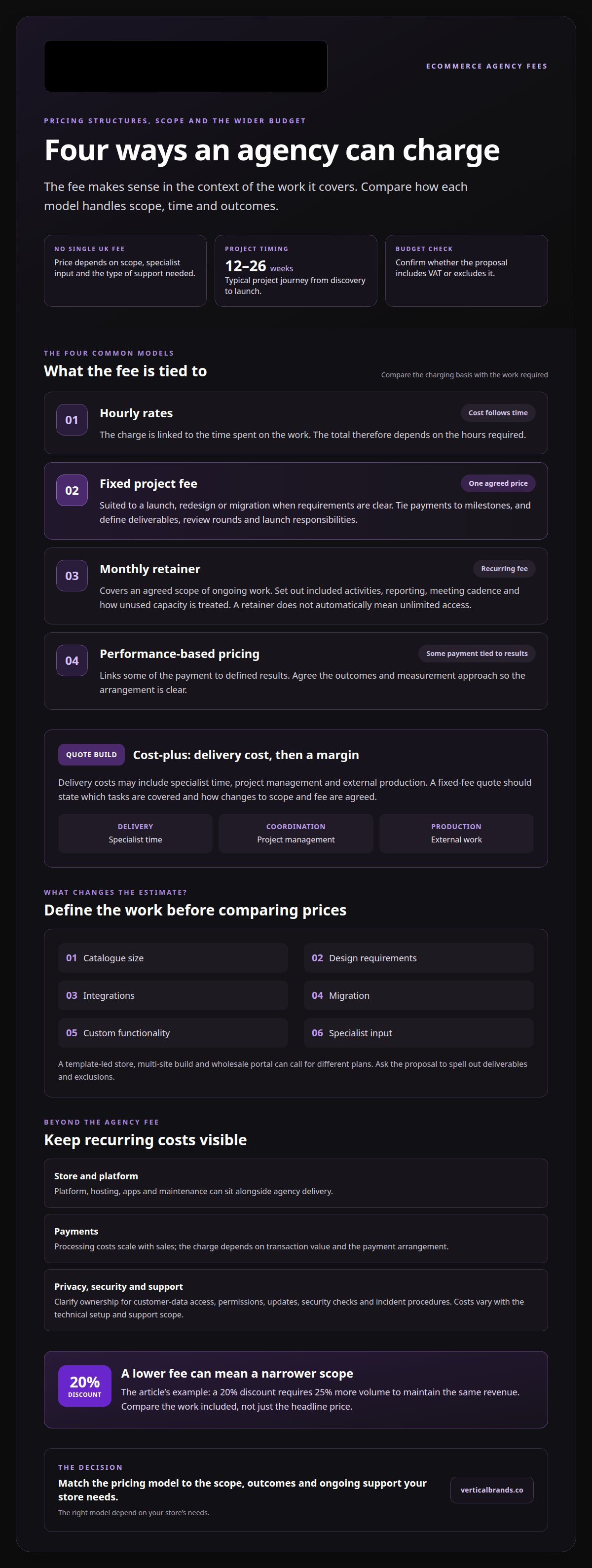
Four common models determine how an agency charges: hourly rates, fixed project fees, monthly retainers and performance-based pricing. Hourly billing ties cost to time spent, while a retainer covers agreed ongoing work. Performance-based pricing links some payment to defined results. The right balance of scope, fee and accountability depends on what the agency is responsible for delivering.
Cost-plus pricing starts with the cost of delivering the work, then adds a margin. For a simple illustration, a bottle of water with a £1 cost could be priced by adding a defined amount on top. Agency work is more complex: delivery costs may include specialist time, project management and external production. A fixed-fee quote should state which tasks those costs cover and how changes are handled. If new requirements emerge, the agency and business can agree a change to scope and fee before extra work begins.
Fixed-fee project work sets one agreed price for a defined outcome. It can suit a store launch, redesign or migration when requirements are clear. The proposal should name milestones, deliverables, review rounds and launch responsibilities. Ecommerce projects typically take 12 to 26 weeks from discovery to launch, so a milestone-based payment schedule can connect invoices to progress rather than leaving timing unclear.
A fixed monthly agency fee means the business pays a recurring amount for an agreed scope of work. The agreement should define included activities, reporting, meeting cadence and how unused capacity is treated. A monthly fee does not automatically mean unlimited access. Clear boundaries help prevent scope drift and make the relationship easier to manage.
Fixed book price policies offer a useful contrast. In the UK, e-books do not have fixed-price regulation, and some are sold under the agency model. This concerns how books are priced for sale, not how an agency charges for ecommerce work. Keep the decisions separate: define your product pricing policy, then choose an agency fee structure that matches the project or ongoing workload.
Legal, privacy, security and ongoing support costs
An ecommerce budget extends beyond launch and agency delivery. Store maintenance, payment processing, privacy controls, security monitoring and technical support can all create recurring costs. List these separately, then assign each to the store, its platform or an external specialist. This makes renewals, responsibilities and operational ownership easier to track.
Payment processing costs scale with sales. The actual charge depends on transaction value and the payment arrangement. PCI responsibilities also need clear ownership: map who manages payment settings, access permissions, updates and incident procedures across the store and its payment provider.
Privacy and security work can include reviewing customer-data access, consent journeys, retention practices and account permissions. Support agreements should define what is covered, how issues are prioritised and whether updates or security checks are included in the monthly fee. Costs vary with the technical setup and support scope.
Retainer pricing can be understood through delivery cost and target margin. That calculation shows why a quoted fee reflects more than staff hours. Reporting, account management, tools and delivery capacity also shape the price. A 20% discount requires 25% more volume to maintain the same revenue, so a lower fee may also mean narrower scope.
Compare agency spend with the full cost of hiring. An agency can provide access to several disciplines, while an employee offers dedicated internal capacity. The right comparison depends on how much specialist work your store needs and how consistently that expertise is required.
Custom functionality and integrations add cost because they require discovery, development, testing and ongoing maintenance. Connecting a store to stock, fulfilment or customer systems can involve data mapping, access controls and exception handling. Define ownership for each integration, including who resolves failures and pays for updates. If product-page creative is also in scope, UGC content can form part of the wider ecommerce operation, with production and technical implementation treated as distinct work.
Typical fees by digital marketing service
Digital marketing fees reflect the delivery model, scope and commercial objective. The contract should connect each charge to defined work, measurement and review points.
Client value and project fees
Value-based pricing sets a project fee according to the commercial value the work is expected to create, rather than delivery hours alone. This matters because a project’s impact can extend beyond its production cost. A store redesign, for example, may aim to improve conversion, while a CRM project may focus on customer retention. An estimate should explain the expected outcome, assumptions and measurement method.
Separate forecast value from guaranteed revenue. Define the baseline, the period being assessed and which factors sit outside the project’s control. A fixed project fee can then cover named deliverables, while any later optimisation is scoped separately. Before signing, review the initial term, renewal process, notice period and any early exit charge. Retainers tend to begin with a 12-month initial term, then move to a three-month rolling notice period.
PPC fees as a share of ad spend
A percentage-of-spend model calculates the agency management fee from the advertising budget, so the fee changes as spend changes. Some agreements reduce the percentage as budgets rise. This can align the management charge with campaign scale, but increased media spend may raise the fee without a proportional change in the work.
Compare the percentage with the service scope. Google Ads management may include campaign structure, keyword work, optimisation and reporting, but the agreement should state which tasks are covered. Separate the agency fee from the advertising platform charge. Payment processing is a separate transaction cost, charged against sales rather than paid to the agency for campaign management. Ask the agreement to define the ad budget, billing route and approval process for changes.
Discovery and design phase fees
A discovery and design phase defines requirements before technical delivery begins. It can cover stakeholder interviews, customer journeys, platform choices, integrations, wireframes and visual direction. A clear scope shows which research and design outputs are included and what would require a later project fee.
Use this phase to resolve decisions that could change the build estimate. Confirm catalogue structure, migration needs, payment flow and the systems that must connect. The proposal should identify review stages, decision owners, assumptions and change control. It should also state whether design files and technical specifications are handed over at completion. This gives both parties a defined basis for pricing the next stage.
Choosing a pricing model based on store size and needs
The right model depends on store scale, project scope and the outcomes you need. In the UK, GMV, technical complexity and internal capabilities all affect an agency proposal.
Performance-based pricing
Performance-based pricing links some or all of the agency fee to agreed results, such as qualified leads or sales. It can connect payment more directly to commercial outcomes, but only if both sides define how results are measured. Set a baseline, attribution window and reporting method before work starts. Otherwise, changes in stock, seasonality or media budget can complicate the link between delivery and results.
For a conversion project, define the measurement period and the pages included. Record the existing conversion rate before changes, then agree how the new result will be calculated. The proposal should also identify factors outside the agency’s control, such as pricing changes or unavailable products.
Time-based agency pricing
Time-based pricing charges for the hours or days used to deliver work. It can suit exploratory tasks with a changing scope, such as investigating a technical issue or assessing an unfamiliar integration. Ask the proposal to identify roles, estimated time and approval points. This structure makes effort visible, but the total can grow if requirements remain open-ended.
Use time-based work for a defined investigation, then agree a separate scope for implementation. For example, an agency could first map a checkout fault, then estimate the development work after identifying its cause. A cap or approval threshold gives the business control over additional time.
Value-based pricing
Value-based pricing sets a fee against the commercial value a project is expected to create. It matters when the outcome could outweigh the hours required, such as improving a high-traffic product page. A HubSpot estimate says value-based pricing can increase profits by as much as 50% compared with a traditional market-based approach.
That estimate is not a forecast for an individual store. Build the proposal around a credible baseline, a defined outcome and a measurement plan. Conversion improvements can be assessed through changes in completed purchases, but traffic quality, promotions and product availability can also affect results.
Factors affecting agency pricing
Agency pricing reflects the work required, the expertise involved and the store’s commercial scale. For UK businesses, GMV can help indicate the level of support needed: specialist agency pods are recommended for stores between £250,000 and £2 million GMV, while full-service support starts to make sense at around £2 million GMV.
Those thresholds are guides, not automatic triggers. A store with a complex catalogue, multiple integrations or limited internal capacity may need more specialist input than a simpler business at a similar GMV. A proposal should define the deliverables, decision owners, technical dependencies and measures of success.
Website conversion work also needs a clear baseline. Define the pages and customer actions in scope, then agree how progress will be assessed. A store rarely benefits from broad activity without a clear commercial purpose. Match the pricing model to the problem, the required level of control and the store’s ability to measure outcomes.
Monthly retainers and deliverables
A monthly retainer is a recurring agreement for a defined set of ecommerce work. Its value depends on the delivery capacity, priorities and reporting included, not simply the number of tasks listed.
Monthly retainers by agency size
Agency size shapes the range of specialists and delivery capacity available within a retainer. A smaller team may focus on one priority, while a larger agency can coordinate several workstreams under one account structure.
Store scale helps determine which structure makes sense. A brand below £1 million GMV may need focused support, while stores between £250,000 and £2 million GMV are a fit for specialist ecommerce agency pods. Full-service support starts to make sense at around £2 million GMV. These are useful planning markers, not automatic triggers. Catalogue complexity and internal capability also affect the level of support needed.
Retainers tend to begin with a 12-month initial term. After that term, they typically move to a three-month rolling notice period. Treat the agreement like a subscription: define its scope, renewal date and exit process before delivery begins. A store preparing for a seasonal launch, for example, should understand how campaign work fits alongside its ongoing monthly priorities.
Specialist monthly retainers
A specialist retainer focuses recurring work on a defined discipline rather than covering every ecommerce need. It can suit a store with an established team that needs additional expertise in one area, such as search performance or customer retention.
Set the operating rhythm around that specialism. A retention-focused programme might include customer journey planning, campaign calendars, audience segmentation and performance reviews. A search-focused arrangement may prioritise technical issues, content planning and visibility reporting. The work should support a business objective, with named outputs and clear approval ownership.
Retainer deliverables
Retainer deliverables are the agreed activities and outputs supplied during each billing period. A useful scope names the work, cadence, dependencies and reporting, so both sides can distinguish planned delivery from additional requests.
For example, a monthly plan might specify campaign development, creative review, optimisation and a performance report. It should also explain how priorities are reset when stock availability, trading plans or results change. Define who supplies product information, who approves creative and how revisions are handled. Without these operating details, a task list can look complete while key dependencies remain unresolved.
For content-led retainers, plan production and approval alongside campaign delivery. Discuss ongoing UGC content needs when customer-led creative forms part of your ecommerce programme. That work can then be scoped against the channels, formats and review process required.
Vertical Brands
Vertical Brands helps ecommerce teams connect customer retention and acquisition with clear commercial priorities. Its Klaviyo Email Marketing and Email Marketing & CRM Management support customer communications, while Paid Social and Paid Search help generate demand across key digital channels.
Turn to Vertical Brands when your store needs focused support in these areas or your internal team needs a partner to shape and deliver ongoing marketing activity. The right scope depends on your priorities, existing capabilities and desired outcomes. Clear objectives help structure the work and keep delivery aligned with your growth plan.
To discuss your ecommerce marketing priorities, contact Vertical Brands.
Set your next growth priority
Choosing between e-commerce agency pricing models in the UK comes down to how you want to build capability. Start with the commercial constraint that matters most: improving acquisition efficiency, strengthening customer retention or creating a more coherent customer journey. Then define the work that will advance that priority and the measures you’ll use to assess delivery.
Vertical Brands supports ecommerce growth through Klaviyo Email Marketing, Email Marketing & CRM Management and Paid Social. These capabilities can connect customer communications with acquisition activity, rather than treating each workstream in isolation. Let your most important priorities shape the scope, responsibilities and measures in your agency relationship.
If you’re ready to align your marketing activity with your store’s next stage, contact Vertical Brands today. A focused conversation is a practical starting point for defining the work ahead. Your next move can be clear, commercially grounded and built around what your store needs.
Frequently Asked Questions
How does it work?
An ecommerce agency engagement starts with agreement on the business objective, responsibilities and scope. The agency then delivers against that scope and reports progress using agreed measures. For example, a store launching a new range might define campaign assets, launch dates and sales measures before work begins. Regular reviews help identify changes in priorities, stock availability or customer behaviour, so the next phase can respond to the business’s needs.
So what should you budget for an ecommerce store?
Budget separately for the build, ongoing platform and operating costs, and marketing. On the market, ecommerce website builds typically range from £11,000 to £44,000, with a median of about £23,000. Your budget should also account for payment fees and any custom work the store requires.
What pricing models do UK e-commerce agencies offer?
UK agencies commonly use hourly billing, fixed project fees, monthly retainers and performance-based pricing. The e-commerce agency pricing models UK businesses consider differ in how they allocate cost and delivery responsibility. A fixed fee can suit a defined redesign, while hourly billing may suit an investigation with an uncertain scope. A retainer supports recurring activity, and performance-based pricing links some payment to agreed results. The proposal should state what work is covered and how changes are agreed.
How much do UK e-commerce agencies charge for website design and development?
On the market, UK ecommerce website builds typically cost between £11,000 and £44,000, with a median of about £23,000. The final estimate depends on catalogue size, design customisation, migration, integrations and technical requirements. A template-led store has a different scope from a bespoke build with multiple systems. Separate platform subscriptions, hosting, apps and ongoing maintenance from the one-off development fee to understand the full budget.
What are typical UK agency hourly rates and day rates for e-commerce work?
Hourly and day rates vary according to specialist role, seniority, technical complexity and whether the work is advisory or implementation. There is no single rate for all ecommerce projects. An analytics review, for instance, requires a different skill set from custom development or design. Ask the proposal to name the roles involved, billing unit, estimated time and approval process for additional work, so each charge relates to a defined task.
How do fixed-fee, hourly, and retainer pricing compare for e-commerce agencies?
A fixed fee sets a price for a defined deliverable, such as a migration with agreed milestones. Hourly pricing charges for time used, which can suit diagnostic work when the cause is not yet clear. A retainer covers recurring work within an agreed scope, such as a planned optimisation programme. The e-commerce agency pricing models UK retailers compare differ in how scope changes affect payment. Choose the structure that matches the level of certainty and continuity you need, and the control you want.
What percentage of revenue do UK e-commerce agencies charge for performance-based fees?
There is no single standard percentage of revenue for performance-based agency fees. Agreements may link payment to an agreed outcome, but the calculation must define attribution, baseline and measurement period. A percentage of ad spend is a different model: ecommerce agencies commonly charge 5% to 10% of monthly ad spend under those agreements. Don’t treat that as a revenue share. Specify which sales count and how returns or cancellations affect the calculation.
What is included in an e-commerce agency retainer in the UK?
A retainer covers the recurring work agreed in its scope, which may include planning, delivery, optimisation and reporting for selected activities. The exact mix depends on the store’s priorities and the agency’s remit. For example, a trading calendar could identify campaign work, review points and information needed from the business. The agreement should also describe account management, reporting cadence, approval responsibilities and how additional requests are handled. These details help prevent scope disputes.