Photo by Clay Banks on Unsplash
The strongest head of e-commerce toolkit for 2026 won’t be the one with the most tools. It’ll be the one that connects customer experience, data and commercial decisions without adding operational drag.
That’s the challenge: every platform promises a new advantage, but another disconnected system can make performance harder to understand. Growth depends on prioritising tools around the outcome they support, not the feature list they bring.
This guide sets out how to assess the head of e-commerce toolkit for 2026, from conversion and personalisation to first-party data, reporting and integration. You’ll learn how to judge whether a tool solves a genuine constraint, improves the metrics that matter and fits the way your team works. It also maps the growth priorities shaping the year, so you can focus investment where it supports a clearer customer journey and stronger commercial decisions. The goal are a toolkit that earns its place, gives teams usable insight and makes growth priorities easier to act on.
Key Takeaways
- Prioritise conversion tools around specific customer friction, such as weak personalisation or an unclear product journey.
- Define shared metrics and data rules before connecting platforms, so teams can interpret performance consistently.
- Set growth priorities around conversion, first-party data, average order value and personalisation, then match tools to those goals.
- Assess each tool for integration fit, team usability, support quality and evidence that it can improve a defined outcome.
- Choose CRM and email marketing capabilities that connect customer data to relevant, timely communication. A shared set of metric definitions make that work easier to assess.
Conversion optimisation
Conversion optimisation starts by finding where shoppers’ journeys break down. Map the path from landing page to checkout, then inspect each step for friction. A product page may attract social traffic but fail to explain sizing, delivery or product differences. That points to an experience problem, not necessarily a traffic problem.
Personalisation can make product discovery more relevant, but it depends on useful customer signals. Start with a clear use case, such as recommending complementary items based on a shopper’s basket. Then decide what the experience should improve: product discovery, basket building or repeat purchases. Don’t add recommendations just because a tool makes them easy to deploy.
Product customisers let shoppers change colours and materials, add personalisation and preview their choices. They suit products where individual choice is central to buying. Before adopting one, map the operational steps behind each option. Product data, imagery, availability and fulfilment processes all need to match the selection shown online.
Checkout is another high-impact point in the journey. Review delivery information, payment choices, forms and error messages on mobile and desktop. Shoppers may abandon an order if delivery terms are unclear. Make costs and conditions easy to find, and remove fields that aren’t needed for fulfilment or payment.
Use a controlled test to separate a useful change from a design preference:
- Identify the friction. Use analytics, search behaviour and customer-service themes to locate a specific issue, such as repeated searches for delivery details.
- Set the measure. Choose a primary metric, such as completed purchases, and a supporting measure, such as basket value.
- Change one experience. For example, move delivery information closer to the purchase button.
- Review the result. Compare the test and existing experience over the same period, while checking device and traffic differences.
Keep the test aligned with the wider commercial picture. A higher conversion rate can still be unhelpful if it depends on discounting that weakens contribution margin. Include product costs, shipping and fulfilment, payment processing, returns and discounts when assessing the outcome. The head of e-commerce toolkit for 2026 should connect the customer experience to these operational measures, not treat conversion as an isolated target.
Prioritise changes by customer impact and delivery effort. A clearer size guide may address a known barrier sooner than a complex, AI-powered interface. European and social commerce trends can suggest test ideas, but local shopper behaviour should determine what merits investment. Improve the experience through evidence, not feature volume. These tests help teams focus on changes that address real friction.
Data integrations, governance and metric definitions
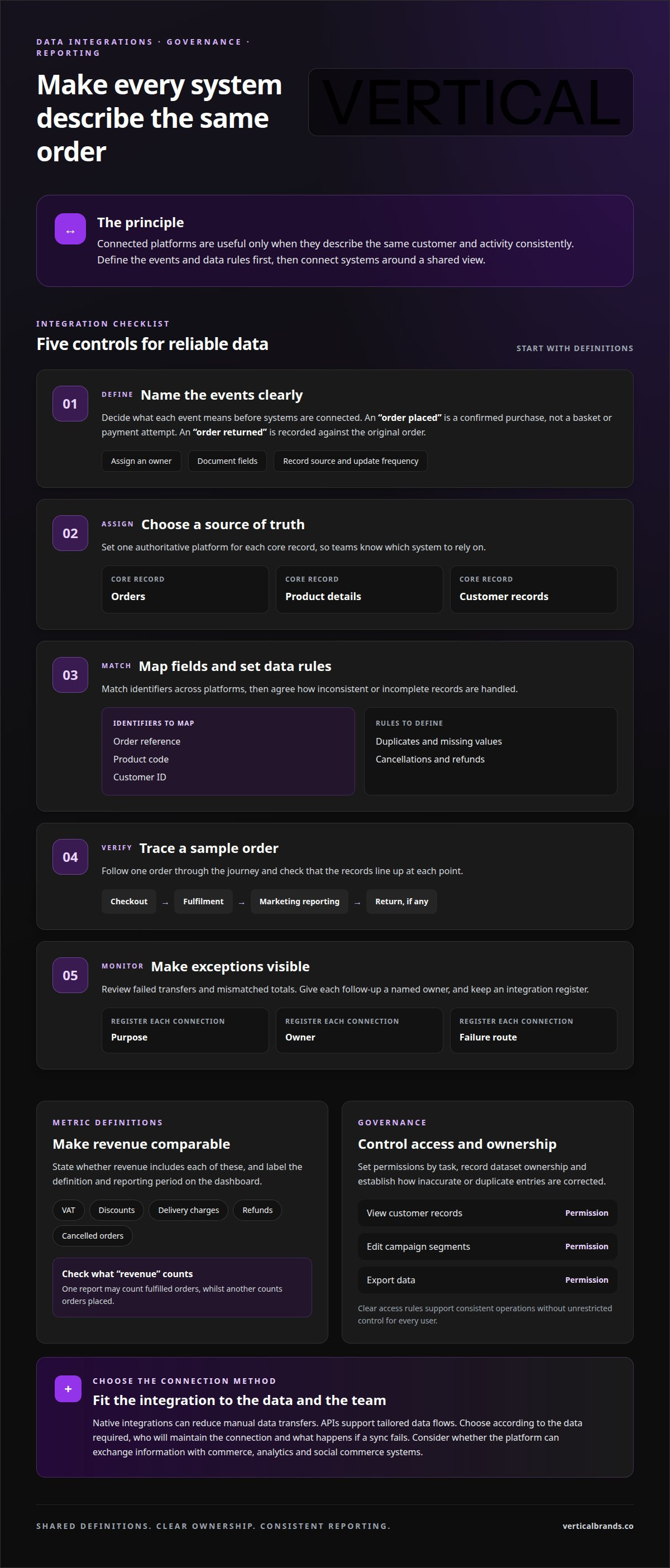
Connected platforms produce useful insights only when they describe the same customer and activity consistently. An online order, for example, may appear in a commerce platform, analytics dashboard and customer relationship management system. If each records cancellations or discounts differently, sales totals can vary between reports. Start by mapping the journey from product view to completed, fulfilled order.
Define the important events before connecting systems. An “order placed” event should record a confirmed purchase, not a basket or payment attempt. An “order returned” event should record the return against the original order. Assign an owner to each definition and document its fields, source and update frequency. This gives analysts and marketers a shared reference when interpreting performance data.
Use a practical integration sequence to reduce mismatched records:
- Choose the source of truth. Assign one platform as authoritative for orders, product details and customer records.
- Map the fields. Match identifiers such as order reference, product code and customer ID across systems.
- Set data rules. Define how duplicates, cancellations, refunds and missing values are handled.
- Test a sample journey. Trace one order from checkout through fulfilment, marketing reporting and any return.
- Monitor exceptions. Review failed transfers and mismatched totals, then assign follow-up to a named owner.
Governance also determines who can access or change information. Set separate permissions for viewing customer records, editing campaign segments and exporting data. Record which team owns each dataset and establish a process for correcting inaccurate or duplicate entries. Clear access rules support consistent operations without giving every user unrestricted control.
Define metrics with the same care. Specify whether revenue includes VAT, discounts, delivery charges, refunds or cancelled orders. Finance and marketing may both report revenue, for example, but one may count fulfilled orders while the other counts orders placed. Label each dashboard metric with its definition and reporting period. Consistent event definitions make comparisons meaningful across teams.
Native integrations can reduce manual data transfers, while APIs support tailored data flows. Choose based on the data required, who will maintain the connection and what happens if a sync fails. A strong partner ecosystem matters when a platform needs to exchange information with commerce, analytics and social commerce systems. Keep an integration register showing each connection, its purpose, owner and failure route.
When campaign performance sits across disconnected channels, Paid Social and UGC content can connect creative activity with clearer measurement. Build reporting around agreed definitions first, then use the resulting insights to guide action across a global customer journey.
E-commerce growth priorities for 2026
UK e-commerce tools in 2026 need to support accurate VAT treatment, clear consumer information, privacy-conscious data handling and accessible shopping journeys. These considerations affect checkout, customer records, product information and returns processes. The right configuration depends on the products sold, the transaction and the customer data used.
Survey priorities point towards conversion and stronger customer relationships. In the survey, 68% of e-commerce leaders identified increasing conversion rates as their top priority for 2026. First-party data also matters: 57% said it would be central to personalisation and segmentation strategies. That makes consented, well-organised customer information a practical growth asset, not merely a reporting input.
Average order value and personalisation extend the same focus beyond the first purchase. In the survey, 44% of e-commerce leaders prioritised growing average order values for 2026, while 42% prioritised scaling personalisation across markets. Brands can connect these goals through relevant product suggestions, useful post-purchase communication and market-specific content. Each activity needs a defined commercial measure, such as order value or repeat purchasing.
Search visibility remains another direct route to product discovery. In the survey, 26% of e-commerce leaders said strong search-result relevance has the biggest impact on sales. That points to practical work: align product titles and descriptions with shopper intent, maintain accurate availability, and organise category pages around how people browse. For international growth, translate and adapt product information rather than assuming one market’s language or terminology works everywhere.
Plan the year around a small set of connected priorities:
- Improve discovery. Track search relevance, product-page engagement and movement from category pages to product pages.
- Develop first-party data. Use customer information to create useful segments and experiences, with clear governance for its use.
- Increase order value. Test complementary products and bundles, then assess the effect on margin as well as basket size.
- Support international demand. Review market-specific product details, payment journeys, delivery information and returns expectations.
Delivery and returns are part of the buying proposition, not just post-purchase operations. Globally, 9 in 10 businesses say delivery and returns offerings are important to securing online sales. For UK brands, clear delivery options and return information can reduce uncertainty before checkout. Make the information easy to find on product pages and during payment.
Finally, avoid treating every trend as a priority. In the survey, 22% of e-commerce leaders were preparing for a future without third-party cookies. Assess changes against your own acquisition mix, customer data strategy and measurement needs. These priorities support a focused plan: choose the growth constraint, set a relevant measure, then assign tools and team ownership to address it.
Key considerations include accurate VAT treatment, clear consumer information, careful handling of customer data and accessible shopping journeys. How these apply depends on the products, transactions and data involved.
Tool evaluation and prioritisation
Evaluate tools against a defined retail constraint, not a feature list. For example, if stock mismatches cause cancelled orders, assess inventory accuracy and order synchronisation first. In the survey, 12% of e-commerce managers cited poor relevance as a challenge with current tools. Only 2% of e-commerce leaders felt confident their tools could adapt quickly. Flexibility and fit deserve scrutiny before another platform enters the digital stack.
For UK retailers, effective inventory, order management and fulfilment tools keep stock, orders and delivery status aligned across sales channels. Prioritise reliable integrations, clear exception handling and workflows that match your fulfilment model; guidance from logistics providers such as Silicon Valley Direct illustrates how robust 3PL connectivity supports scalable operations. Before choosing, test a typical order, amendment, cancellation and return.
Popular e-commerce tool costs in the UK in 2026 vary by platform, modules, users, order volume and implementation needs. Compare the full cost of operation, including integration work, support and internal time, rather than relying on a headline subscription fee.
Security, privacy, integration and vendor lock-in risks include excessive user access, unclear data flows, failed synchronisation and difficult data exports. Assess access controls, data handling, recovery processes, API options and exit provisions before adoption. A tool that can’t transfer usable records may restrict future changes.
Use a weighted scorecard to compare shortlisted platforms. Define each criterion clearly, then score every tool against the same operational scenario:
- Business impact: Connect the tool to a measurable result, such as fewer stock discrepancies or faster order processing.
- Integration fit: Map required connections to commerce, payments, warehouse and reporting systems. Check how errors surface and who resolves them.
- Usability: Test a real task with the people who will use the platform, such as correcting a product quantity.
- Adaptability: Review configuration options, data export and documented APIs before committing to a long-term workflow.
- Evidence: Request a demonstration using your own retail processes, then record gaps and dependencies.
For analytics, ask whether the tool can reduce analysis time by at least 30%. Tie that target to a specific task, such as producing a channel performance report. Record the current process, then compare the time required after implementation. If the platform only changes dashboard presentation, it may not solve the underlying demand for faster decisions.
Prioritise according to impact, effort and risk. A tool that improves order visibility may matter more than a new forecasting feature if teams currently rely on manual updates. Give each platform an accountable owner, adoption plan and review point. For brands seeking external guidance to streamline their digital architecture, consulting partners such as eComQB provide strategic advice and technology solutions to accelerate commercial growth. After implementation, reassess it against the original criteria, including integration failures, user uptake and conversion or fulfilment outcomes. Keep the scorecard current as business needs change.
Which CRM, email marketing and customer service tools should an e-commerce leader use?
Choose tools by workflow, not category labels. A CRM should connect customer records and purchase history; email marketing should use those records for relevant campaigns. Customer service tools should bring order details and conversations together, so an agent can answer a delivery query without switching between disconnected screens.
Start with the customer record. Decide which system owns contact details, consent preferences, order history and support interactions. Then check whether the CRM passes those fields into email segments and service views. For example, a customer with an unfulfilled order shouldn’t receive a message promoting that same product as a new purchase.
Email marketing needs dependable segmentation, automation and reporting. A welcome flow, abandoned-basket reminder and post-purchase message each serve a different moment. Ensure campaign rules account for order status, customer preferences and suppression lists. The system should show which audience and message produced a result, not just opens or clicks without commercial context.
Customer service platforms should make common tasks straightforward. Test an order-status query, return request and product question. Check whether an agent can see the relevant order and communication history in one working view. A shared customer record helps support teams avoid contradictory replies and gives customers a more consistent experience.
Assess connections between systems before committing. E-commerce brands should prioritise robust APIs, native integrations with major platforms and strong partner ecosystems. Map how records move between the commerce platform, CRM, email tool and service desk. Check how each system handles duplicate profiles, changed email addresses, refunds and failed transfers. A useful demonstration follows one customer journey across all four systems.
Use this selection sequence to focus evaluation:
- Document the workflow. Choose a real customer journey, such as a first order followed by a delivery enquiry.
- Set ownership. Decide which platform controls each record and which team maintains its accuracy.
- Test the hand-offs. Check that order, consent and service updates appear in the systems that need them.
- Review reporting. Connect campaign activity and customer service outcomes to agreed business measures.
- Plan adoption. Assign training and operational ownership before moving live workflows.
Keep the stack proportionate. If email campaigns need reliable customer segments, strengthen CRM and email integration before adding another messaging channel. If service teams lack order context, resolve that data hand-off before expanding automation. To align customer records with campaign execution, develop a connected CRM and email strategy around the workflows that matter.
Survey findings underline personalisation: 28% of e-commerce leaders said personalised product recommendations have the biggest impact on sales; 48% of e-commerce managers said their current tools lack the personalisation needed to meet shopper expectations.
Vertical Brands
Vertical Brands helps e-commerce teams connect growth priorities with the digital activity needed to support them. If customer data, campaign execution and performance measures feel disconnected, its Klaviyo Email Marketing and Email Marketing & CRM Management can help create more joined-up customer communications. Paid Social and Paid Search can align acquisition activity with those priorities.
The right next step depends on the constraint: improving customer retention, creating clearer CRM workflows or coordinating paid channels around commercial goals. Vertical Brands can shape this work around your business needs, rather than adding tools without a clear role. Bring your growth priorities and current challenges to a conversation with the team to discuss where it can help.
Make your next toolkit decision count
The next decision is not which platform to add. It is which operating gap deserves attention first, and who will own resolving it. Treat the head of e-commerce toolkit for 2026 as a working model, not a fixed collection of software. Review it as customer expectations, trading priorities and team capabilities change. Clear ownership and agreed measures keeps decisions grounded in what the business needs.
If stronger customer communication or more coordinated acquisition is the priority, Vertical Brands offers Klaviyo Email Marketing, Email Marketing & CRM Management and Paid Social. These services support a considered approach to customer relationships and campaigns, without adding tools for their own sake.
Bring the business challenge and the outcome you want to discuss. Contact Vertical Brands to discuss your e-commerce toolkit. A focused next step can turn a technology decision into a clearer direction for growth.
Frequently Asked Questions
What are the essential tools in a head of e-commerce toolkit in 2026?
An essential toolkit connects the storefront to stock, orders, payments, customer records, marketing and service workflows. The right combination depends on how the business sells. A brand selling through its website and marketplaces, for example, needs a reliable way to reconcile orders and stock across both. Add tools only when they support a defined task, and assign an owner to each system.
What are the best analytics and reporting tools for e-commerce teams in 2026?
The best analytics setup turns trading data into decisions, rather than producing dashboards no team uses. For a head of e-commerce toolkit in 2026, prioritise reporting that joins product, order and channel performance with agreed definitions. Check that teams can investigate a change from summary to underlying transactions. Attribution has limits across privacy changes, cross-device journeys and marketplaces, so use several consistent signals instead of treating one model as complete.
How do leading e-commerce platforms and tool stacks compare for small, mid-sized and enterprise businesses?
Smaller businesses often benefit from a simpler stack with fewer integrations to maintain. Mid-sized teams may need stronger workflows across marketing, service and fulfilment as channels multiply. Enterprise businesses typically face more complex permissions, regional operations and reporting requirements. Compare platforms against real workflows, including product updates and refunds, rather than company labels. A tool is a good fit when its complexity solves an operational need without creating unnecessary maintenance.
How can a head of e-commerce choose and implement a 2026 technology stack?
Start with a business constraint, then map the workflow and systems involved. Set success measures, identify data owners and assess integration requirements before choosing a tool. Run a focused pilot with representative products and orders, including exceptions such as refunds or amended addresses. Document staff responsibilities and training before rollout. After launch, review adoption, data quality and the original measures, then adjust the stack if actual use reveals gaps.