Photo by Andrej Lišakov on Unsplash
Growth is not the only test of e-commerce leadership. Marketing director challenges in e-commerce include team leadership, cross-functional alignment, performance measurement, channel costs and talent. Directors must connect marketing activity to commercial outcomes while working across teams that shape different parts of the customer experience.
This pressure is familiar: channel performance can be difficult to assess in isolation, and marketing decisions depend on input from finance, operations, technology and customer service. Talent gaps add another constraint. These pressures do not sit within marketing alone, so effective leadership depends on clear priorities and shared accountability.
This article explains the main challenges, why they arise and how they affect decisions about investment and growth. It covers leadership demands, team alignment, the limits of performance measurement, the tension between costs and return on investment, and the skills e-commerce teams need. The aim is to show where the work gets complex and what directors need to manage.
Key Takeaways
- Set clear ownership for commercial outcomes, then give teams the authority and support to influence them.
- Bring sales, finance, operations, technology and customer service into decisions that affect the customer journey.
- Use a balanced view of performance to distinguish channel activity from its contribution to business results.
- Assess marketing investment across costs, channel performance and return, rather than relying on one metric.
- Identify critical capability gaps early. A focused talent plan help protect delivery when teams are stretched.
Leadership and team management
E-commerce leadership combines commercial accountability with influence across teams. A Director of E-Commerce may report to a Chief Marketing Officer (CMO) or Chief Digital Officer (CDO), while a Marketing Director must connect customer insight to decisions made by senior leaders and boards. This means translating campaign results and customer behaviour into clear implications for revenue, investment and priorities, rather than presenting marketing activity without its business context.
The position can carry broad ownership. An e-commerce director may shape strategy, hold profit and loss (P&L) responsibility, or develop and scale a new business-to-consumer (B2C) or business-to-business (B2B) function. These responsibilities demand clear decision rights. If one leader owns the commercial target but another controls pricing, stock or technology, teams need agreed responsibilities and a route for resolving trade-offs.
Communication is operational, not ceremonial. A useful leadership update links a customer signal to a decision. For example, rising checkout abandonment may prompt a joint review of payment options, site performance and customer support feedback. The director should explain what the evidence suggests, what remains uncertain and which team owns the next action. This helps finance assess investment and gives technology a defined problem to solve.
Priorities can shift quarterly between direct-to-consumer, omnichannel, retail-first and international growth. A leadership team needs to make those changes explicit, including what moves down the list and how success will be judged. Otherwise, channel teams may pursue conflicting goals. Strong leadership protects focus while adapting to market trends, and communicates the reason for a change before it becomes a delivery problem.
Define expectations across the first 30, 60 and 90 days, then set a clear position for the period after a year. Early milestones might cover stakeholder alignment, performance diagnosis and an agreed strategic plan. A six-month website re-platforming goal, for example, needs dependencies, decision owners and a realistic delivery sequence. Without those specifics, a headline target can obscure the work required from product, operations and technology.
Team development matters because strategy depends on execution. Map the capabilities the plan needs, such as digital trading, customer insight and conversion optimisation, then assign ownership and development priorities. A director should also distinguish a skills gap from a structural bottleneck: training cannot fix a decision process that leaves teams waiting for approval. Leadership is more effective when people understand their remit, escalation route and contribution to commercial outcomes.
Connecting marketing with sales, finance, operations, technology and customer service
E-commerce decisions connect customer demand with stock, pricing, fulfilment and service. In high-value retail sectors where complex inventory and customer trust are paramount, resources such as jewelryecommerce.com highlight how digital platforms and operational practices must align. As third-party cookies recede, teams need to rely more on consented customer data, contextual advertising and platform reporting.
Prioritising customers, channels and investment
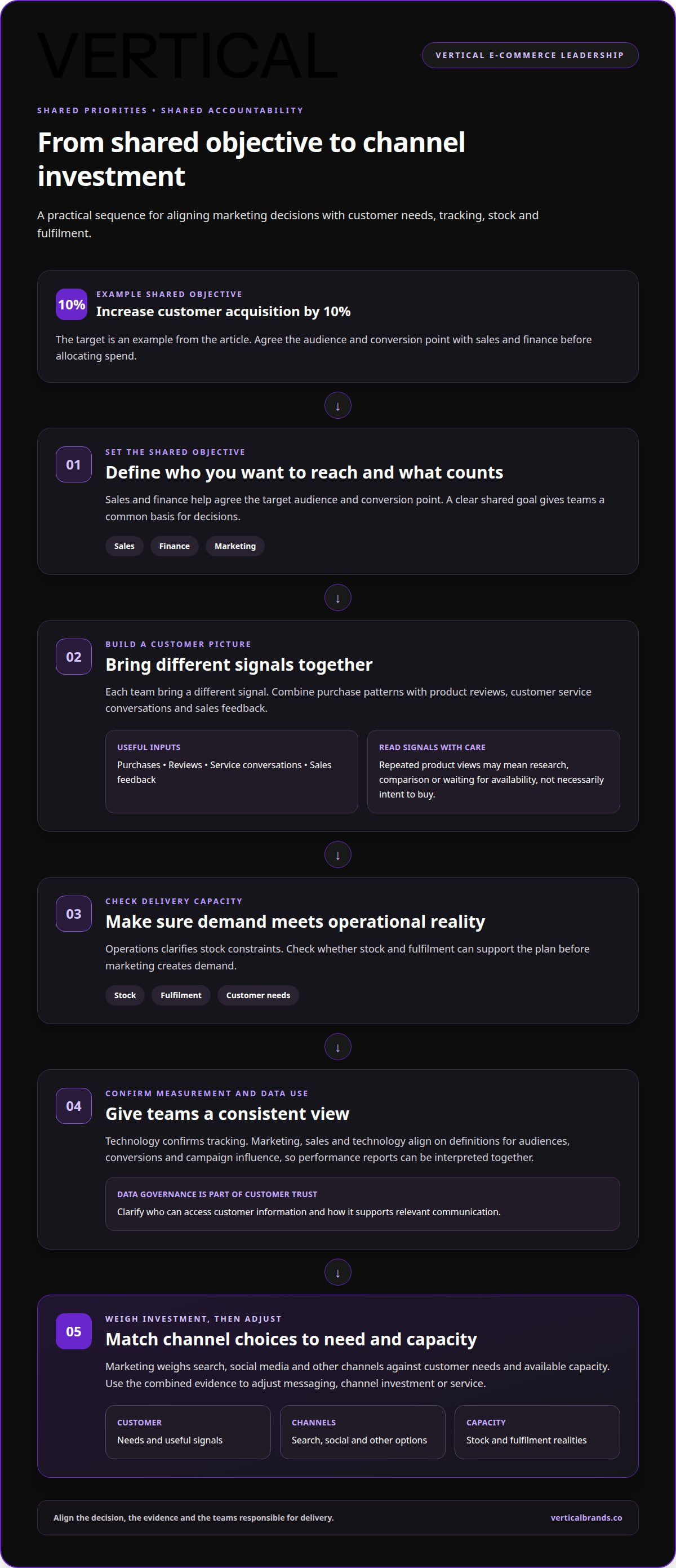
Shared prioritisation means choosing customer groups and channels with input from teams that shape the entire customer experience. This matters because marketing can create demand that operations cannot fulfil, or direct investment towards customers whose needs the product team has not addressed.
For example, sales can identify repeated objections, while customer service sees delivery complaints. Operations can clarify stock constraints, and finance can assess the commercial case. Marketing can then weigh search, social media and other channels against customer needs and available capacity.
Set a shared objective before allocating spend. If the goal is to increase customer acquisition by 10%, define the target audience and conversion point with sales and finance. Then ask technology to confirm tracking, and operations to assess whether stock and fulfilment support the plan.
Customer understanding and personalisation
Customer understanding combines historical data with direct evidence of needs, intent and behaviour. It matters because past purchases show what someone bought, but not always why they chose it or what will meet their next expectation.
Combine purchase patterns with product reviews, customer service conversations and sales feedback. A customer who repeatedly views a product may be researching, comparing or waiting for availability. Treating every signal as purchase intent can lead to irrelevant messages and weaken the customer experience.
Personalisation should respond to useful signals, not simply insert a name into a message. For example, a relevant follow-up can reflect a recent purchase or a stated product interest. Marketing and technology should agree which data the platform uses and how teams interpret it.
Cookie changes make first-party relationships and measurement discipline more important. Marketing, sales and technology need shared definitions for audiences, conversions and campaign influence. Otherwise, platforms may report competing versions of performance, leaving finance without a consistent basis for investment decisions.
According to the European Union, the GDPR places increased responsibility on retailers to prevent customer data from falling into the wrong hands. Data governance is therefore part of customer trust, not merely a technical task. Teams should clarify who can access customer information and how it supports relevant communication.
A comprehensive view connects customer signals with operational reality. The data from separate platforms help most when teams interpret them together, then adjust messaging, channel investment or service based on the evidence. For a more coordinated customer journey, align communication with what customers need before and after purchase.
Data analysis and performance measurement
E-commerce directors monitor sales, website performance, conversion rates and traffic. One of the most demanding marketing director challenges in e-commerce is turning those measures into decisions that improve commercial performance.
Digital marketing and analytics skills
Digital marketing analytics combines channel knowledge with the ability to interpret consumer behaviour and commercial performance. These skills matter because directors need to distinguish a change in traffic from a genuine shift in demand.
For example, a paid search campaign may attract visits while product-page conversion weakens. The director must investigate the journey, assess the audience and identify where interest is lost. Skills in search, paid media and conversion analysis help teams test explanations instead of treating one metric as the answer.
Strong analysis also requires consistent definitions. Teams should agree what counts as a conversion, which sales belong in the reporting period and how returns affect performance. Without this alignment, dashboards can describe the same campaign differently, making decisions harder for marketing and finance.
Turning data into actionable insights
Actionable insight connects a measured change to a plausible cause and a specific decision. A report showing lower conversion has limited value until teams identify what to investigate or change.
Start with the affected measure, then compare relevant parts of the journey. If traffic remains steady but checkout completion falls, examine device patterns, product availability and checkout errors. Each factor points to a different owner and response, from merchandising adjustments to technical fixes.
Conversion performance needs context. The reported success rate for selling to a new customer is 5 to 20%, while the reported success rate for selling to an existing customer is 60/70%. These figures frame different customer relationships, but don’t replace analysis of audience, offer and purchase context.
Analytics and AI
Analytics and AI use data to identify patterns, support decisions and accelerate analysis. They are useful when teams need to process complex information, but their outputs still require commercial judgement.
In 2024, 92% of online businesses were reported to be planning to invest in AI. Adoption alone does not show value. As artificial intelligence also changes customer discovery and search behaviour, platforms such as yourprofitweb.com help businesses adapt by optimising for AI-generated search results. Assess whether an output is reliable, what assumptions it makes and whether its recommendation makes commercial sense. These marketing director challenges in e-commerce demand both technical understanding and sound judgement.
Review potential brand, reputational, legal and customer risks before using AI-generated insights in a campaign or customer decision. An audience recommendation may appear efficient but rely on incomplete or misleading inputs. Data points do not explain their own limitations, so teams need people who can challenge the result.
Performance measurement should separate observation from interpretation. A rise in traffic describes activity; it does not prove that the right customers arrived or that sales improved. Pair website metrics with sales outcomes and customer behaviour, then assign an owner to the next analysis or test. This makes analytics a management tool rather than a reporting routine.
Marketing costs, channel performance and ROI
E-commerce directors may be expected to drive qualified traffic while paid acquisition sits with performance marketing. The pressure is clear: deliver stronger commercial outcomes, sometimes without an increase in budget.
Performance monitoring and optimisation
Performance monitoring tracks channel activity against commercial indicators, then uses the findings to refine investment. Traffic alone cannot show whether marketing contributes to sustainable sales.
Assess sales, average order value and lifetime value alongside traffic and conversion rates. If a campaign brings more visitors but average order value falls, examine the products and audiences driving those visits. A useful review connects each change to an action, such as adjusting targeting or revising the offer.
Set a consistent review rhythm across marketing and finance. Compare like-for-like periods, account for changes in stock or pricing, and record why budgets shift. This clarifies channel responsibilities and helps teams distinguish a short-term fluctuation from a pattern that needs intervention.
A demand to double revenue without increasing budget forces sharper prioritisation. Directors can assess whether existing channels reach qualified customers, whether conversion friction limits results and whether repeat purchases receive enough attention. No single metric captures the full return, so weigh acquisition performance against customer value and operational capacity.
Attribution across online and offline channels
Attribution assigns credit to the interactions that contribute to a sale, including online advertising and offline activity. This matters because customers may discover a brand on social media, then purchase through another route.
For UK brands, connect campaign tags, customer records and transaction data where available. Compare online journeys with store or telephone sales, and agree how teams define an influenced sale. This gives marketing and finance a more consistent view than relying on the final click alone.
Attribution remains an estimate, not a complete account of every decision. Use several views, such as first interaction, last interaction and broader campaign trends, then compare them with sales outcomes. This reduces the risk of cutting a channel simply because its contribution appears late in the journey.
Marketplace costs and competition
Marketplaces such as Amazon place a brand’s products alongside competing offers in a shared shopping environment. Visibility, pricing and customer choice on the platform can affect the role of a brand’s own channels.
Marketplace advertising and promotions can add pressure to acquisition budgets, while competing listings make differentiation harder. Assess performance after marketplace-related costs and consider whether sales build customer relationships or mainly meet immediate demand. The right balance depends on margin, customer experience and channel responsibilities.
Track marketplace sales separately from direct-site results, then compare conversion, average order value and repeat purchasing. A seamless customer experience across channels depends on accurate stock information, consistent product details and joined-up service. These measures show whether marketplace reach supports wider growth or shifts demand between channels.
Marketing and e-commerce talent shortages
Talent shortages become a commercial constraint when e-commerce plans depend on skills the team cannot access. A marketing director may need to deliver campaigns, interpret performance and coordinate digital operations while existing staff already carry day-to-day responsibilities. The result is a capacity problem as much as a recruitment problem: priorities compete for the same expertise, and delayed work can affect growth plans.
Some e-commerce directors manage without additional headcount for two years. This can leave critical work concentrated in a small team, from trading decisions and customer analysis to platform improvements. The risk is not simply slower delivery. If one specialist owns campaign reporting, for example, their absence can delay decisions across marketing, finance and e-commerce.
Hiring brings its own constraints. Candidates for a Director of E-Commerce role typically need 10-15 years of e-commerce management experience. Those expectations make role design important: businesses need to distinguish leadership responsibilities from specialist execution, then recruit for the capabilities the strategy genuinely requires.
Marketing demand can outstrip available talent, while strong candidates may already be employed. This makes a narrow job description costly in time and missed opportunity. Define the business problem first. If retention is weak, prioritise customer lifecycle and CRM capability; if acquisition is the bottleneck, identify the channel expertise and analytical skills needed to improve campaign decisions.
Capacity planning should reveal work that can stop, shift or be simplified. Map recurring activity, such as reporting, campaign production and retail promotions, against strategic priorities. Then identify single points of failure, including processes that rely on one person’s undocumented knowledge. Cross-training and clear handovers reduce operational exposure without pretending that recruitment can solve every gap.
Separate a skills shortage from a structural one. A team may understand e-commerce but lack authority to approve creative, data access or platform changes. In that case, another hire will not remove the bottleneck. Clarify decision ownership, then assess whether training, recruitment or external campaign support best addresses the capability gap. Otherwise, capability gaps can leave strategy disconnected from execution.
The practical takeaway is to match hiring and development to measurable business priorities. Protect time for critical work, document processes and review whether campaign delivery is repeatedly delayed by the same missing skill. Strengthen your campaign delivery when specialist execution is the constraint.
Vertical Brands
Vertical Brands helps e-commerce teams address marketing execution gaps that can limit channel performance and customer retention. Its work spans Klaviyo Email Marketing, Email Marketing & CRM Management, Paid Social and Paid Search, connecting specialist delivery with the commercial priorities discussed above.
Turn to Vertical Brands when your team needs stronger coordination across acquisition and customer communications, or when limited internal capacity is slowing campaign delivery. The right focus depends on the constraint: improving paid channel execution, building customer relationships through email, or bringing both into a clearer growth plan. The aim is practical alignment between marketing activity and business priorities, not added complexity for its own sake.
Contact Vertical Brands to discuss the marketing challenges your e-commerce team is working through.
Set the next growth priority
Marketing director challenges in e-commerce are easier to manage when the next decision is specific. Rather than pursuing every improvement at once, identify the constraint most directly limiting progress. It could be unclear ownership, a weak customer journey or a gap between strategic priorities and day-to-day execution. Then define what would change if that constraint were removed and who needs to contribute.
Make the decision visible across the business. A concise growth brief can state the intended outcome, the trade-offs leadership accepts and the evidence that will guide future decisions. This gives teams a practical reference point when channel demands compete or priorities shift. It also makes external support a focused extension of internal capability, rather than another disconnected workstream.
Vertical Brands can support e-commerce teams with marketing execution aligned to their growth priorities. If you’re ready to discuss where specialist support could make a difference, contact Vertical Brands. A clear next step gives your team a stronger basis for moving forward, and progress starts with choosing it.
Frequently Asked Questions
What are the biggest challenges for e-commerce marketing directors in 2026?
The biggest challenges combine commercial accountability with limited control over every factor affecting sales. Directors may need to align marketing with stock, pricing, technology and customer service while showing how channel activity contributes to revenue. Measurement is harder when customer journeys cross platforms, and talent gaps can delay execution. In practice, the priority is to clarify decision ownership, then focus resources on the constraint most affecting growth.
How are rising customer acquisition costs affecting UK e-commerce marketing budgets?
Rising acquisition costs leave less budget for each new customer unless conversion, order value or repeat purchasing improves. UK brands can respond by assessing channel performance alongside product margins and customer lifetime value, rather than cutting spend evenly. For example, if paid activity attracts visitors who do not complete checkout, investigate the offer and buying journey before increasing investment. Budget decisions should reflect both acquisition quality and the capacity to serve resulting demand.
What are effective ways to increase conversion rates and reduce cart abandonment?
Find where shoppers leave, then address the specific friction at that point. If product views remain strong but checkout completion weakens, review delivery information, payment choices, stock visibility and mobile usability. Make total costs and fulfilment details clear before checkout, and ensure promotional codes work as advertised. Test one meaningful change at a time, comparing completed purchases with the relevant stage of the journey rather than relying on traffic growth alone.
How should e-commerce marketing directors balance customer acquisition and retention spending?
Balance both against the business’s growth objective, margins and customer behaviour. Acquisition brings new buyers into the business; retention activity can encourage repeat orders and strengthen customer value. Compare the quality and subsequent behaviour of customers from each channel, rather than judging campaigns only by immediate sales. If existing customers respond to relevant follow-up communication, protect investment in that journey while checking that acquisition remains sufficient to support future growth.
How can e-commerce marketers use AI while managing privacy, accuracy and brand risks?
Use AI to support analysis and draft work, then apply human judgement before acting on its output. Check whether recommendations rely on sound inputs, make commercial sense and fit the brand. Avoid using customer information without appropriate governance. According to the European Union, the GDPR places increased responsibility on retailers to prevent customer data from falling into the wrong hands. AI can accelerate a workflow, but it does not establish that the underlying data or recommendation is accurate.
What skills and team structures do e-commerce marketing directors need to manage these challenges?
Effective teams combine digital channel expertise, commercial analysis, customer insight and clear decision ownership. A director needs to interpret performance, communicate its implications and coordinate specialists across marketing, finance, technology and operations. Structure the team around business priorities, not channel labels alone. For example, a retention goal needs people who can connect customer data, communications and service feedback. Documenting responsibilities and handovers helps maintain delivery when a specialist is unavailable or priorities change.