A well-designed marketing experiment answers one question with one change, a control group, a metric chosen in advance and a decision rule written before launch. Most teams that run tests skip at least one of those four. They end up with results nobody trusts and a backlog of opinions. Brands that run paid social, email and site changes through the same plan tend to learn faster, because one team owns the question from hypothesis to rollout. That is how we run tests at Vertical, with strategy, creative, performance and web work in one team.
TL;DR
- An experiment needs a hypothesis, a control, random assignment, a metric and a decision rule, all set before launch.
- Test one variable at a time, and do not change the goal mid-test.
- A/B tests suit specific design features, such as a subject line or landing page. Channel-level questions need geo holdouts.
- Read results by effect size and confidence interval, then scale, iterate or stop.
- Low traffic does not rule out learning: use interviews, surveys and smaller, bolder tests.
Table of Contents
- What marketing experiment design actually is
- Start with a test-and-learn framework
- How to design the experiment, step by step
- Choosing an A/B testing strategy
- Reading the results
- When you lack traffic or cannot randomise
- Building a monthly test calendar
- Why the experiment gets better with one team
- Run your experiments with one integrated team
- FAQ
- Sources
What marketing experiment design actually is
A marketing experiment is a plan for assigning audiences to a treatment (the change) and a control (no change), then measuring the outcome. A 2021 peer-reviewed paper on designing marketing experiments says causal conclusions depend on four things: manipulating a variable, having a control, assigning units at random and measuring outcomes after exposure.
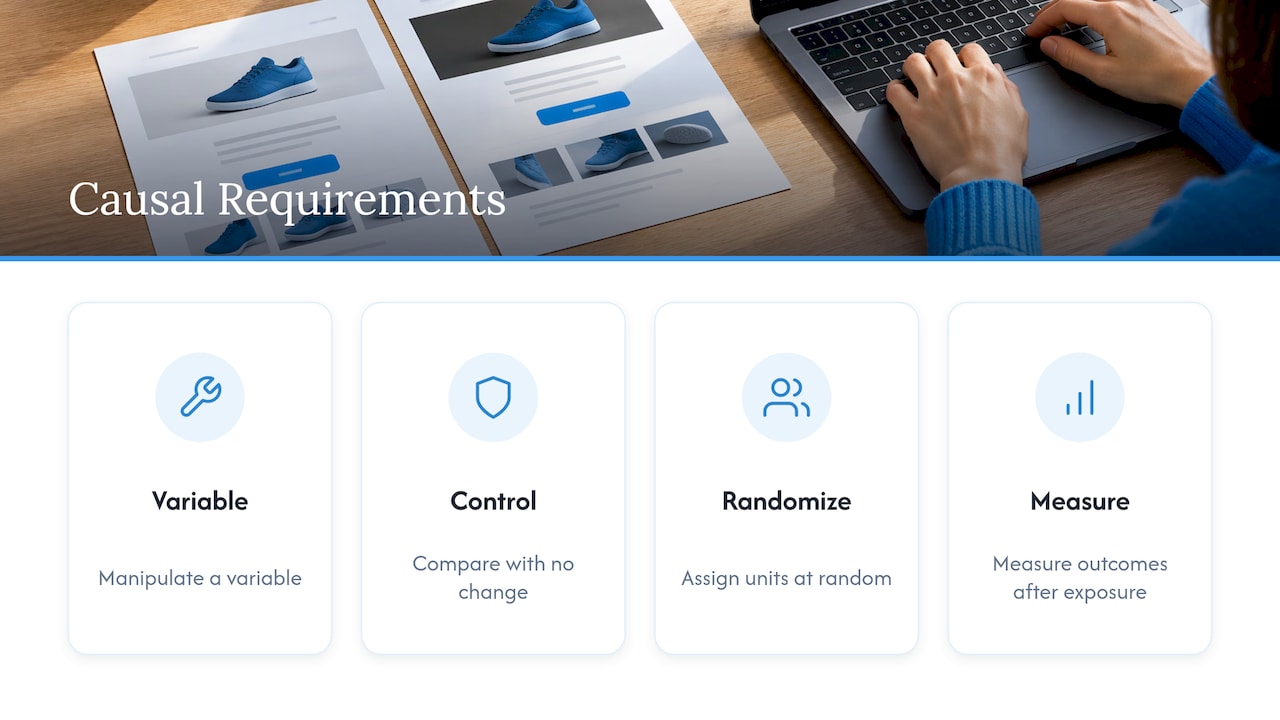
The control matters most. It shows what would have happened without your change. Random assignment protects you from selection bias, where the people who saw version B simply differed from the people who saw version A.
This is different from “launching a campaign and seeing what happens”. Before/after comparisons mix your change with seasonality, promotions, stock levels and competitor activity. A control group absorbs all of that.
Start with a test-and-learn framework
A test-and-learn framework is the routine that turns questions into experiments and results into decisions. The UK Government’s Test, Learn and Grow Playbook gives a clean version you can borrow:
- Identify your assumptions and pick the riskiest one.
- Turn it into a prediction: “If we…, then…, because…”
- Plan the method, success measures and decision criteria in advance.
- Interpret the evidence and decide: continue or scale, iterate, pause or stop.
- Feed what you learned into the next cycle.
A worked example for an eCommerce brand: “If we add a three-email abandoned basket flow with a reminder of free delivery, then basket recovery revenue will rise, because delivery cost is the most common reason shoppers leave.” The test group receives the new flow, the control keeps the existing one, and the success measure is revenue per recipient over 28 days.
The IPA’s 2024 report on making effectiveness work argues for a learning culture with formal learning agendas that connect evidence to decisions. It recommends a Model-Experiment-Simulate-Implement approach: use modelling to find opportunities, experiment on the change, simulate plans using the evidence, then implement and refine. For brands that want the modelling side, our guide to marketing mix modeling shows how it fits.
How to design the experiment, step by step
1. Write a focused hypothesis
Pick one variable. Think with Google’s experimentation playbook says to define the hypothesis, success metrics and intended actions before launch, and warns that changing goals during a test can invalidate the results. Where it goes wrong: teams test a new headline, image and offer together, win, and cannot say why.
2. Choose the metric that matches the decision
Use one primary metric tied to money or behaviour: purchases, booked calls, qualified leads, course enrolments. Click-through rate is a diagnostic, not a verdict. The academic checklist above also asks whether the outcome reflects actual behaviour, not just stated intent.
3. Build the control and the variation
The GOV.UK guidance on A/B testing says to create a control and a variation, test the variation against the original, and split the sample groups equally and randomly. Keep groups separate and non-overlapping, so nobody sees both versions.
4. Size the sample and set the duration
The same guidance notes that tests need many users to reach statistical significance. Sample size and duration should reflect monthly visitors, the behaviour change you expect and other factors. Small expected lifts need large samples. Practical rules:
- Run the test for whole weeks, so weekday patterns are even.
- Decide the end point before you start, and do not stop the moment a result looks good.
- Avoid launching during a sale or a major send you do not want in the data.
5. Pre-register the decision rule
The American Marketing Association’s planning workbook includes a prioritisation matrix, an experiment brief, a readiness check and a results tracker covering goal, audience, hypothesis, measurement, timing and decision rule. You do not need that exact template. You do need those fields written down: “If conversion rate rises by at least X with a confidence interval above zero, we roll out. If not, we iterate once, then stop.”
Choosing an A/B testing strategy
A/B testing compares versions of a design to see which performs better. The Magenta Book, the UK Government’s evaluation guidance, says A/B testing suits specific design features or delivery mechanisms, not whole programmes.
For marketers, that means matching test type to question:
| Question | Test type | Example |
|---|---|---|
| Which message or creative works better? | A/B test | Two ad hooks, two subject lines, two landing page headlines |
| Does a channel add sales that would not happen anyway? | Geo holdout | Pause paid social in matched regions and compare |
| Where should budget go across channels? | Modelling, calibrated by tests | Marketing mix model |
Ipsos MMA’s guide to marketing testing draws the same line between tactical A/B tests and channel-level incrementality, and warns that the wrong test type may not answer the business question.
Where to test first
Start where volume and revenue meet:
- Paid social and paid search creative. Hooks, formats and offers change quickly and cost little to test. Our creative testing framework lays out a weekly routine, and our guide to ad creative frameworks helps you match concepts to buyer temperature.
- Email and Klaviyo flows. Subject lines, send timing, flow length and incentives give clean A/B splits, and revenue per recipient is easy to read.
- Landing pages and copy. Test voice-of-customer language against internal phrasing. See our notes on conversion copywriting.
- Lead generation forms and sequences. For B2B, test form length, offer and follow-up cadence against qualified leads, not raw form fills.
Reading the results
Ipsos MMA recommends interpreting results through effect size and confidence interval, linking them to plausible business scenarios and giving explicit recommendations to scale, stop or iterate. The 2021 academic checklist makes a similar point: report effect sizes, not only p-values.
In practice:
- Scale when the lift is meaningful for the business and the interval stays clear of zero.
- Iterate when the direction is promising but the interval is wide. Refine the hypothesis and retest.
- Stop when the effect is flat or negative and the idea does not justify a second round.
A losing test is still a useful one if it was interpretable. Think with Google’s playbook treats an interpretable test as a success even when the change loses, because negative results still teach you something. The GOV.UK A/B guidance adds that inconclusive results mean revisiting the hypothesis and testing new variations.
Mistakes that make results unreliable
- Changing several variables at once.
- Moving the goal after launch.
- Overlapping test and control audiences.
- Calling a winner early because one version leads on day three.
- Measuring clicks when the decision depends on purchases or bookings.
- Ignoring attribution gaps. If platforms report different numbers, settle on one source of truth first. Our piece on marketing attribution models covers that.
The Magenta Book adds that iteration does not undermine rigour if you document changes, state assumptions upfront and involve analysts early.
When you lack traffic or cannot randomise
Smaller brands, course creators and service businesses often cannot reach significance on a landing page test. The Magenta Book suggests proportionate methods: interviews, short surveys and user journey mapping, combined with quantitative evidence. Practical options:
- Test bigger differences, such as an entirely different offer, so you need less data to see the effect.
- Test at the top of the funnel, where volume is higher, such as ad creative, and carry the learning down.
- Run a geo test with test and control regions. The DMA’s 2025 measurement guide describes comparing performance against prediction in both, and notes that it is not a simple A/B test and needs data-science input and historical data.
- Pair experiments with modelling. Ipsos MMA describes tests as causal evidence in a specific context and modelling as the view across the portfolio, with test results calibrating the model.
The IPA also notes that no single measurement approach answers every strategic, campaign and tactical question. If you want to see how experiments link to wider effectiveness planning, this playbook on measuring and maximising ROI shows the same evidence-first thinking applied to property marketing.
Building a monthly test calendar
A calendar turns one-off tests into a habit:
- List ten ideas and score each on expected impact, confidence and effort.
- Run one to three tests per channel at a time, never overlapping on the same audience.
- Review every four weeks: what was learned, what rolls out, what comes next.
- Keep a log with hypothesis, setup, result and decision, so the next person does not repeat a failed idea.
The discipline is in the log. Without it, a team re-tests the same ideas every year.
Why the experiment gets better with one team
Most failed experiments fail in the handoff. The ad agency tests creative, the email freelancer tests subject lines, the web developer ships a page change, and nobody owns the question. Results collide, tracking differs and learning stays inside each vendor.
Our view
We design experiments around a business decision, not a channel. A paid social test on a hook only matters if the landing page, the email follow-up and the tracking can carry the result through to purchases or bookings. That is why we keep strategy, creative, performance marketing and web development under one roof.
With one senior team, the hypothesis, the creative, the build and the measurement come from the same plan. There is no waiting for another vendor to change a page, and no argument over whose numbers are right.
Our approach rests on clarity, nimble execution and data. We write the decision rule before launch, test one variable at a time and report what we will scale, iterate or stop. Clients such as FACEGYM have seen a 50% increase in purchases and a 41% rise in bookings working this way.
Alex
Run your experiments with one integrated team
If you want a test plan that covers paid media, email, CRM and your website together, we can build it with you. Our team covers digital marketing strategy, paid social, email marketing, Klaviyo and CRM management, creative and web development, so each experiment has one owner from hypothesis to rollout.
Tell us the decision you need to make, and we will help you design the test that answers it. You can start from our homepage.
FAQ
How long should a marketing experiment run?
Long enough to reach the sample size you estimated, and in whole weeks so weekday patterns balance out. The GOV.UK A/B testing guidance says duration should reflect monthly visitors and the behaviour change you expect. Set the end date before launch.
How many things can I test at once?
Test one variable per experiment so you know what caused the change. You can run several experiments at the same time if their audiences do not overlap. Think with Google’s playbook recommends separate, non-overlapping groups.
What is the difference between A/B testing and a geo holdout?
An A/B test compares two versions of a message or design with randomly split users. A geo holdout compares regions where activity runs with matched regions where it is paused, which answers channel-level questions about incremental sales. Ipsos MMA says using the wrong one may not answer your business question.
What if the test result is inconclusive?
Revisit the hypothesis and test a new variation, as the GOV.UK guidance advises. Often the change was too small to detect, so try a bolder version or test higher in the funnel where volume is greater.
Sources
- How to design good experiments in marketing (2021)
- Test, Learn and Grow Playbook, GOV.UK
- IPA: Making effectiveness work
- Think with Google: marketing experiment playbook
- A/B testing: comparative studies, GOV.UK
- AMA Marketing Experiment Planning Workbook
- The Magenta Book: Test and Learn, GOV.UK
- Ipsos MMA: What is marketing testing and experimentation?
- DMA Guide to Best Practice Measurement 2025