Photo by Chris Vasquez on Unsplash
A 30-day optimisation plan won’t prove a Performance Max campaign is fully mature, but it can expose weak structure and establish a sharper testing rhythm. The strongest Performance Max campaign best practices for e-commerce start with a controlled sequence: organise campaigns around product economics, group assets by category and intent, align budgets and bidding with conversion data, and measure revenue accurately.
It’s understandable to want quick clarity when campaign spend and sales aren’t moving in step. But reacting to every early performance change can disrupt learning before the data is useful. These five actions give you a more disciplined way to decide what to adjust, what to measure and what to leave alone.
Over 30 days, the plan moves from campaign structure and asset groups to budget, bidding and revenue tracking. Performance Max typically needs 4 to 6 weeks for its initial learning phase, so treat this as a focused optimisation cycle, not a promise of settled results. The aim is clearer decisions and a stronger basis for the next round of optimisation.
Key Takeaways
- Structure campaigns around product margins and conversion volume, rather than splitting the catalogue without a clear reason.
- Group assets by category, intent and price to keep each group relevant to its products.
- Make budget and bidding changes in measured steps, then allow time to assess their effect.
- Track conversion value accurately so bidding can respond to revenue, not just order volume.
- A sequenced 30-day plan help prioritise feed checks, audience reviews and creative tests without treating early results as final.
1. Campaign structure based on product margins and conversion volume
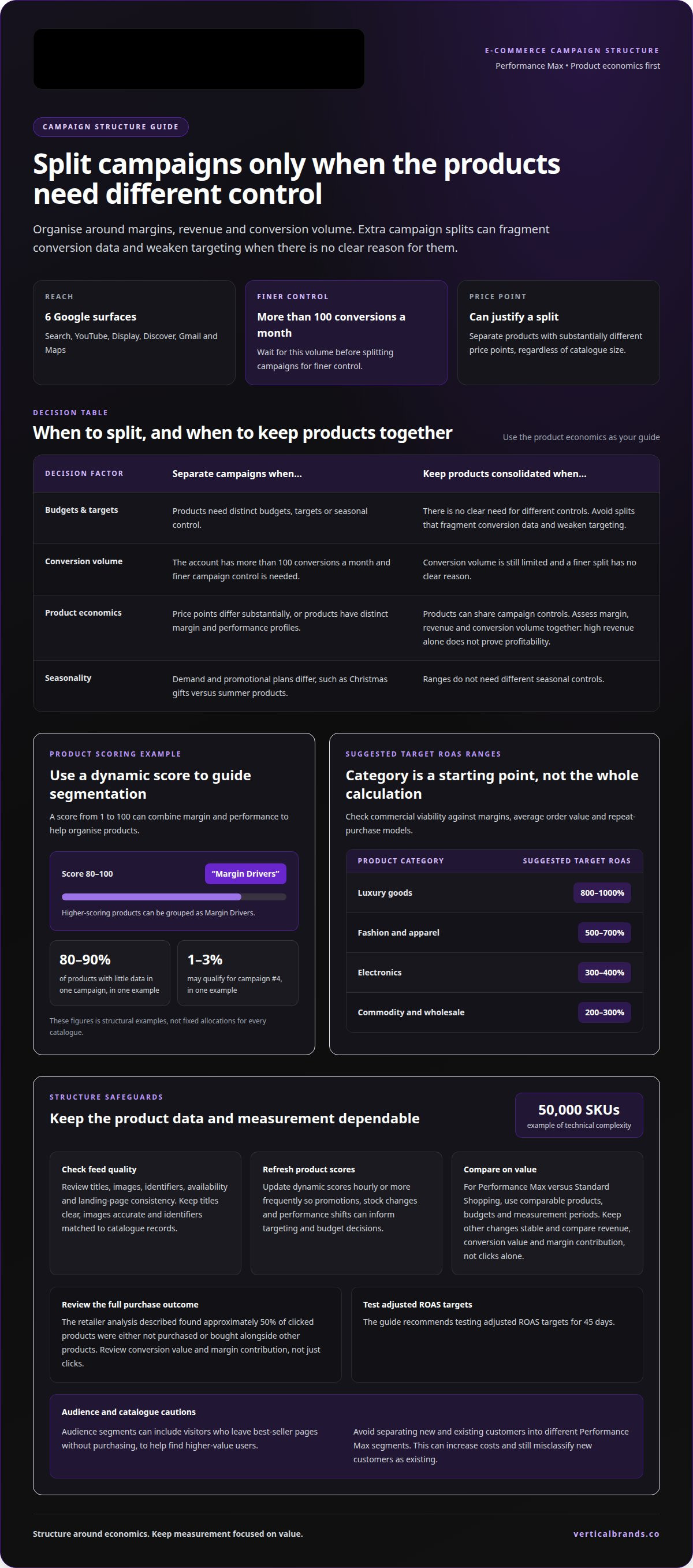
For retailers applying Performance Max campaign best practices for e-commerce, campaign structure should reflect product economics. Performance Max reaches Google inventory across Search, YouTube, Display, Discover, Gmail and Maps. Separate campaigns when products need distinct budgets, targets or seasonal control. Otherwise, extra splits can fragment conversion data and weaken targeting.
Wait until an account has more than 100 conversions a month before splitting campaigns for finer control. Separate products with substantially different price points regardless of catalogue size. Assess margin, revenue and conversion volume together. A high-revenue product may still be unprofitable if its margin is low. UK retailers can also separate seasonal ranges when demand and promotional plans differ, such as Christmas gifts and summer products.
Product-level segmentation can use a dynamic score from 1 to 100, combining margin and performance. Products scoring 80-100 can sit in a “Margin Drivers” group, while weaker or less-proven products stay consolidated. In one approach, 80-90% of products with little data remain in one campaign, whilst 1-3% may qualify for campaign #4. Treat these as structural examples, not fixed allocations for every catalogue.
Feed quality determines whether the structure can work. Review product titles, images, identifiers, availability and landing-page consistency. Titles should identify each product clearly, images should show it accurately, and identifiers should match the catalogue record. Review feed titles and identifiers regularly. Update dynamic product scores hourly or more frequently, so promotions, stock changes and performance shifts inform targeting and budget decisions.
Set Target ROAS in context, not by category alone. Suggested ranges are 800-1000% for luxury goods, 500-700% for fashion and apparel, 300-400% for electronics, and 200-300% for commodity and wholesale products. Margins, average order value and repeat-purchase models still determine whether a target is commercially viable. This is a core consideration in Performance Max campaign best practices for e-commerce.
To compare Performance Max with Standard Shopping, run a controlled experiment using comparable products, budgets and measurement periods. Keep other campaign changes stable, then compare revenue, conversion value and margin contribution rather than clicks alone.
Resolve common risks through a consistent diagnostic review. Check feed errors, product disapprovals, stock and landing-page mismatches, then address issues before judging performance. Review seasonal availability and creative relevance, too. Accurate assets and product messaging keep campaigns aligned with the range being promoted.
A further check is whether apparent product interest leads to meaningful orders: the retailer analysis described on the page found that approximately 50% of clicked products were either not purchased or were bought alongside other products. This reinforces the value of reviewing conversion value and margin contribution rather than clicks alone. The guide recommends testing adjusted ROAS targets for 45 days.
Technical limits can also shape campaign structure. The page gives 50,000 SKUs as an example of a catalogue size for which calculating scores and pushing updates can create technical difficulties. It describes four common approaches to structuring Performance Max campaigns, from entry-level setups to advanced, data-driven strategies. Audience segments can include visitors who leave best-seller pages without purchasing, to help find higher-value users. Avoid separating new and existing customers into different Performance Max segments, as this can increase costs and still misclassify new customers as existing.
2. Asset group segmentation by category, intent and price
Build asset groups around meaningful differences in the products and message, not minor catalogue variations. A practical starting point is 2 to 4 asset groups per Performance Max campaign. For a UK homeware retailer, separate furniture from lighting when each category needs distinct imagery, product selection and messaging. A group should have a clear purpose and enough relevant inventory to support it.
Google Ads combines campaign settings, product listing groups and creative assets. Google AI uses those inputs to decide which combinations and placements may suit a customer. The campaign type sets the broad objective, while asset groups organise the products and material available for targeting. Strong settings cannot compensate for mismatched product data or generic creative.
Keep product eligibility clear. Listing groups define which items can serve, using feed attributes such as product type, brand or custom labels. Divide inventory into distinct groups and exclude items from groups where they do not belong. If the same products appear across overlapping groups, reporting becomes harder to interpret and the intended category distinction loses value.
Price and purchase intent also shape the message. A premium coat and an entry-level accessory may belong to the same broad category, but they need different creative and value propositions. Build groups where product price points, buying considerations or promotional messages differ materially. Keep each group’s headlines, descriptions and imagery aligned with its products, rather than using one generic message across unrelated inventory.
Review asset performance alongside revenue and product-level results. Google Ads insights can show which combinations are serving, but asset labels alone do not establish profitability. A strong image may attract attention while the product converts poorly; assess the whole path from advert to purchase. Replace weak or outdated creative with relevant alternatives, then give the revised group time to generate comparable data. Test asset group restructuring for 60 days before drawing firm conclusions.
Brand traffic requires separate oversight. Review search terms and campaign reporting to understand where branded demand appears, then avoid running non-brand Search and Performance Max campaigns against the same products at the same time. Check placement and product-level results together, so overlap or shifting revenue is not mistaken for incremental growth.
For a creative refresh, UGC creative production can supply customer-style assets suited to a specific product group. Each asset groups should reflect one coherent category, price position or intent, giving both the messaging and inventory a clear role.
For a retailer selling $2,000 suits, separate those products from lower-priced products in a Performance Max campaign. Give the suits creative that reflects their premium positioning, while keeping lower-priced products in a group with messaging suited to their own value proposition. This makes it easier to assess whether the product selection and assets are aligned, rather than blending unlike items into one broad group. Apply the same logic when buying considerations differ substantially: preserve a clear connection between the products in a group and the message shown with them. If the distinction no longer reflects the catalogue or offer, revise the grouping and check results across products and revenue.
3. Budgeting and automated bidding strategies
Set the budget against the campaign goal, not an arbitrary spend target. For a shopping campaign focused on revenue, assess product margins, average order value and the conversion volume needed to guide bidding. A budget that cannot generate enough relevant purchase data can restrict automated decisions. Forecast using actual account performance, expected demand and stock availability, then compare projected spend with the revenue target.
Use campaign insights to identify where additional budget could support profitable demand. Review conversion value, costs and order patterns across products before reallocating spend. A high-performing campaign may merit more investment, but only if its margin can support the resulting acquisition cost. These forecasts are planning tools, not a reason to assume every extra pound will produce the same return.
Automated bidding responds to the conversion goals and values it receives. Before setting a Target ROAS, allow the campaign to generate 30 to 50 conversions in the past month, or complete at least three full conversion cycles, whichever takes longer. A target set too early can constrain delivery before the system has a useful pattern. Choose a goal that reflects commercial priorities, such as revenue efficiency, rather than chasing volume alone.
Change bidding strategies with discipline. After an adjustment, allow 1 to 2 weeks for its effect to play out before making another major change. Frequent edits can make it harder to distinguish a real performance shift from campaign adjustment. During that period, review spend, conversion value and the proportion of budget used, alongside any changes in product availability or demand.
Scale gradually. Increase a Performance Max budget by 10% to 20% at a time, then wait 7 to 14 days between budget changes. This gives performance time to respond and creates a cleaner basis for the next decision. Doubling a budget in one move has been shown to raise CPA by 25% to 50%; ROAS can also fall for one to two weeks before recovering. A large budget jump may therefore distort short-term results.
For a seasonal retailer, forecast around the promotion calendar and product stock. Allocate more only where expected demand, margins and available inventory support it. If the goal changes from acquiring new customers to improving revenue efficiency, align the campaign’s conversion goal and bidding approach before reallocating spend. That keeps each budget decision relevant to the business objective.
During a 30-day optimisation cycle, avoid changing the budget, bidding strategy and campaign goal simultaneously. Adjust one major variable, document the date and compare the following period with the previous baseline. That sequence makes it easier to see which intervention influenced results, and prevents automatic bidding from being judged on an unstable comparison.
4. Revenue-based conversion tracking and value-based bidding
Performance Max can only optimise towards the conversion signals it receives. For e-commerce, configure purchase tracking to pass transaction value and currency, not simply a completed-order count. A sale worth more should carry a higher value signal, while cancelled or duplicate transactions should not inflate reported revenue. This gives bidding a clearer commercial objective across Search, Shopping and Display inventory.
Before launch, review the purchase event from product page to confirmation page. Confirm that the event fires once, records the correct order value and uses GBP consistently. Check how discounts, delivery charges and VAT appear in the recorded amount. Choose a consistent value basis that matches the retailer’s revenue reporting, then keep it stable across campaigns and channels. These checks make the first performance signals more useful.
For UK e-commerce, promotions and delivery charges can alter the amount paid without changing the product’s underlying margin. Ensure discounted orders report the actual transaction value, and decide consistently whether delivery is included. Align VAT treatment in the feed, analytics and conversion data with the business’s chosen revenue measure. Otherwise, a campaign may appear to produce stronger revenue simply because reported values include components treated differently elsewhere.
Target ROAS suits campaigns where order values vary and revenue efficiency matters. Set the target against historical conversion value and allowable acquisition costs, not an aspirational figure alone. Use the data threshold from the bidding plan: consider Target ROAS after 30 to 50 conversions in the past month, or at least three full conversion cycles, whichever takes longer. Target CPA focuses on the cost of each conversion; for ecommerce with variable basket values, it can overlook differences in order value.
Conversion volume also affects campaign structure. If a campaign has fewer than 30 conversions per month, consolidate campaigns or consider alternatives rather than splitting signals across thin segments. A larger pool can give automated bidding more purchase information, whilst unnecessary splits can leave individual campaigns with too little data. Keep the conversion action consistent when assessing whether a campaign has enough volume.
Value rules can reflect differences between customer groups or regions when those differences are supported by business data. For example, a retailer may assign a 2× conversion-value multiplier to new customers to account for lifetime value. Apply such a rule only when the customer classification is reliable, and avoid counting an existing purchaser as new. Regional adjustments should likewise reflect measurable differences in value, not assumptions about location.
Linking Google Ads with Google Analytics 4 can provide additional campaign insights. Compare reported purchases, conversion value and revenue trends across both systems, then investigate material discrepancies before changing the bidding strategy. A specialist can also distinguish a tracking fault from a genuine change in performance, helping ensure the campaign optimises towards meaningful sales rather than incomplete signals.
5. A 30-day Performance Max optimisation plan
Use the first days to establish a reliable baseline, not to force immediate change. A Performance Max campaign typically needs 4 to 6 weeks for its initial learning phase, with full optimisation and stable performance taking 60 to 90 days overall. A 30-day cycle is therefore a structured review, not a final verdict. The specialist records campaign goals, conversion values, budgets and seasonal factors before changing settings.
At the start, the specialist reviews feed health and campaign delivery. Weekly product-feed audits help identify missing attributes, availability mismatches and disapproved products before they distort results. Newly launched products should enter the feed within 24 hours of launch, so the campaign can represent current inventory. Dynamic product scores need updating daily or more frequently where stock, promotions or performance shifts quickly.
During the first part of the cycle, check that audience signals reflect valuable customers and relevant shopping behaviour. These signals guide the algorithm, but they don’t restrict it to those audiences. Review audience signals monthly, and keep useful first-party groups aligned with the retailer’s customer data. Avoid abrupt structural edits during learning unless tracking, feed quality or policy restrictions demand immediate correction.
Next, test creative themes across the full 30 days. The specialist can compare distinct messages, product benefits and images, including assets suited to YouTube and other Google inventory. Keep the product offer and campaign settings stable during a creative test, so results are easier to interpret. Changing several asset groups and budgets together makes it harder to identify which adjustment affected performance.
As the cycle progresses, review spend, revenue, conversion value and product availability against the baseline. Account for seasonal changes before pausing or reducing a campaign. A short-term dip during a promotional transition may reflect demand or stock movement, rather than a failing algorithm. Record each intervention and its timing. This creates a clear decision trail for the next optimisation period.
At the end of 30 days, separate confirmed issues from early signals. Keep effective changes, reverse interventions that weakened results, and carry unresolved tests into the next cycle. The campaign may still be learning, so avoid treating one month as proof of stable performance. The strongest optimisation plan is disciplined, documented and responsive to actual revenue, not daily fluctuations. A rushed review can lead to changes that obscure the underlying trend.
Need a managed review of your campaign structure, signals and creative? Plan your next optimisation cycle.
Vertical Brands
Vertical Brands helps e-commerce businesses turn campaign analysis into a coordinated growth plan. If your Performance Max structure, revenue tracking or bidding strategy needs professional oversight, its Paid Search service aligns campaign decisions with commercial objectives. Paid Social and Email Marketing & CRM Management can support a wider view of customer acquisition and retention, rather than treating each channel in isolation.
Bring your campaign goals, product priorities and available performance data into the conversation with Vertical Brands. The team can use that context to shape a practical next step around your needs. Strong campaign decisions depend on accurate signals and a clear view of how paid activity contributes to revenue, with both working together.
Contact Vertical Brands to discuss your ecommerce campaign.
Make the next decision count
A 30-day review is most valuable when it creates a clear next move, not another round of reactive adjustments. Use what the campaign has revealed to set priorities for the next phase: where to refine the proposition, which customer signals deserve attention, and how paid activity fits your wider growth plan. Effective Performance Max campaign best practices for e-commerce depend on keeping those decisions connected to commercial goals, rather than treating campaign metrics in isolation.
That wider view can include how customer acquisition connects with retention. Klaviyo Email Marketing can support relevant follow-up after a purchase, while a coordinated marketing strategy helps teams make better use of customer relationships. Campaign performance and customer value together make the next decisions clearer.
If you want experienced input on your campaigns and the next steps, contact Vertical Brands. Build on the work already done, and move into your next optimisation cycle with purpose.