A checkout email address isn’t, by itself, permission to send marketing. Effective e-commerce email opt-in strategies make the choice clear, explain the value of subscribing and capture consent without making a purchase feel conditional.
In the UK, a shopper can actively opt in through an unticked consent box. PECR also allows the soft opt-in for existing customers when its conditions are met, including marketing similar products. The right approach depends on how the address was collected and what the customer agreed to receive.
That distinction matters. A larger list is useful only when subscribers understand why they’re hearing from you and receive emails that match their interests. Clear permission and relevant follow-up are the foundation.
This article explains what email opt-in means and how checkout consent, timely offers, segmentation and personalisation can support list growth. It also shows how these elements work together to build a list with a clear purpose, not just more names.
Key Takeaways
- Understand when the UK soft opt-in may apply and why an email address alone does not equal marketing consent.
- Use a clear, unticked checkout box so customers can choose whether to receive marketing emails.
- Time exit-intent and abandoned-cart messages around customer behaviour, with offers that give a relevant reason to subscribe.
- Make homepage pop-ups purposeful: explain the benefit of signing up and avoid letting discounts become the only reason to join.
- Segment subscribers by their interests and behaviour, then tailor messages so the content match what they’re likely to value.
1. What does soft opt-in mean in UK email marketing?
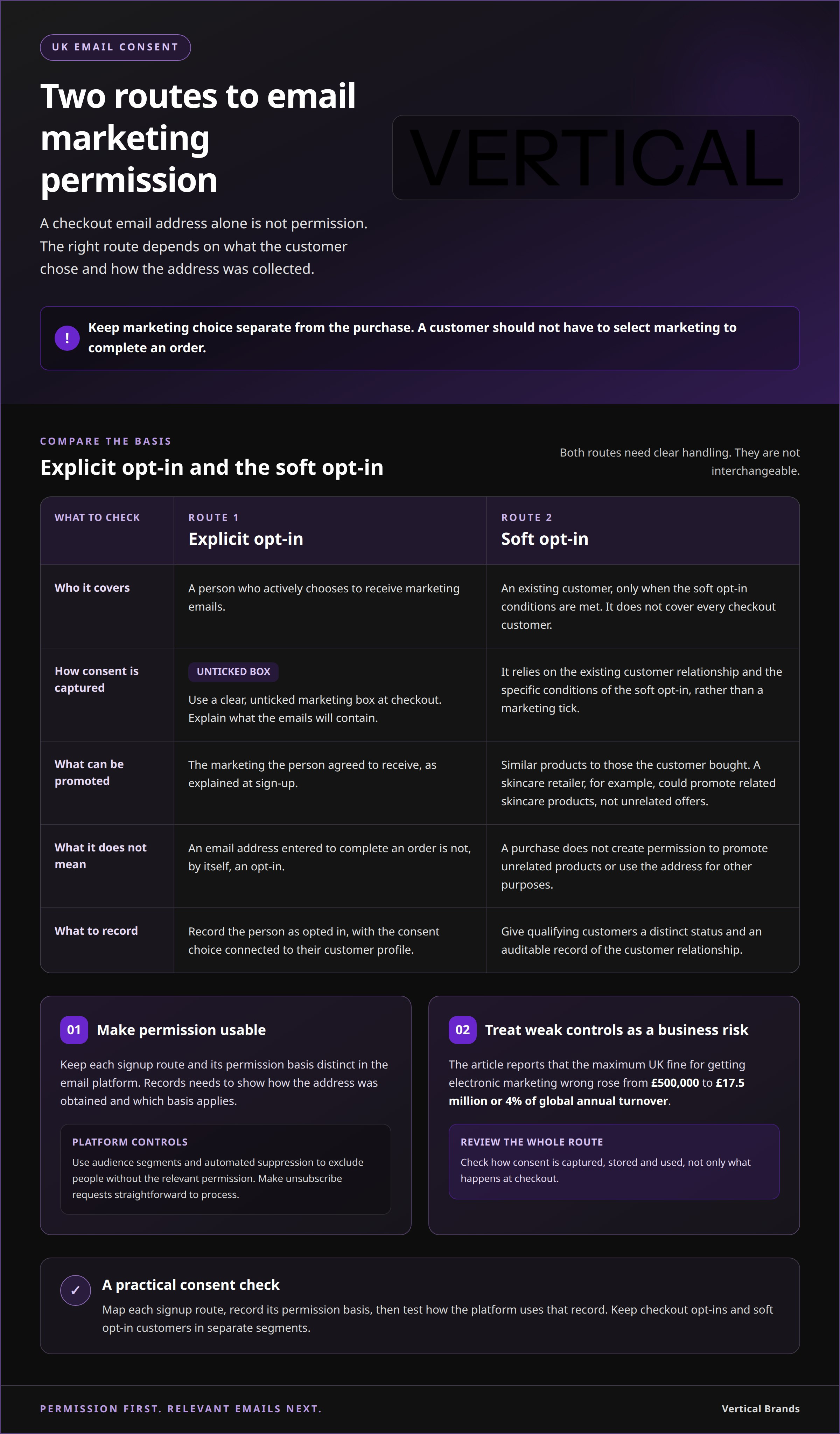
An email opt-in records a person’s agreement to receive marketing emails. In the UK, PECR also permits businesses to email existing customers without explicit prior consent when the soft opt-in conditions are met. This is a limited route, not permission to add every checkout customer to a mailing list.
The soft opt-in applies to marketing similar products to those a customer bought. For example, a skincare retailer might use it to promote related skincare products. The customer relationship and the nature of the marketing matter: a purchase alone doesn’t create permission to promote unrelated offers or use an address for other purposes.
The Data (Use and Access) Act 2025 left the UK commercial soft opt-in intact and extended a version of it to registered charities, according to UK Parliament. That change did not remove the need to distinguish existing customers from people who have only browsed or abandoned a basket.
Permission matters because subscribers should understand what they’ll receive and why. An explicit opt-in gives a business a clear record of someone choosing marketing, while the soft opt-in relies on specific conditions. Respecting this distinction supports relevant email marketing and reduces the risk of complaints from people who didn’t expect promotional messages.
Effective consent management starts by separating permission types in the email platform. Someone who ticks an unticked marketing box can be recorded as opted in. A qualifying existing customer covered by the soft opt-in needs a distinct status and an auditable record of the customer relationship. Records need to show how the address was obtained and which marketing basis applies.
Choose a platform that supports these records, audience segmentation and automated suppression. For example, customer groups can be configured so promotional campaigns exclude people without the relevant permission. The platform should also make unsubscribe requests straightforward to process and keep consent data connected to the correct customer profile. These controls make segmentation operational, not just a campaign-planning exercise.
PECR penalties make weak controls a material business risk. The maximum UK fine for getting electronic marketing wrong rose from £500,000 to £17.5 million or 4% of global annual turnover. A professional review should therefore examine how consent is captured, stored and used, rather than focusing only on conversion at checkout.
A practical process maps each signup route, records the permission basis, then tests how the platform uses that record. A checkout opt-in and a soft opt-in customer shouldn’t be treated as interchangeable segments. This structure helps teams automate campaigns around valid permission and keep marketing emails aligned with each customer’s relationship to the business.
2. How can a professional help an ecommerce store collect email consent at checkout?
A professional maps each checkout step, from the email field to the order confirmation. Effective e-commerce email opt-in strategies keep the marketing choice separate from transactional messages, using an unticked box and clear wording. For example, “Receive product news and offers by email” explains what subscribers will receive. The purchase shouldn’t depend on selecting it. The specialist also checks how the choice appears on mobile, where a crowded checkout can make the wording harder to notice.
An incentive can give shoppers a clear reason to subscribe. Show the offer beside the signup choice, not in small print. Connect it to the signup flow and define when it’s sent. This helps prevent an offer being promised before the address and subscription choice have been recorded correctly.
Placement matters. A checkout prompt reaches customers completing an order, while a footer newsletter form gives visitors another way to join. Make the footer form visible across key pages and explain its value, such as daily or weekly deals and product updates. It works as a backup rather than the only collection point, since visitors can easily overlook a footer.
Text-to-join can support sign-ups beyond checkout. For example, a shopper scans a QR code at an event, opens a mobile signup form and enters an email address. The form explains the newsletter benefit and presents a separate, unticked marketing choice. Connect that source to the email platform so the subscriber record shows how the person joined.
The process also includes the message sent after signup. A double opt-in flow sends a follow-up email asking the subscriber to verify their address. The confirmation page explains what happens next, while the welcome email delivers the promised offer or updates. Test the signup form and confirmation message together across mobile and desktop before launch.
Measurement completes the setup. Track which entry point attracts engaged subscribers, not just form completions. Compare checkout, footer and text-to-join records by source and later engagement. If an incentive brings sign-ups but little response to subsequent emails, its offer or placement may need adjustment. Well-designed e-commerce email opt-in strategies connect performance data to practical refinements without making checkout more intrusive.
For coordinated forms, signup sources and follow-up messages, professional email consent management can align the collection process with the email platform.
3. Exit-intent and abandoned-cart offers
An exit-intent prompt can respond when a shopper appears ready to leave a product page. A professionally managed offer matches the item viewed, rather than presenting a generic discount to every visitor. For example, a related product with free shipping may give the shopper a relevant reason to continue. A limited free-shipping promotion can run for 24 hours, with its terms and expiry stated clearly.
Abandoned-cart automation starts with a defined event: a shopper adds an item, enters checkout, then leaves without completing the order. The email platform can use that behaviour to start a sequence, while checking for a completed purchase before each send. This prevents reminders about a basket the customer has already bought. The setup should also distinguish cart reminders from general promotional campaigns.
Timing shapes the sequence. A first reminder can be sent within an hour of abandonment, while a follow-up can arrive over the next 24-48 hours. A possible third message can follow 3-5 days after the initial abandonment. Each message needs a distinct purpose, such as showing the saved items first, then addressing delivery or product questions.
Offers should support the decision, not train every shopper to wait for a discount. A first reminder might simply link back to the basket. If a later message includes an incentive, limit it to the relevant audience and communicate its conditions plainly. A free-shipping offer related to the basket may be more suitable than reducing the price of every product.
About 70 out of every 100 shopping carts are abandoned, so the sequence needs controls as well as persuasive copy. A professional configures suppression rules for completed orders, unsubscribed contacts and people who have already received the planned messages. They also review bounce and complaint signals, since repeated or poorly targeted sending can damage deliverability.
Exit-intent and cart messages serve different moments. An exit prompt appears before a visitor leaves; an abandoned-cart email follows a recorded checkout event. Test the trigger and message across mobile and desktop, including the basket link, product details and offer terms. Review engagement and recovered orders by message, timing and incentive to give the e-commerce team evidence for refinement rather than relying on blanket discounts.
4. Homepage pop-ups and first-purchase offers
A homepage pop-up can turn a first visit into a subscriber relationship, but timing affects the experience. A professional might test an eight-second delay against a prompt shown after a visitor scrolls through 60% of the page. These are starting points for experiments, not fixed rules. The best trigger depends on how quickly shoppers find useful products and whether the prompt interrupts browsing.
The offer needs a clear connection to the next purchase. A 10% welcome discount can give a new subscriber a direct incentive, with the code displayed on the signup success page. Another test might compare that offer with useful product updates and no discount. This reveals whether shoppers value savings, information or a combination before they join the list.
A/B testing works best when you change one element at a time. Compare two headlines, then test button wording, form length or offer presentation. For example, “Get product updates” and “Unlock a welcome offer” make different promises. Track completed sign-ups and later purchase behaviour, not just clicks. Otherwise, a high-converting form may attract subscribers who never engage.
Consent remains part of the design. The signup form should identify email marketing clearly and make the choice active, rather than bundling it into another action. The success page can confirm the subscription and explain the next step. On mobile, make sure the form, close control and call to action remain usable without covering essential product information.
Spin-to-win forms add a game mechanic, often presenting different rewards through a digital wheel. Test this channel against a straightforward signup form, then assess whether the interaction attracts suitable subscribers. Make the reward clear before entry, and explain how the offer works in the terms. Shoppers shouldn’t have to guess what joining means or what they might receive.
Discount frequency also needs a deliberate plan. Some experts suggest offering coupons at most once a month, helping prevent visitors from expecting a fresh reduction on every visit. A specialist can test a first-purchase incentive against non-discount benefits, then review sign-ups alongside subsequent orders. A 4% pop-up conversion rate appears as a suggested target in some advice, but results depend on the offer, audience and placement. The results gives the team a basis for refining the form, rather than relying on a single headline metric.
5. Segmentation and personalisation
Segmentation turns customer data into distinct audiences for relevant campaigns. Group subscribers by product interest, purchase history, browsing behaviour or engagement with previous messages. For example, a customer who buys running accessories can receive updates about related products, while a first-time skincare shopper sees content from that category. These groups make campaign planning more precise. Each segment receives messages suited to its behaviour, rather than identical promotions sent to the entire list.
Personalisation then adapts the content within each campaign. A specialist can use a subscriber’s product category, previous order or location to shape recommendations and calls to action. One email might highlight accessories related to a recent purchase; another can feature products matching a recorded interest. Personalised subject lines can make emails 26% more likely to be opened. The value comes from matching the detail to the customer, not inserting a name into every message.
Pop-ups can use similar signals before a visitor subscribes. Tailor the prompt to viewed categories, pages visited or time spent on the site. Someone browsing a particular product range could see an offer linked to that interest, while another visitor receives a broader newsletter invitation. Country-specific messaging can also make an offer more relevant. Test the rules against the customer experience so pop-ups support browsing rather than obstruct it.
Measurement needs to connect personalisation with business outcomes. A team can compare open and click behaviour, conversion rate, unsubscribes and revenue across segments. Personalised calls to action are associated with conversion rates increasing by 202%, while 71% of consumers expect personalised experiences from businesses. These figures indicate why relevance matters, but campaign results depend on the audience and execution. Professionals use performance data to refine segments and creative, rather than treating one result as a universal forecast.
Strong practices also include maintaining useful segment definitions and updating them as behaviour changes. A lapsed buyer, an active repeat customer and a recent subscriber need different messages. Suppression rules can prevent irrelevant promotions, such as acquisition offers reaching existing customers. For a structured implementation, commission personalised email campaigns that align segmentation, content and measurement. This gives each campaign a defined audience, purpose and conversion signal to assess.
Vertical Brands
Vertical Brands helps e-commerce businesses turn consent-led sign-ups into a structured growth channel. Its Klaviyo Email Marketing and Email Marketing & CRM Management services connect signup sources, subscriber segments and relevant campaigns. Paid Social and Paid Search can complement this work by aligning acquisition activity with the customer journey.
Consider professional support when checkout consent, pop-ups and follow-up messages operate separately, or when your email platform isn’t using customer data effectively. A coordinated approach makes it easier to manage signup records and build campaigns around permission and relevance.
Contact Vertical Brands to discuss your ecommerce email opt-in requirements.
Build a permission-led growth system
The next stage is making email consent a dependable part of your customer experience. Treat the signup journey as an operating system, not a collection of disconnected forms. Set a clear purpose for each channel, define how subscriber data supports relevant communication, then review whether the approach still fits as your product range and customer behaviour change. A disciplined approach to e-commerce email opt-in strategies connects acquisition with lasting customer relationships.
Professional support can help bring that system together. Vertical Brands offers Klaviyo Email Marketing and Email Marketing & CRM Management to support campaign delivery and customer data management. Paid Social can also align acquisition activity with the audiences and messages your email programme serves. The next step is to identify where your current process needs structure, then decide what a more coordinated setup should achieve.
Contact Vertical Brands to discuss email marketing. A clear plan gives your team a practical foundation to build on.
Frequently Asked Questions
What is an opt-in email?
An opt-in email is a marketing message sent to someone who has agreed to receive promotional communication. Depending on context, the term can also describe an email used to confirm a subscription. For example, a welcome message might confirm the type of updates a subscriber selected. Businesses should distinguish marketing permission from messages needed to process an order, such as an order confirmation or delivery update.
How can an email marketing provider help businesses encourage opt-ins?
An email marketing provider can plan signup journeys, configure forms and connect subscriber data to relevant campaigns. For instance, a business might use different signup prompts on product pages and in its newsletter footer, then compare the quality of subscribers each source attracts. Vertical Brands offers Klaviyo Email Marketing and Email Marketing & CRM Management to support platform management, campaign planning and customer data organisation. The aim is a clear process from signup to useful follow-up.
How can a professional help an ecommerce store collect email consent at checkout?
A professional can review the checkout journey, position a distinct marketing choice and ensure the form records the customer’s selection accurately. They can also test how that selection appears in the store’s customer records and email platform. For example, a completed purchase without a marketing choice shouldn’t be mistaken for a newsletter subscription. The checkout wording, confirmation flow and data transfer all need to work together, especially across mobile and desktop journeys.
What are the benefits of using an opt-in strategy?
An opt-in strategy gives a business a clearer basis for building an audience of people who chose to hear from it. That makes it easier to plan communications for subscribers rather than treating every customer as a marketing contact. It also provides insight into which signup sources attract engaged readers. A retailer can use that insight to prioritise the forms and messages that bring in subscribers who interact with its content.
What does soft opt-in mean in UK email marketing?
Soft opt-in is a limited route for sending marketing emails to existing customers without explicit prior consent, provided its conditions are met. It applies to similar products or services and involves giving customers a clear opportunity to refuse marketing when their details are collected and in later messages. For example, a customer buying a product may receive marketing about related items, but that doesn’t automatically justify unrelated promotions.
What is a Double Opt-in?
Double opt-in is a subscription process with an additional confirmation step. After submitting a signup form, the person receives a follow-up email and must use its confirmation link to complete the subscription. For example, someone entering an address on a newsletter form remains unconfirmed until they click the link. This can help catch typing errors and establish that the person controlling the inbox completed the signup.
What is the Soft Opt-In?
The soft opt-in is a UK email marketing exception for certain existing-customer relationships, not a form setting or an alternative name for double opt-in. It can apply when a business obtained contact details during a sale or sales negotiation, markets its own similar products, and offered a clear way to refuse at collection and in each message. Keep the relevant customer relationship and marketing context distinguishable in business records.
What is the difference between single opt-in and double opt-in?
With single opt-in, a person joins after submitting the signup form. Double opt-in adds a confirmation email, and the person joins only after completing that extra step. The first method creates less friction; the second adds a verification action that may screen out mistyped addresses or unconfirmed sign-ups. Choose a process based on your audience, signup experience and the quality controls you need.