Photo by Luisa Brimble on Unsplash
Facet order shapes SEO as much as the filters themselves. Ecommerce catalogues, property listings, travel search pages and job boards use faceted navigation to help people narrow large sets of results. But when the same selections create different URLs depending on their order, pages can multiply and make crawling harder to control. Strong faceted navigation SEO best practices start with deciding which combinations deserve a search landing page and which should stay out of the index.
Filters make browsing more precise, and useful filtered pages can match specific searches. The challenge is preserving that value without creating near-duplicate pages or sending crawlers through endless combinations. URL structure, canonical tags, indexation rules and internal links all affect the outcome.
This guide explains how to select indexable facets, manage crawl access and keep URL patterns consistent. It also covers how to order and combine filters so that applying the same choices in a different sequence does not create another URL. The objective is a controlled set of pages that serves search demand and users, rather than a catalogue of URLs that multiplies without purpose.
Key Takeaways
- A professional audit connect faceted URLs with crawl and indexation signals, helping identify where search visibility is being diluted.
- Filtered pages with distinct search value can be prioritised for indexation, while low-value or duplicate combinations need tighter controls.
- Consistent URL rules and canonical signals help search engines interpret filtered pages and avoid unnecessary duplication.
- Ecommerce, property, travel and job websites can all use facets, but each site needs controls suited to its catalogue and search behaviour.
- Keeping facet order consistent means the same filter choices lead to one URL, not several competing versions.
How should a professional SEO team assess your faceted navigation pages?
Google-focused recommendations start with control: make valuable filtered pages crawlable, give indexable pages a self-referencing canonical, and keep low-value combinations out of the index. Google Search Console and a technical site audit help an SEO team compare the URLs a site generates with those search engines crawl, index and surface.
Facets create URLs when someone selects product attributes such as colour, size and brand. Selecting “red” and then “size 9” can produce a different address from selecting those attributes in reverse. Add more attributes or multiple values within one filter, and a catalogue can generate thousands of URLs. The audit groups these patterns by parameter, filter combination and response, then identifies duplicates and pages with search value.
Google Search Console helps the team review indexed pages, search performance and individual URL status. The team compares pages receiving impressions with filtered URLs that are indexed but attract little search activity. A site audit then crawls the category and facet links, checking status codes, canonical tags, robots directives and internal links. For example, “red trainers” may merit a landing page, whilst “red trainers, size 9, sale” may simply repeat a broader result.
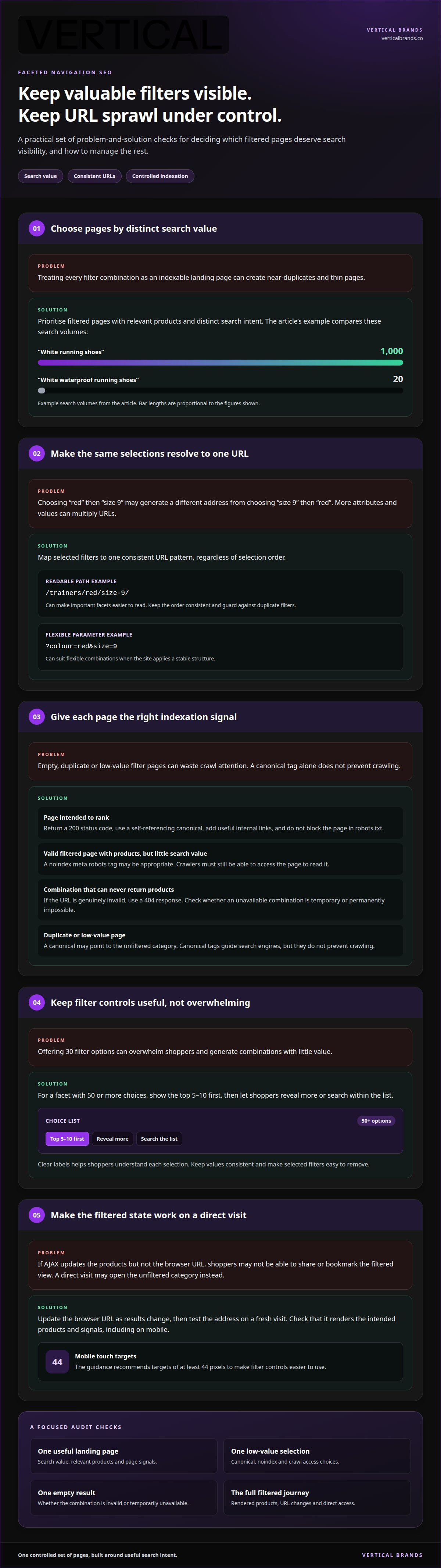
URL design affects both crawling and usability. Fixed paths, such as /trainers/red/size-9/, can make important facets easier to read, but require a consistent order and safeguards against duplicate filters. Query parameters, such as ?colour=red&size=9, suit flexible combinations when the site applies a stable structure. An SEO team maps the selected filters to one canonical URL pattern, rather than allowing different selection sequences to create duplicate addresses.
For pages intended to rank, the team checks that the URL returns a 200 status code, has a self-referencing canonical and is not blocked by robots.txt. For duplicate or low-value filtered pages, a canonical may point to the unfiltered category. Canonical tags guide search engines; they don’t prevent crawling. Where a page must stay out of search results, the team assesses a noindex directive instead.
AJAX filters should update both the visible results and the browser URL. This makes a filtered view bookmarkable and shareable, rather than leaving users with a URL that opens the unfiltered category. The SEO team tests a direct visit to the address, then checks that the page renders the intended products and signals. These checks turn faceted navigation SEO best practices into a controlled URL and indexation system, not a collection of disconnected technical fixes.
Making valuable filtered pages indexable and optimising their URLs with professional SEO support
Professional SEO support starts by separating filtered pages with distinct search value from combinations that add little. For example, a UK ecommerce site could treat “white running shoes” as a landing page, while “white waterproof running shoes” may attract less demand. The research example assigns these searches volumes of 1,000 and 20 respectively. A filter page with relevant products and distinct search intent are stronger indexation candidates.
Once a page qualifies, the SEO team aligns its URL, content and technical signals. A path such as /running-shoes/white/ can represent a durable landing page, whilst changeable selections can use a consistent parameter structure. The page should return a 200 response, use a self-referencing canonical and have useful internal links. Its heading and copy need to reflect the specific search intent, rather than duplicate the parent category.
Empty results need a different response. If a shopper selects an unavailable combination, such as a discontinued brand and colour, the team checks whether that URL is genuinely invalid or temporarily out of stock. A combination that can never return products should produce a 404 response. A valid filter page with products but no search value may use a noindex meta robots tag. Crawlers must still access the page to read that tag, so blocking it in robots.txt can prevent the intended signal from being seen.
AJAX filtering should change the browser URL as results update. That lets shoppers bookmark or share a filtered view, and lets search engines access the intended state directly. The SEO team tests the URL after selection and on a fresh visit, including mobile layouts. For mobile controls, the guidance recommends touch targets of at least 44 pixels, making filters easier to use without creating extra URL states.
Filter design also controls URL growth. Offering 30 filter options can overwhelm shoppers and generate combinations with little value. Where a facet has 50 or more choices, show the top 5-10 first, with an option to reveal more or search within the list. Clear labels, consistent values and a visible way to remove filters help shoppers understand each selection. Commerce sites can then support useful filtering without exposing every possible state to crawling.
For a practical audit, the SEO team tests representative combinations: one useful landing page, one low-value selection and one empty result. It checks rendered products, URL changes, status codes and indexation signals across those cases. This turns technical fixes into a controlled plan for ecommerce pages. Where product discovery also depends on creative, UGC content for ecommerce can complement the experience without replacing URL and indexation work.
How an SEO team chooses which pages to index, noindex or block from crawling
An SEO team prioritises ecommerce landing pages by mapping facets to product taxonomy and keyword demand. A combination earns a dedicated page when it serve a distinct search intent and has products to support it, rather than simply creating another URL. The team then assigns each URL a clear indexation treatment.
Three outcomes guide the decision. Index pages with useful, distinct content and internal links. Apply noindex where a page can help shoppers but adds little search value. Use robots.txt to restrict crawling of patterns that generate excessive low-value URLs, while recognising that blocked URLs may still appear in search results if other sites link to them.
Google does not treat crawl budget as a priority for most websites. It may matter for sites with more than 1 million unique pages, or more than 10,000 unique pages and rapidly changing content. In those cases, analysts are looking for repeated Googlebot visits to deeply filtered URLs that attract little traffic. Crawl data and Google Search Console help the team identify those patterns and compare them with pages that receive search impressions.
Noindex and robots.txt solve different problems. A noindex directive keeps an accessible page out of search results, but Googlebot must crawl the page to see the directive. A robots.txt disallow rule can reduce crawling of matching URLs, but it does not guarantee that a URL stays out of the index. Some crawlers may also ignore robots directives, so the team assesses each control against the site's actual URL patterns.
Duplicate facets create crawl bloat when the same products appear at multiple addresses. For example, choosing “blue” before “size 8” should not create a separate URL from choosing “size 8” before “blue”. Canonical links to a less-filtered category can help consolidate signals, but they do not stop crawlers discovering every version. The team therefore combines consistent URL rules with controlled internal links.
Important landing pages need clear crawl paths beyond filter controls. An SEO team can link to them from relevant category copy, navigation or breadcrumbs, then ensure parent and child pages connect logically. A sitemap can reinforce discovery of canonical, indexable facets, while excluded combinations stay out. This structure help Google find valuable pages without relying on endless filter clicks.
Finally, the team reviews whether controls produce the intended result. It checks that indexable pages return a 200 response, that noindex pages remain crawlable, and that blocked patterns match only the intended URLs. The signals are reviewed alongside traffic and Googlebot activity, so indexation and crawl rules can be adjusted as the catalogue changes.
4. What types of websites have faceted navigation?
Ecommerce catalogues commonly use facets for product attributes such as colour, brand and material. Travel sites filter accommodation by location and facilities; property listings narrow results by bedrooms and price. Job boards use role, salary and location filters. The interface differs, but each site can generate multiple URLs for similar results. An SEO audit assesses indexation, duplication, sitemaps and internal links against the site's own page structure.
The audit starts by grouping URLs by category and filter state, then comparing indexed pages with intended landing pages. For a sofa listing, “grey corner sofas” and “grey fabric corner sofas” express different levels of specificity. The supplied search figures are 14,800 and 880 searches per month respectively. The team checks whether each page offers distinct products and search intent, or merely repeats a broader listing.
Duplicate content becomes an SEO risk when multiple facet URLs show substantially the same products and copy. Search engines may select a different page from the one intended, while similar headings can cause keyword cannibalisation. If a filtered page is canonicalised to its parent, the team aligns its H1 and copy with that relationship. If the facet should rank independently, it needs distinct content and a self-referencing canonical.
Thin pages need equal scrutiny. A filter combination that returns very few products may offer little value beyond the parent category, especially if its description repeats the same template. The audit compares the listing, product selection and page copy before deciding whether to index, consolidate or exclude it. This assessment prevents large sets of near-empty pages from competing with useful category pages.
Sitemaps and internal links should reinforce the same indexation plan. When facet pages are canonicalised, the sitemap should contain only canonical URLs. Include intended indexable facets in XML sitemaps and link to them from relevant parent categories. Breadcrumbs can connect a facet page to its parent and child pages, giving search engines a clear route through the site.
A rel="nofollow" on filtered-result links may help limit discovery, but it is only a hint. It is effective only when every anchor pointing to that specific URL carries the attribute. The team checks navigation, product links and other internal routes, then implements consistent rules across templates. Audit findings are useful only when technical signals, sitemap entries and internal links all support the same target pages.
How an SEO team manages combinations and ordering of facets
Facet order determines whether the same selections resolve to one URL or several competing versions. If a shopper chooses colour, then size, the address should match the one created by choosing size, then colour. An SEO team defines a stable sequence for filter attributes and applies it across navigation, page rendering and links. A fixed sequence keeps equivalent combinations from creating duplicate URLs.
Combination rules matter as much as sequence. The team defines how multiple selections behave within each facet and across different facets. For example, choosing “10 medium”, “11 wide” and “11.5 medium” in a golf-shoe size group can use OR logic, showing products matching any selected size. Across groups, such as size and colour, AND logic narrows results to products matching both.
That structure needs a deliberate limit. Four facets with ten options each can produce more than 10,000 possible URL combinations. The SEO team maps facets to product taxonomy and search demand, then separates useful landing pages from combinations designed only for on-site filtering. A colour-and-style page might serve a distinct search intent; adding a stock status or sort order may create no additional value.
URL conventions make those decisions consistent. For path-based filters, the team fixes the order and prevents the same facet from appearing more than once. For query parameters, it uses a consistent structure, with ampersands separating parameters. It also standardises facet values, so “grey” and “grey” do not create separate versions of the same result. Canonical tags can consolidate non-indexable combinations towards a selected landing page.
Facet order on the interface affects how people use commerce sites. SEO professionals review filter click data to identify which attributes shoppers select first and which combinations lead to useful product discovery. They can then adjust the visible order quarterly, while keeping URL generation rules stable. Filter options also need a unified, logical sequence, such as alphabetical order, so shoppers can locate values predictably.
The central control is a mapping between selection state, URL and intended page. The SEO team tests different selection sequences, multiple values within one attribute, and combinations with no matching products. Each meaningful state should produce a predictable result, while irrelevant states should not create indexable pages. This keeps the user experience flexible without allowing every possible combination to become a search landing page.
For a structured review of facet combinations and URL rules, request professional SEO support.
Vertical Brands
Vertical Brands can help when faceted URLs, indexation rules and search priorities need to work as one SEO strategy. Its Search Engine Optimisation service supports businesses that need a clearer plan for valuable landing pages, duplicate combinations and crawl access. The work starts with the site's structure and search goals, then connects technical decisions to the pages customers need to find.
This is a relevant next step when filter rules are inconsistent, search visibility is being diluted, or a catalogue change has created new URL patterns. The aim is a coherent approach across pages, signals and internal pathways, rather than isolated fixes. Priorities are shaped around each site's specific faceted navigation challenges.
To discuss how Vertical Brands can support your SEO priorities, contact Vertical Brands.
Make your next SEO decision count
Your next step is to turn the audit into a clear implementation plan. Decide which landing pages support distinct search intent, assign each URL a defined indexation role, then align development priorities with that plan. The right faceted navigation SEO best practices are the ones your site can implement consistently as its catalogue and customer journeys change.
For businesses coordinating organic search with other acquisition and retention activity, Vertical Brands also offers Paid Search, Paid Social, Klaviyo Email Marketing and Email Marketing & CRM Management. These channel plans are most useful when they support a shared growth strategy, rather than operating as disconnected tasks.
If you’re ready to bring structure to your search priorities, contact Vertical Brands. A focused plan gives your team a practical route forward.
Frequently Asked Questions
What types of websites have faceted navigation?
Faceted navigation suits websites where people need to narrow large listings by several attributes. Ecommerce sites use product features such as colour, brand or material; travel websites filter accommodation by location or facilities. Property portals, job boards and vehicle marketplaces also use facets. The common requirement is a catalogue with structured attributes, where visitors benefit from refining results without starting a new search.
What SEO problems can faceted navigation cause?
Uncontrolled facets can create duplicate or near-identical pages, making it harder for search engines to identify the page that best matches a query. They can also expose low-value URLs to crawling and split internal links between versions. For example, separate pages for identical products with different sorting settings offer little distinct search value. The risk comes from uncontrolled URL generation, not simply from offering filters.
Facets vs filters: what’s the difference?
A facet is a category of information used to describe or organise listings, such as colour, size or location. A filter is the control a visitor uses to apply that information and narrow results. On a property website, “number of bedrooms” is a facet; selecting three bedrooms is a filter action. The terms are often used interchangeably, but distinguishing the attribute from the interface helps clarify technical discussions.
How might URL parameters cause problems for SEO?
Parameters can represent filter choices, sorting, tracking or other page states. If a site creates a separate address for each combination, search engines may encounter many URLs with overlapping listings. Parameter order can also create duplicate versions if identical selections produce different addresses. An SEO team defines which parameters change meaningful content and which should not create separate indexable pages.
How should I treat my faceted navigation pages?
Treat each page according to its purpose. A filtered listing can be a search landing page when it serves a distinct query and shows a useful range of products. A temporary selection used only to help visitors browse may not need search visibility. Before assigning a technical treatment, assess the page's products, content, internal links and likely search intent together.
Is faceted navigation good for user experience?
Faceted navigation can make large catalogues easier to explore, particularly when filters use clear labels and reflect how people compare items. A furniture shopper, for instance, might narrow sofas by shape, fabric and colour. Poorly organised controls can create friction if choices are difficult to scan or applied filters are hard to remove. Clear feedback helps people understand how each selection changes the listing.
What are URL parameters, and how do they relate to faceted navigation?
URL parameters are values added after a question mark in an address, often to describe a page state. A retailer might use parameters to represent a selected colour and size. The site can use them to show filtered results, but each combination may have a distinct address. An SEO review distinguishes useful, shareable states from variations that should not compete as separate search pages.
Why is faceted navigation worth the effort?
Well-planned facets help visitors reach relevant products without repeatedly changing their search. They can also create focused landing pages for specific needs, such as waterproof walking boots or oak dining tables, when the catalogue supports those searches. The value depends on keeping the experience clear and the URL system controlled. A coherent structure benefits both product discovery and search visibility.