Photo by Bruno Kelzer on Unsplash
What if the problem with a campaign starts before a shopper even sees an ad? Google Shopping campaign management services bring product feeds, Merchant Centre data, Shopping and Performance Max campaigns into one managed system. Product titles, descriptions, categories and images influence how products are matched and displayed, while campaign settings and conversion tracking help measure performance.
When results fall short, budget is not always the cause. Feed issues, poor product visibility, unsuitable bidding or inaccurate conversion data can all affect performance. The key is to identify what is limiting the campaign and make evidence-based changes, not rely on guesswork.
This article explains how feed and Merchant Centre management support campaigns, how Shopping and Performance Max campaigns are structured, and what ongoing monitoring and optimisation involve. It covers how a considered approach can address common performance problems, what information helps shape the work, and which factors influence its scope. Accurate feed titles, descriptions and images help determine how products are matched, so optimisation starts with reliable product data.
Key Takeaways
- Product titles, descriptions, categories and images influence how Shopping ads match to searches. Accurate feed information helps campaigns present products clearly.
- UK Shopping ads must comply with the Consumer Rights Act 2015, according to UK Parliament.
- Shopping and Performance Max campaigns use different levels of automation. Campaign structure should account for product range, inventory and the quality of conversion data.
- Smart bidding, audience segmentation and CPA control work together. The right approach depends on the campaign’s conversion signals and commercial priorities.
- Regular reporting on performance, visibility and product-level results can reveal where optimisation matters most.
Product feed optimisation and Google Merchant Centre management
Google Merchant Center stores product data used to serve Google Shopping ads, rather than relying on keywords to determine matching. UK retailers’ Shopping ads must comply with the Consumer Rights Act 2015, according to UK Parliament.
Feed audits and product data mapping
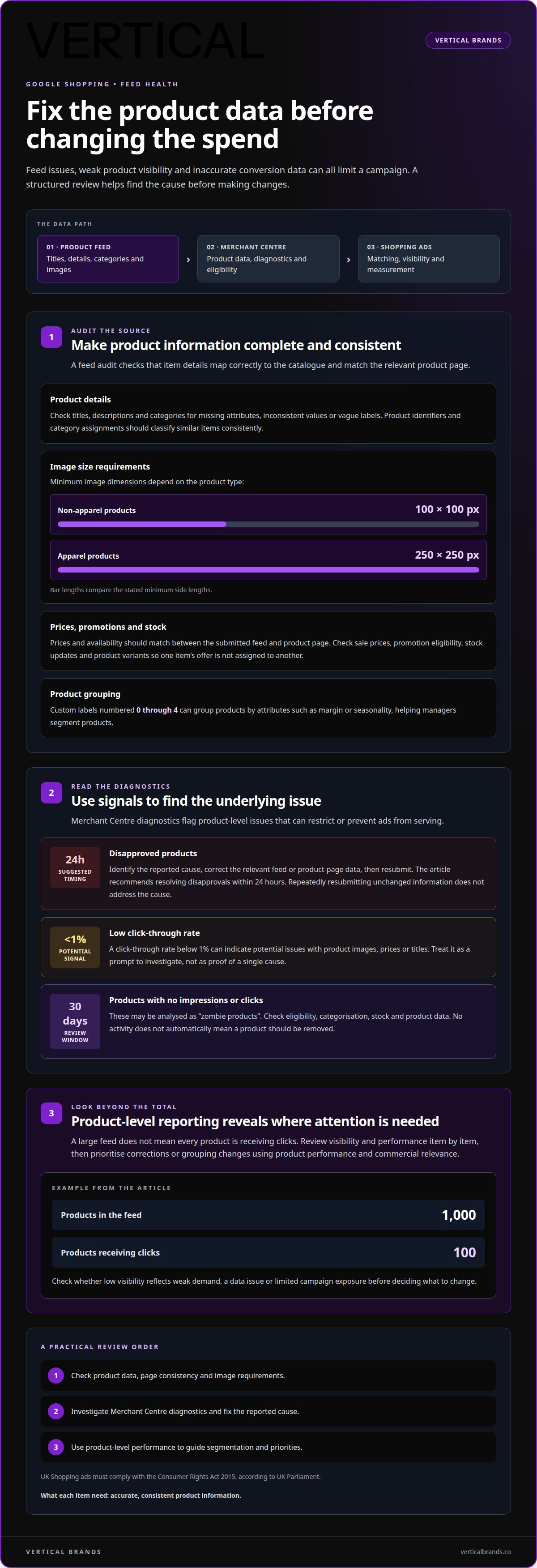
A feed audit checks that each item has complete, consistent information and that the data maps correctly to the product catalogue. Titles, descriptions and categories influence when ads appear, so the audit looks for missing attributes, inconsistent values and mismatches between feed data and product pages. For example, a title should identify the product clearly rather than rely on a vague label.
Image specifications matter too: the minimum image size is 100 × 100 pixels for non-apparel products and 250 × 250 pixels for apparel products. Audits also examine product identifiers and category assignments, so similar items are classified consistently. Custom labels, numbered 0 through 4, can group products by attributes such as margin or seasonality. This gives campaign managers a clearer basis for product segmentation.
Promotions and product availability updates
Product prices, promotions and availability need to match across the feed and the relevant product page. A mismatch can frustrate shoppers and create data-quality issues. Feed management checks that sale prices are represented correctly, promotions apply to the right products, and stock changes appear in submitted data.
Product information can sync with ads, allowing updates to appear when feed data changes. This makes the quality and timing of source data important. A price change or stock update should flow through accurately, rather than leaving an ad showing an outdated offer. Management also reviews how promotions apply across variants, so one product’s discount or availability is not mistakenly assigned to another.
Merchant Centre diagnostics and disapprovals
Merchant Centre diagnostics show product-level issues that may restrict or prevent ads from serving. Management reviews affected items, identifies the reported problem, then corrects the relevant feed or product-page data before resubmitting. The priority is to resolve the underlying cause, not repeatedly submit unchanged information.
Common checks include price consistency, missing product details and image quality. A click-through rate below 1% can indicate potential problems with product images, prices or titles, so performance data can help direct the investigation. Merchant Centre disapprovals should be addressed promptly; the page recommends resolving them within 24 hours. Clear tracking of affected products helps distinguish an isolated error from a broader feed issue.
Products with no impressions or clicks
Products with no impressions or clicks over a 30-day period can be treated as “zombie products” for analysis. This does not automatically mean they should be removed. The management process checks whether products are eligible, correctly categorised, in stock and supported by clear, relevant product data.
A feed may contain 1,000 products, while only 100 receive clicks. That gap makes product-level reporting essential. The review identifies whether low visibility reflects weak demand, a data issue or limited campaign exposure. Managers can then prioritise feed corrections, adjust product groupings or exclude items that don’t support the campaign’s objectives. The decision should reflect product performance and commercial relevance, not the feed’s total item count alone.
Shopping and Performance Max campaign management
Google Shopping campaign management services connect campaign structure, product priorities and conversion measurement. Shopping and Performance Max offer different levels of automation, so management should match campaign controls to the retailer’s objectives and operating needs.
Bidding and budget management
Shopping advertisers set a daily budget, while bidding determines how campaign spend competes for opportunities. Managers select a bidding strategy to suit the campaign objective and available conversion data, then monitor spend, clicks and conversion value together. Automated bidding can respond to signals, but inventory shortages, price changes and competitor activity still require oversight.
Budget reviews assess how spend is distributed across campaigns and product groups. For example, continuing to spend on an unavailable item may be inefficient. Managers use current evidence to adjust bids, budgets or product priorities. Decisions should reflect inventory and commercial goals, not a temporary change in clicks alone.
Performance tracking and return on investment
Conversion tracking connects campaign activity with meaningful actions, such as an online purchase and its value. Without accurate data, bidding systems have a weaker basis for optimisation, and reported return on ad spend can mislead. Managers assess tracking quality alongside spend, revenue and conversion value before interpreting results.
ROAS targets should reflect the retailer’s margins and break-even point. A 300% ROAS can serve as an example break-even target, while a mature account might use a 500% Target ROAS. These are examples, not universal benchmarks. Google Shopping campaign management services should set targets in context, because an unsuitable threshold can restrict useful traffic or prioritise sales that do not support profitability.
Performance analysis and structured testing
Testing works best when each change has a clear purpose. Managers can compare bidding approaches, product group structures or asset combinations, then assess whether a change improves conversion value or efficiency. Changing several variables at once makes results harder to interpret.
Performance reviews distinguish campaign-level patterns from product-level outcomes. If clicks rise but conversion value does not, managers may investigate product mix, landing-page relevance or traffic quality. They consider conversion volume and campaign stability before deciding whether a test has produced useful evidence to keep or reverse a change.
Performance Max and Standard Shopping
Standard Shopping centres on product groups and their bids. Performance Max uses automation across Google advertising channels, drawing on Merchant Centre feed data and advertiser-provided assets. Google can generate or optimise ads using those assets and feed information, so asset quality affects what the campaign can use.
The choice depends on the retailer’s need for control, available creative assets and conversion data. A hybrid structure can combine Performance Max with selected Standard Shopping campaigns, providing closer oversight where inventory or pricing needs attention. Managers assess overlap, targeting and incremental results before shifting budget between campaign types. Neither format replaces accurate measurement or considered analysis.
Where campaign growth also depends on stronger customer follow-up, customer retention planning can complement acquisition activity.
Struggling with Google Shopping?
UK management costs depend on the campaign’s scope and are given after a quote request. Product range, feed complexity, campaign structure and reporting needs shape that scope. Common problems include inaccurate conversion tracking, product disapprovals, stock changes and bids that don’t match profitability goals.
Smart bidding and CPA control
Smart bidding uses conversion signals to adjust bids in line with the campaign objective. Target CPA focuses on acquisition cost, while Target ROAS prioritises conversion value relative to advertising spend. Audience targeting can help campaigns reach relevant groups, but segmentation needs enough useful conversion data to inform decisions.
Google recommends at least 15 conversions in the past 30 days before changing from Manual CPC to automated bidding. Managers assess CPA alongside order value and margin, not in isolation. If CPA rises, they examine audience quality, product mix and conversion tracking before changing targets. The chosen settings also affects delivery volume.
Comparison Shopping Services and bidding power
The UK participates in Google’s Comparison Shopping Service programme. Retailers can participate in Shopping ads through one or more CSSs of their choice. Some CSSs manage product data and campaigns on a retailer’s behalf; others provide tools for retailers to manage their own setup.
A CSS does not replace campaign strategy. Management still needs to align product data, bidding and commercial objectives. The right operating model depends on how much campaign work the retailer wants managed and whether it needs direct control over the setup. Managers consider these responsibilities when assessing competitive positioning and campaign performance.
Campaign structure and bidding strategies
Shopping campaigns can use Manual CPC, Maximise Clicks, Maximise conversion value or Target ROAS. Each strategy serves a different purpose: Maximise Clicks seeks traffic, while conversion-focused bidding uses tracked outcomes to guide delivery. Audience targeting can add another layer by helping campaigns serve ads to defined groups.
Structure affects how clearly performance can be analysed. Managers organise products into relevant groups, then assess spend and results across them. For example, a product group with strong sales but weak margins may need different bidding priorities from one that generates valuable conversions. Clear campaign descriptions and naming conventions also make it easier to identify purpose and compare results.
Billing and bidding considerations
Shopping campaigns charge on a cost-per-click basis when someone clicks an ad leading to a website landing page or Google-hosted local inventory landing page. A daily budget controls planned campaign spend, while the bidding strategy influences how that budget competes for traffic. These controls work together but measure different things.
Managers review actual spend against budget alongside clicks, conversions and CPA. If a campaign attracts clicks without valuable outcomes, they examine targeting, product relevance and conversion tracking before raising bids. If spend is limited, they assess whether budget or uncompetitive bids are restricting visibility. This helps distinguish a billing concern from a campaign performance issue.
Campaign monitoring, reporting and optimisation
A useful report connects advertising activity with sales, profitability and visibility. It shows what changed, what the data indicates and what the next optimisation will test.
Bids, budgets and profit-focused optimisation
Profit-focused optimisation compares campaign spend with revenue, product margins and the cost of acquiring a sale. ROAS alone does not show whether a product is profitable, so managers review revenue and margin by product. If an item has high revenue but a narrow margin, its bids may need different priorities from a product generating a stronger contribution.
Budget reviews also identify whether a campaign is missing market opportunities because of limited budget or uncompetitive bids. Managers assess impression share alongside spend before changing either control. They then adjust bids or budget to reflect the retailer’s commercial priorities, rather than treating more clicks as the goal. The next report records the change and its effect on CPA, conversion value and margin.
Campaign testing and ongoing optimisation
Ongoing testing gives each campaign change a clear purpose. An agency might test a bidding adjustment or product grouping, then compare conversion rate, CPA and ROAS with the previous setup. Changing one meaningful variable at a time makes the result easier to interpret. Managers also account for stock and price changes, which can affect performance independently of the test.
Landing-page and checkout performance matter after the click. Managers review whether a mobile product page clearly displays the advertised item, price and availability. They also examine whether the journey from product selection to checkout creates friction. For example, a strong click-through rate paired with a weak conversion rate may prompt a closer look at mobile page speed, product information and checkout steps. Testing should link these observations to campaign results.
Monitoring, reporting and performance KPIs
Weekly reporting should cover ROAS, CPA and conversion rate, alongside visibility measures such as impression share and average position. These indicators show whether a campaign attracts valuable actions and whether its ads appear competitively. A weekly review can identify a rise in CPA or a decline in impression share, then link the change to bidding, budget or product performance.
Monthly analysis adds revenue per product, margin and auction insights with benchmark comparisons. This helps explain whether reported revenue translates into commercial value and how competition may be shifting. Google Ads results should also be considered alongside mobile landing-page behaviour and checkout completion. Together, these measures give a more useful account of performance than clicks alone and identify where the next optimisation should focus.
Google Shopping campaign creation and management
Effective campaign creation turns product priorities into a structure that can be measured and improved. Google Shopping campaign management services should connect catalogue organisation, commercial goals and conversion measurement from the outset.
Choosing a Google Shopping agency
UK businesses should assess how an agency plans campaign structure, measures sales and explains its decisions. Ask how product groups and bidding priorities will reflect trading objectives, rather than treating traffic volume as the sole measure of success. Providers of Google Shopping campaign management services should explain what the campaign will measure, how results will inform decisions and how those decisions will be reported.
Account access and measurement responsibilities should also be clear. Conversion tracking needs to represent meaningful business outcomes, and reports should make campaign changes understandable. For example, a retailer should be able to see why one product group receives more budget than another, and what evidence would prompt a change. Clear ownership of setup, monitoring and reporting makes decisions easier to evaluate.
Campaign planning also depends on input from product and commerce teams. Stock levels, promotions and product priorities can change what deserves visibility. A useful working process accounts for those updates and records the reason for campaign adjustments. Look for a partner that distinguishes a planned test from a reactive change, then explains how each decision supports commercial priorities—a structured approach advocated by digital agencies such as jWeb Media.
Campaign setup and improvement timelines
Setup typically involves reviewing account access and conversion measurement, mapping campaign structure to product priorities, organising product groups, allocating budgets and completing launch checks. The time required depends on feed readiness, tracking accuracy, catalogue complexity and account issues to resolve. Clean product information and reliable measurement can simplify preparation; a complex catalogue or inconsistent tracking may require more work before launch.
Improvement continues after campaigns begin generating useful performance data. Managers establish a baseline, identify a specific opportunity, make a focused adjustment and assess its effect before changing other variables. Overlapping edits can obscure what drove a result, so a structured sequence makes findings more actionable. The process should also account for shifts in stock, pricing and trading priorities during optimisation.
Seasonal activity needs additional coordination. Campaign preparation for seasonal peaks should begin 4-6 weeks in advance, leaving time to align product priorities, promotions and budgets. The schedule also depends on the retailer’s readiness to provide current commercial information and approve campaign changes. A disciplined setup create a clearer basis for later optimisation, rather than treating launch as the end of the work.
Plan your Google Shopping campaign setup around your product range, tracking and trading priorities.
Vertical Brands: Email Marketing & CRM Management
Vertical Brands supports online store growth through Email Marketing & CRM Management and Klaviyo Email Marketing. These services are a natural next step when Shopping campaigns bring visitors to a store but customer communication and repeat engagement need more structure.
Campaign performance is only one part of the customer journey. Email and CRM activity can help retailers organise customer communications around business priorities, while Paid Social and Paid Search support broader acquisition planning. The right mix depends on where the business needs stronger coordination, from attracting potential customers to maintaining relevant contact after a purchase.
If you want to connect paid activity with customer communications, contact Vertical Brands to discuss your priorities.
Set your next growth priority
Start by deciding what your Google Shopping activity needs to achieve commercially. That could mean improving product visibility, making campaign decisions more accountable or aligning acquisition with the wider customer journey. Clear priorities give management a sharper direction and make future decisions easier to assess.
Google Shopping campaign management services can support that direction when campaign structure, trading priorities and business goals are aligned. The approach should fit the way your store sells, rather than force every product into the same strategy. Paid Social can also complement search activity when your growth plan calls for coordinated acquisition across channels.
Bring your current challenges and priorities into a conversation, whether you’re reviewing an existing setup or planning a new direction. Contact Vertical Brands to discuss the next step for your business. Your campaign direction starts with a clear commercial objective, and the right priorities give it focus.
Frequently Asked Questions
How does a Google Shopping management service track e-commerce sales and ROAS?
Conversion tracking connects advertising interactions with recorded purchases, then compares attributed revenue with ad spend to calculate return on ad spend (ROAS). The reporting setup should distinguish tracked conversions from completed orders, especially when cancellations, refunds or duplicate events affect sales data. For example, if an order is recorded twice, reported returns can be overstated. Clear attribution settings and consistent conversion values make the analysis more useful.
Skyrocketing Costs with No Return?
Start by finding where costs rise without a corresponding commercial outcome. Compare spend, cost per click, conversion rate and order value by campaign and product group. If clicks increase but purchases do not, investigate the landing-page journey and checkout, not just bids. If a small product range absorbs most of the spend, review its contribution to sales and margin. Make one targeted change, then assess its effect before adjusting other settings.
What does a Google Shopping campaign management service include?
A managed service can cover campaign planning, account and conversion tracking reviews, campaign structure, bidding, budget oversight and ongoing analysis. The work should also define reporting responsibilities and how decisions are made when sales or trading priorities change. For example, a retailer launching a new product range may need different priorities from those for an established catalogue. The precise scope depends on the account’s needs, feed complexity and level of support required.
How are Google Shopping management fees structured: fixed fee, percentage of ad spend, or performance-based?
Possible fee models include a fixed management fee, a charge linked to advertising spend or a performance-based arrangement. Each calculates the management fee differently, so the agreement should define the work included and how any performance measure is calculated. The price for this service depends on the case and is provided after a quote request. Factors include account scope, catalogue complexity, campaign structure and reporting requirements.
How do Google Shopping agencies set up and optimise campaigns or Performance Max?
Campaign setup typically aligns account structure with product priorities, budgets and measurement requirements. For Performance Max, managers use Google Merchant Centre feed data alongside advertiser-provided assets. Optimisation then uses campaign results to guide adjustments to targeting, assets, budget or bidding. For example, if a campaign attracts visits but not valuable sales, the review should examine conversion measurement and the customer journey before expanding spend. A considered sequence of changes helps clarify what is driving results.
What product feed management and Google Merchant Centre services are included?
Feed support can include checking product attributes, mapping catalogue fields, reviewing diagnostics and addressing errors that restrict product visibility. It may also cover processes for keeping prices, promotions and availability aligned with current product information. For example, a variant with a changed price needs accurate data associated with that specific item. These checks help maintain consistency between submitted product data and the information shoppers see.