Photo by Clay Banks on Unsplash
A good brand name comes from a short written brief, a shortlist cut against clear criteria, and legal and market checks run before you spend on design or ads. The brainstorm is the smallest part of the job. Most naming problems come from skipping the brief, or from falling in love with a name that is already taken or can never be protected. As an integrated growth team that handles brand strategy, brand identity, web and paid media together, we see a name as the first decision every later channel inherits. Here is the process in order.
TL;DR
- Write a one-page naming brief before you generate a single name, and get every decision-maker to approve it.
- Pick a name type on purpose: names that describe your product are weak in UK trade mark law, while invented and allusive names are easier to protect.
- Cut the long list with criteria, then test the shortlist with real customers, not only colleagues.
- Clear the name in the UK: Companies House, the UK trade mark register, domains and social handles.
- Treat the name as a working asset: it will be your search term, your ad headline and your email sender name.
Table of Contents
- Why the name deserves a process
- Step 1: Write the naming brief
- Step 2: Choose a naming approach
- Step 3: Generate a long list
- Step 4: Cut to a shortlist
- Step 5: Test the shortlist with real people
- Step 6: Clear the name in the UK
- Step 7: Check what the name will do in marketing
- Common naming mistakes
- Our view on naming
- When the name is settled, build the brand around it
- FAQ
- Sources
Why the name deserves a process
A name is the one brand asset you cannot easily change once customers, search results and packaging carry it. A survey of 112 UK consumer goods manufacturers, summarised in a 1995 academic study, found that firms set explicit objectives and criteria before generating names. Relevance to the product category, connotations and overall liking scored highest. The same study found that most firms did little formal testing: 45% used focus groups and only 35% used surveys. The survey is old, but the pattern is familiar: clear criteria at the start, thin evidence at the end.
For an ecommerce brand, a B2B company, a course creator or a service business selling bookings, the stakes are practical. The name has to be typed into search boxes, spoken on podcasts, read in an inbox and fit inside an ad headline. It has to be available as a domain. And it must not collide with someone else’s registered mark.
Step 1: Write the naming brief
Start with what is being named and who it is for. Name the business, product or service, then describe in a few lines:
- What it does and the single thing you want customers to remember.
- Who buys it, in specific terms: a founder buying software, a parent buying gifts, a student buying a course.
- What the name should convey: trust, speed, warmth, expertise, playfulness.
- Competitor and peer names, so you know which sounds and patterns to avoid.
- Constraints: length, languages, whether the name must work as a domain and a handle.
Before brainstorming, define your vision, mission, values and brand personality. Those answers become the filter you use later. If you cannot say how the brand should feel, every name will seem equally good or equally bad, and the loudest voice in the room wins.
Then share the brief with everyone who has a say and get sign-off. That single step prevents the most common failure: a director who rejects the whole shortlist because nobody asked what they wanted. The agreed brief becomes your objective yardstick when opinions clash.
Step 2: Choose a naming approach
Before generating names, decide which kind you are looking for. Each category carries different strengths in marketing and in law.
| Type | What it is | Marketing strength | UK trade mark position |
|---|---|---|---|
| Descriptive | Says what you sell | Instantly clear | Weakest: often refused as lacking distinctive character |
| Allusive (suggestive) | Hints at a benefit or feeling | Memorable and meaningful | Generally registrable |
| Invented | A coined word with no prior meaning | Highly ownable, needs marketing to build meaning | Strongest |
| Founder or place name | A surname or location | Personal, credible | Variable; common surnames and place names can be harder |
The legal column matters more than most founders expect. A UK trade mark attorney firm explains that names directly describing a product fall foul of Section 3 of the Trade Marks Act 1994 and are often devoid of distinctive character. Their example is a leak-proof lid sold under a name that says exactly that. Strong marks are invented words that say nothing about the goods yet stick in memory, and allusive marks hint at a feature without describing it.
The Act itself bars registration of marks that are devoid of distinctive character, exclusively descriptive or customary, or deceptive. A mark can overcome some of those grounds by acquiring distinctiveness through use, but that takes years of trading and is not a plan to start with.
The practical read: if you will advertise heavily, lean allusive or invented. A name nobody else can claim is cheaper to defend and easier to rank for in search. A descriptive name can feel safe on day one and become a problem the first time a competitor uses something similar.
Step 3: Generate a long list
Now brainstorm, with the brief on the table. Aim for 50 to 100 names and do not judge while writing. Useful prompts:
- Benefits and emotions: the result customers want, in words and in other languages.
- Metaphors and images: things that behave the way your product behaves.
- Word play: blends, truncations, altered spellings, real words used out of context.
- Sound: names with strong consonants, rhythm or alliteration are easier to say and recall.
- Structure: one word, two words, or a short phrase. Short names fit in ad headlines, email sender fields and mobile screens.
Check each idea against the competitor names in your brief. If three rivals use a similar prefix, a fourth will blend in.
Be careful with altered spellings. A name customers must spell correctly to find you will lose traffic every day to misspellings. That matters most for brands that rely on search and direct response.
Step 4: Cut to a shortlist
Score every name against the same short list of criteria, drawn from your brief:
- Fit with brand personality: does it sound like the brand you described?
- Meaning and emotional response: what does it suggest to a stranger?
- Look on paper and screen: how does it appear in a logo, a URL, an app icon, lower case and capitals?
- Standout: does it separate you from competitors or sit among them?
- Availability: can you get the domain, the handles and a defensible trade mark?
- Room to grow: will it still fit if you add products, services or markets?
The last criterion is the one founders forget. A name tied to a single product becomes awkward the day you add a second. Ask for each candidate: could this brand sell something adjacent in three years?
Use a quick, cheap screen first. A UK law firm’s clearance guide recommends fast screening searches before full trade mark searches, and notes that early screening can cut the field of proposed names by over 50%. That saves you from testing, and growing attached to, names you could never use.
Aim for three to five names that survive the screen.
Step 5: Test the shortlist with real people
Friends and family are kind, and kindness is not data. Show the shortlist to people who resemble your customers, and keep the questions simple:
- Recall: show the names, wait a day, and ask which they remember without prompting.
- Pronunciation and spelling: ask people to say the name aloud on sight, and to type it after hearing it. Count how many get it right first time.
- Association: ask for the first three words that come to mind. Do they match the personality in your brief?
- Distinctiveness: show your name among competitor names and ask which is which. If people confuse yours with a rival, drop it.
- Preference: with enough respondents, ask which name they prefer and why.
Check the name for unwanted meanings in other languages and regions you may sell to. A harmless word in English can be an embarrassment elsewhere, and it is much cheaper to find out now.
Keep the sample matched to your buyers. If you sell to procurement managers, a survey of students tells you little. Record the answers, because they also give you language for your messaging later.
Step 6: Clear the name in the UK
This step separates a name you like from a name you can use. Run these checks before you commit to a logo, a domain purchase or any ad spend.
Companies House and legal name rules
Government guidance says a limited company’s legal name is protected and cannot be used by others, but any separate trading name must be registered as a trade mark to be protected. A name cannot be offensive, identical to an existing company name or trade mark, or contain sensitive or restricted words, or words suggesting a government connection, without permission. It also cannot be the same as, or too similar to, a name already on the Companies House register.
Two rules from the 2015 names regulations are worth knowing. A company name must not exceed 160 permitted characters, and nobody may carry on business in the UK under a name ending in “Limited”, “Ltd”, “LLP” or “plc” unless they are a company or other body registered by that name.
Trade marks
A company name registered at Companies House does not give you exclusive trade mark rights. A legal advisory firm explains that you can register a company name while still infringing an earlier trade mark. Their recommended order is: search the UK Intellectual Property Office trade mark register for identical and similar names, compare them for visual, phonetic and conceptual similarity, then check Companies House, domains, social handles and competitors’ trading names.
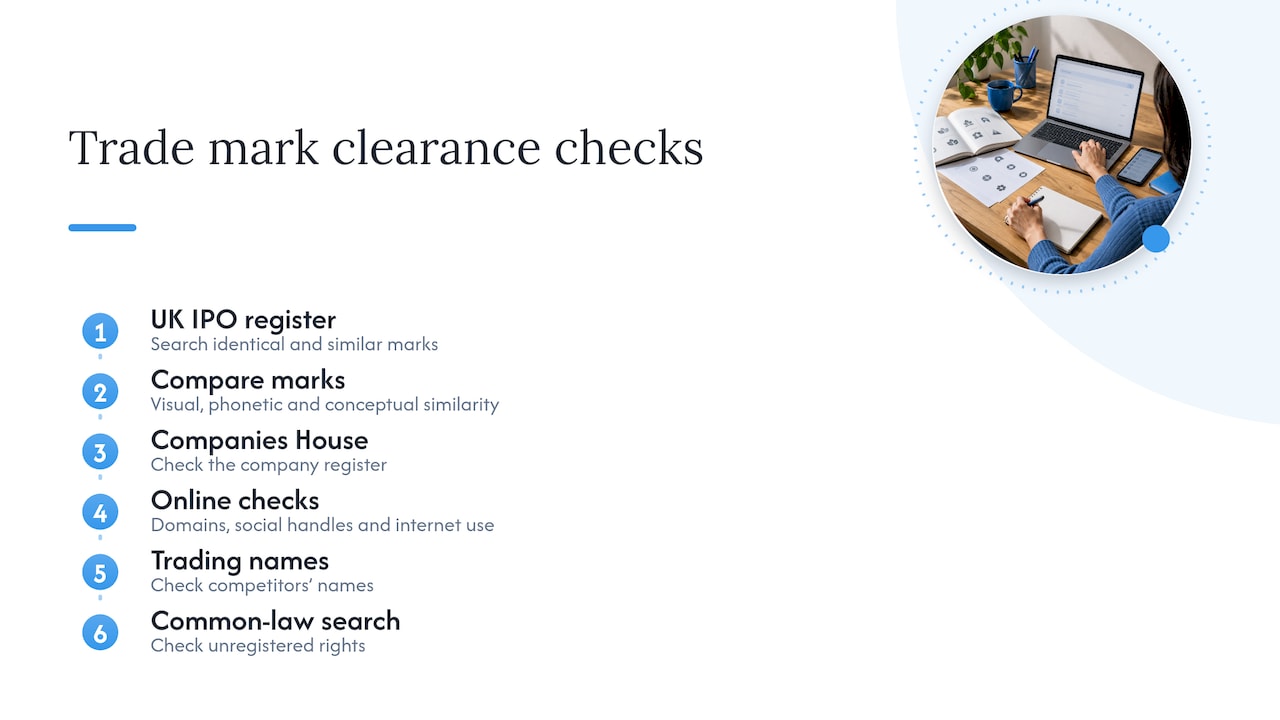
Similar is the word that catches people out. A clearance search should cover phonetically equivalent and similar marks, not only identical wording. It should also include an internet search for identical or confusingly similar use, domain checks and company register checks. The same applies to unregistered rights: an established business can sometimes stop a newcomer through passing off, even without a registered mark, which is why clearance guides include common-law searches too.
If you decide to register, know the process and cost. A standard online UK application was published at £205 for one class and £60 for each additional class in November 2026, with registration usually taking about three to four months if unopposed. A UK trade mark lasts 10 years and can be renewed every 10 years. Fees are set by the UK IPO and can change, so confirm them on the official page when you apply.
After examination, you normally get time to resolve any objections about distinctiveness, and the mark is then published for a two-month opposition period, which can be extended to three months, according to a 2024 UK trade mark chapter. Build that timeline into your launch plan. For a name you will invest heavily in, take advice from a UK trade mark attorney or solicitor before you commit to the launch.
Domains and handles
Government guidance advises checking and securing web domains and social media handles even before you start using the name. For a UK business, secure the .co.uk and the .com where you can, and the handles on the platforms where your customers are. A name that works everywhere except your own URL costs you every time someone searches for you.
Step 7: Check what the name will do in marketing
A name has to work in the channels that will carry it. Before you finalise, run it through the places it will live:
- Search: type it into Google. Are the results clean, or crowded with an unrelated meaning? Your brand name will become a keyword you bid on and rank for, so a name that shares its spelling with a common word costs more to own. If you plan to bid on your own name, our branded search bidding playbook for UK marketers covers the advertising rules to keep in mind.
- Email: how does it look as a sender name, and in a subject line, on a phone?
- Paid social and display: does it fit a headline, and is it legible at small sizes?
- Imagery: names set expectations that your visuals then confirm or contradict. Consistent photography in branding helps the name feel like part of one identity rather than a label added at the end.
- Spoken use: say it on a call. Spell it out. If you have to spell it twice, expect lost word of mouth.
This is also where brand and performance meet. A name that is easy to remember lifts the return on every pound of paid media, because people who remember you come back and search for you. Our piece on making brand and performance marketing pay off in 60 to 90 days explains how the two work together once the name is in market.
Common naming mistakes
- Starting with names instead of the brief. You end up debating taste rather than fit.
- Choosing a descriptive name for safety. It is the hardest type to protect in the UK.
- Testing only with insiders. Colleagues already know what the business does, so they cannot judge how a stranger reads the name.
- Checking the domain but not the trade mark register. An available domain says nothing about whether the name is legally free.
- Ignoring similarity. Near matches in sound or meaning can be refused or challenged just as identical ones can.
- Naming for today’s product only. Leave room for the range you will have in three years.
Our view on naming
A name is the first piece of brand strategy a customer meets, and every channel afterwards depends on it. Paid social, search, email, the website and packaging all repeat it. If it is hard to spell, hard to say or hard to protect, every channel pays for that, every month.
That is why we treat naming as part of brand strategy rather than a creative exercise on its own. The brief comes first: audience, positioning, personality, competitors. The name then has to survive a simple question: can this carry a full funnel, from the first ad to the repeat purchase email?
We built Vertical so that strategy, creative, performance marketing and web development sit under one roof. When the name, the identity, the site and the media plan are decided together, there is less to reconcile later and fewer vendors to coordinate. Clarity at the start is cheaper than a rebrand later.
Alex
When the name is settled, build the brand around it
Once the name is cleared, the next decisions are the identity, the website, the creative and the media plan that make it known. Our team covers brand strategy, brand identity, creative design, website design and development, paid social, paid search, email marketing and CRM management as one integrated service, so the name you chose is applied consistently from the first ad to the retention flow. If you are launching a brand or repositioning one, you can see the full range on our services page.
If you want to talk through the brief and how the name will carry into your marketing, get in touch with Vertical.
FAQ
How do you name a brand?
Write a brief covering audience, personality, competitors and constraints. Choose a name type, generate a long list, score it against agreed criteria, test a shortlist with real customers, and clear the winner against UK company, trade mark, domain and social records before launch.
Should a brand name describe what you sell?
It can help customers understand you quickly, but names that directly describe the goods are often refused as trade marks in the UK for lacking distinctive character. Allusive and invented names are generally easier to register and defend, so they suit brands that plan to advertise at scale.
Is a Companies House registration enough to protect my brand name?
No. Registering a company name records your corporate identity but does not give exclusive trade mark rights. A separate trading name needs to be registered as a trade mark to be protected, so search the UK IPO register as well as Companies House.
How long does UK trade mark registration take?
Usually about three to four months if nobody opposes it, according to published guidance from a UK legal services provider. The mark is published for a two-month opposition period, which can be extended to three, so allow for that in your launch plan.
Sources
- Naming your business, Business.gov.uk
- The Company, Limited Liability Partnership and Business (Names and Trading Disclosures) Regulations 2015
- Trade Marks Act 1994, WIPO Lex
- How to Choose and Register a New Brand Name, Shand P
- Creating Effective Brand Names: A Study of the Naming Process, WPI
- Brand Clearance Guide, Lewis Silkin
- Should I Trademark My Business Name?, Go Legal
- UK trade mark chapter 2024, Bird & Bird
- Register a business name in the UK, Sprintlaw