Photo by Adrien Olichon on Unsplash
A management contract and a campaign contract serve different purposes. For creators negotiating influencer contracts in the UK, the distinction matters: a management agreement covers ongoing representation, while a campaign agreement sets terms for specific promotional work. A manager can sign on a creator’s behalf only if authorised to bind them.
It’s reasonable to expect the contract to specify who approves content, how the brand may use it and what commission applies. These terms should be explicit. A manager’s commission on independently sourced work depends on how the agreement defines income, activities and introduced business.
This guide explains when management terms are useful, who can approve deals and usage rights, and what to clarify about commission and contract responsibilities. It also covers UK disclosure rules: the Competition and Markets Authority provides guidance on influencer advertising and consumer protection, and required disclosures should be clear and prominent. The agreement should also state how long content rights last. Get these boundaries clear before work begins, and the deal is easier to manage from brief to final post.
Key Takeaways
- Separate ongoing representation from the terms of a single campaign so each agreement has a clear purpose.
- Set out who approves content and what the brand can do with it. Clear approval rules keeps disputes easier to manage.
- Define commission around income, introduced business and any obligations that continue after termination.
- Make UK advertising disclosures clear and prominent, including where incentives or affiliate links are involved.
- Allocate campaign responsibilities carefully, while recognising that contractual wording does not automatically remove regulatory responsibility.
Who Approves Brand Deals, Content And Usage Rights?
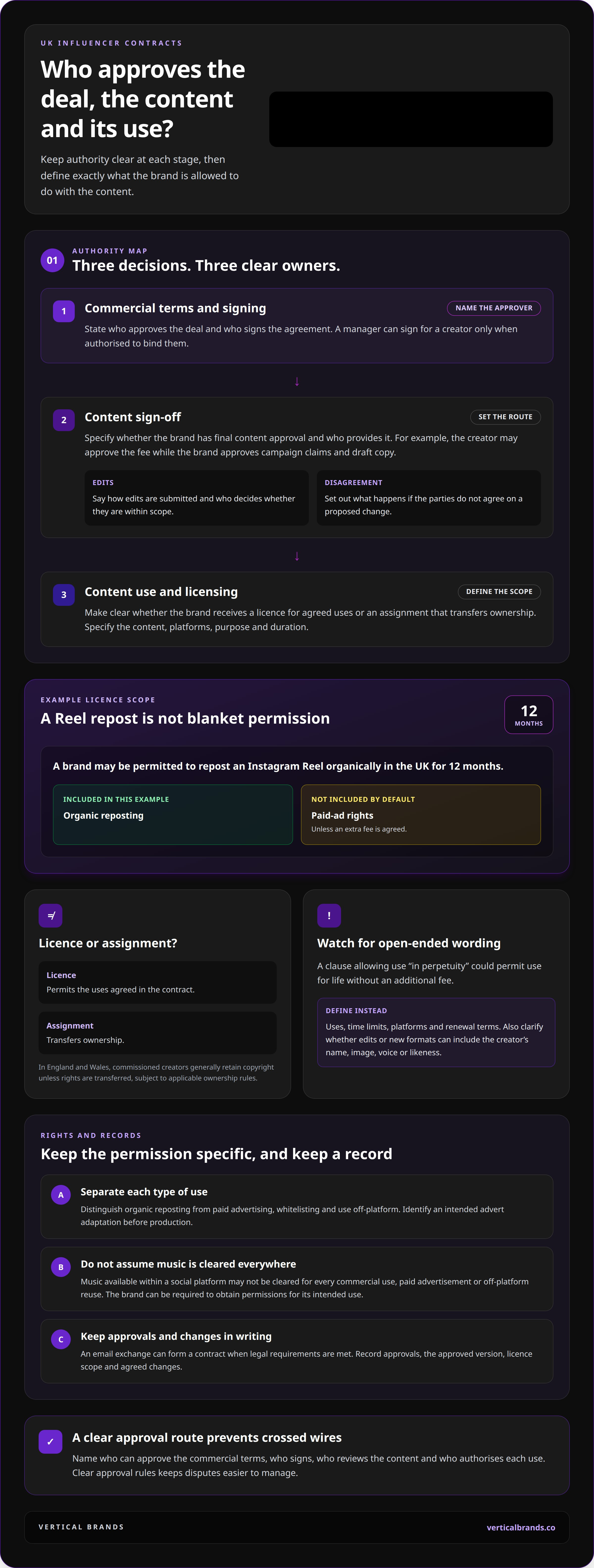
A creator, manager and brand may all shape a campaign, but their authority is not interchangeable. The agreement should identify who can approve the deal, sign it and authorise each use of the content.
Deal and Content Approval Authority
A manager can sign for a creator only when authorised to bind them. State who approves the commercial terms and who signs the agreement. Separately, specify whether the brand has final content sign-off and who provides it. A clear approval route helps prevent conflicting instructions from the brand, agency and creator.
For example, the contract can name the creator as the final approver of the fee while giving the brand approval over campaign claims and draft copy. Set out how proposed edits are submitted, who decides whether they fall within scope and what happens if the parties disagree. An email exchange can form a contract when legal requirements are met, so keep clear records of approvals and changes.
Content Licensing and Usage Rights
Distinguish a licence from an assignment. A licence permits agreed uses; an assignment transfers ownership. In England and Wales, commissioned creators generally retain copyright unless rights are transferred, subject to applicable ownership rules, according to the UK legislation register. The agreement should state whether the brand receives a limited licence or ownership.
Define the content, platforms, purpose and duration covered. A brand may receive permission to repost an Instagram Reel organically for 12 months in the UK, without paid-ad rights unless an extra fee is agreed. The agreement should name which platforms the licence cover. It should also distinguish organic reposting from paid advertising, whitelisting and off-platform use.
Preventing Campaign Disputes and Unauthorised Use
Unauthorised use often stems from a broad clause, rather than a deliberate dispute. A term allowing use of content and the creator’s image “in perpetuity” could permit use for life without an additional fee. Replace open-ended wording with defined uses, time limits, platforms and renewal terms. Specify whether the creator’s name, image, voice and likeness can appear in edits or new formats.
Music used on a platform needs separate consideration. Music available within a social platform should not be assumed to be cleared for every commercial use, paid advertisement or off-platform reuse. The agreement can require the brand to obtain appropriate permissions for its intended use, rather than treating the creator’s post as blanket clearance.
If the brand wants to adapt a video for an advert, identify that use before production. Record the approved version, licence scope and any agreed changes in writing. These steps give both parties a practical reference if a later campaign post, paid placement or repost goes beyond the agreed rights.
Do You Need an Influencer Management Contract in the UK?
A management contract is useful when representation extends beyond one campaign. It records what the manager handles, how either party can end the arrangement and which payments or expenses it covers. For a single promotion, campaign terms may be enough. A management agreement makes sense when the manager will negotiate opportunities, communicate with brands or collect income on an ongoing basis.
Define the manager’s role before signing. Will the manager source opportunities, negotiate terms, advise on content or handle invoices? Name each responsibility. Also state whether the creator can accept work independently and how the manager’s authority differs from the creator’s. A clear division reduces disputes about who approved an offer or agreed to a change.
Payment terms should identify who pays whom, when payment is due and what triggers it. Influencer agreements may provide cash, free products or both. Freeman Harris notes that cash payments can be made upfront or after campaign completion. The management agreement should explain how the manager’s payment is calculated and when it becomes payable. Link each trigger to an identifiable event, such as the brand paying the creator or the creator completing the agreed work.
Address expenses and collection risks separately. State which costs require advance approval, who pays them and how receipts are submitted. If a brand pays late, clarify whether the manager must pursue the invoice or whether that remains the creator’s responsibility. Also explain what happens if a campaign is cancelled, a brand disputes delivery or payment arrives after the management relationship ends. These terms prevent uncertainty over money already earned.
Keep payment records that connect each invoice to its campaign, deliverables and payment date. The Information Commissioner's Office says UK agencies handling personal data must comply with the UK GDPR and the Data Protection Act 2018. Bank details, contact information and payment records therefore need careful handling. The agreement can identify which party holds those records, who can access them, and what happens when the partnership ends.
Before signing, map the agreement against a real payment journey: the brand approves work, the creator delivers it, an invoice is issued, and funds arrive. That example can expose gaps in payment triggers, expenses and late-payment responsibilities. Where campaign operations and creator coordination need a defined structure, influencer campaign management can support a more consistent process.
Advertising disclosures and UK regulatory compliance
UK influencer advertising rules affect campaign briefs, captions and approval workflows. The Digital Markets, Competition and Consumers Act 2024 affects UK influencer advertising and consumer protection rules, according to the UK legislation register.
Who is responsible for UK advertising law and ASA compliance in influencer contracts? The contract should allocate practical tasks, but assigning responsibility does not automatically remove a party’s regulatory obligations. The ASA applies the CAP Code to influencer advertising.
Advertising Disclosure Requirements
Disclosure depends on the connection behind a post. Influencer content is advertising when a creator works with a brand on content for their own channel and receives payment from that brand in relation to it. Non-cash incentives, affiliate arrangements, ownership and other connections can also matter.
Use a clear, prominent disclosure where required. Do not assume that a brand tag or “Sponsored” alone is sufficient. Add an upfront “Ad” label where needed, rather than placing it behind “more”. For example, put the label at the start of a caption, where viewers can see it before engaging with the post.
The ASA describes an influencer as any human, animal or virtually produced persona active on an online social media platform. This means the disclosure process applies beyond individual human creators. A campaign brief should identify the required label and its placement for each format, including captions and short-form video.
The Competition and Markets Authority provides guidance on influencer advertising and consumer protection. Its guidance is relevant when a brand plans incentives or affiliate activity. Clear labels and consistent placement make the commercial relationship visible. Build those requirements into the brief before content is produced, rather than relying on a last-minute caption edit.
Compliance Responsibilities
A contract should distinguish responsibility for the brief, claims, content review and disclosure. The creator may prepare and publish a caption, while the brand supplies campaign information and reviews content against the brief. Record who handles each step, including corrections if a post goes live with an unclear label.
This allocation organises the workflow, but it does not automatically remove either party’s regulatory responsibility. The ASA applies the CAP Code to influencer advertising, so a clause stating “the creator is responsible for compliance” is no substitute for workable briefing and approval.
For example, require the brand to provide approved product claims and disclosure instructions before production. Give the creator a clear route to flag missing or conflicting information. Set out who requests edits and who confirms the final caption. This makes compliance part of campaign delivery, rather than a separate promise buried in the agreement.
Use a final pre-publication check to confirm the commercial connection, disclosure wording and placement against the agreed brief. If affiliate links or gifted products form part of the campaign, include them in the review. A written process gives the brand and creator a shared record of decisions and responsibilities.
How Should Commission Work On Brand Deals?
Commission terms should define which income counts, which deals qualify and when payment becomes due. Clauses should also address late payment, termination and breach by setting out payment triggers, notice processes and the consequences of ending the agreement.
Commission Scope and Income Definitions
Influencer management commission on campaign fees is often around 10% to 20%, although there’s no legal standard rate. The agreement should state the actual rate and the income it applies to. Define whether commission is calculated on cash received, the full campaign fee, or another agreed amount. Address gifted products separately, so their treatment isn’t left open to interpretation.
Define introduced business precisely. State whether a brand counts as introduced when the manager makes the first contact, negotiates a deal or secures a campaign. Then explain how the agreement treats work the creator sourced independently. Commission on that work depends on the contract’s definitions of activities, income and introduced business.
Commission for Ongoing Work
A successful brand and creator partnership may lead to repeat campaigns or ongoing work paid through commission. Specify whether the manager’s commission applies to later campaigns with the same brand and which work qualifies. For example, distinguish a fresh brief negotiated by the manager from a renewal arranged directly by the creator. Clear wording links the obligation to the manager’s role.
Also define the payment event. Commission might become due when the creator receives the brand’s payment, rather than when a campaign is booked. The agreement should explain how partial payments, cancelled work and disputed invoices affect the calculation. This makes it easier to reconcile the payment record against each campaign.
Post-Termination Commission
Ending a management agreement does not automatically end commission obligations. A commission tail may continue for brand deals connected to the manager’s work. Common tail periods are 3, 6 or 12 months. State when the period begins, which brands it covers, and whether it applies to renewals or only deals already agreed.
For example, specify whether a campaign negotiated before termination remains commissionable if the brand pays afterwards. Define how a later renewal is treated, rather than leaving “related work” open-ended. The creator and manager can then distinguish an existing obligation from a new opportunity secured independently.
Late-payment terms should identify the due date or payment trigger, who follows up and how an invoice dispute is handled. Set out what happens if a brand pays only part of a campaign fee. Record whether commission is calculated on the amount received or remains payable on another agreed basis.
Termination and breach clauses should explain how either party gives notice, which actions amount to a breach and what follows. For instance, address unpaid commission, failure to perform agreed management duties or a creator ending representation. State how outstanding invoices, active campaigns and commission tails are treated. Precise definitions keep financial obligations clear after the relationship ends.
Agency, brand and creator contractual responsibilities
A campaign agreement should assign each task to a named party. The brand, creator and any agency need a shared document covering delivery, approvals, payment administration and disputes. Clear ownership of each task helps prevent gaps between the brief and the published work.
The brand should provide the campaign brief, approved product information and any required claims. The creator should deliver the agreed content and follow the approved brief. An agency may coordinate communications, negotiate terms or manage delivery, but the contract should state which duties it accepts. Do not assume that arranging introductions also makes an agency responsible for every campaign decision.
Agency status can matter where an organisation finds paid work for creators. The Employment Agencies Act 1973 may be relevant to UK agencies that find paid work for creators, according to the UK legislation register. The Conduct of Employment Agencies and Employment Businesses Regulations 2003 may also be relevant to UK agencies that find paid work for creators, according to the UK legislation register. Those references make the agency’s role and contractual structure important to document.
Set out the campaign workflow in practical terms. Name who sends the brief, reviews drafts, requests changes and gives final approval. For example, the brand might review product claims, while the creator checks that the final content reflects their own experience. The agreement should set boundaries for edits, including how the parties handle a request that changes the original brief.
Allocate responsibility for claims and disputes clearly. State who responds if a product claim is challenged, who communicates with the other party and who handles any proposed settlement. Contract wording helps organise the response, but assigning a task does not automatically remove a party’s regulatory responsibility. Keep approval records and the final published version with the campaign document.
Deliverables should identify the format, channel and timing. “Create social content” leaves room for disagreement; “deliver a short-form video for the agreed campaign channel” is more operational. If the brand requires exclusivity, define the competing category and the restriction period. A skincare clause might restrict promotion of competing products for 30, 60 or 90 days. Record the precise scope, not just the word “exclusive”.
For creator campaigns that need a clear production and delivery process, develop UGC content around documented responsibilities, approved claims and agreed deliverables.
Vertical Brands: Influencer Marketing
Vertical Brands supports brands planning influencer campaigns through its Influencer Marketing offering. Turn to this service when creator selection, campaign coordination and content requirements need to align with wider marketing activity. Clear campaign goals, creator fit and usage requirements give the work direction before launch. Paid Social can also support campaigns that include paid distribution, with activity shaped around the brief.
Bring the campaign objective, audience and proposed deliverables into the discussion. These details help establish how influencer activity fits the wider plan, alongside any paid social requirements. This creates a structured starting point for planning creator partnerships and campaign delivery.
For a considered next step, contact Vertical Brands to discuss your influencer marketing requirements.
Set the terms before the next opportunity
Use your next brand conversation to put a stronger operating framework in place. Before agreeing to new work, decide what you need from representation, which campaign activities you’ll manage directly and how you want future partnerships to develop. A deliberate approach to negotiating influencer contracts in the UK can help you enter those conversations with clear priorities, not just a document to sign.
For brands building a wider growth plan, influencer activity can sit alongside Paid Social, Klaviyo Email Marketing and Email Marketing & CRM Management. The right combination depends on the business objective and each channel’s contribution. Clear priorities make those decisions easier to structure.
Vertical Brands can discuss how its Influencer Marketing offering fits your campaign goals and wider marketing activity. Bring the contract or campaign requirements you want to work through, and use the conversation to define a practical next step.
Contact Vertical Brands about your contract, and move forward with a more considered plan.
Frequently Asked Questions
Can You Use Exclusivity In A Social Media Talent Contract?
Yes, an exclusivity clause can restrict competing promotions, but define its boundaries. Identify the product category, relevant platforms, duration and any existing commitments that remain allowed. For example, a skincare campaign could restrict promotion of competing products for 30, 60 or 90 days. A broad restriction may affect unrelated opportunities, so connect its scope to the campaign and state when the restriction starts and ends.
Gross Or Net?
Specify whether commission applies to gross campaign income or net receipts. Define “net” precisely: list permitted deductions, such as agreed production expenses, and state whether taxes, agency costs or refunds are excluded. For example, if a brand pays in instalments, define whether commission follows each payment or applies to the full fee. Do not rely on accounting terms alone; explain the calculation in plain language in the contract.
How should influencers be paid?
Influencers can receive cash, free products or a combination, with the agreement identifying each form of compensation. Cash may be paid upfront or after campaign completion, as Freeman Harris notes. Link payment to clear milestones, such as delivery or publication, and state what evidence supports an invoice. For a product-only arrangement, record the item and any agreed content obligations. Keep payment records linked to the relevant campaign.
What Legal Compliance Should Influencer Agencies Build In?
Build compliance into the campaign process, not just the contract wording. Set a route for approving claims, captions and required disclosures before publication. Keep the brief, approved copy and final live content together, and record who made each decision. If a creator flags a claim they cannot substantiate, pause that content and escalate it to the brand’s designated contact. These controls make responsibilities traceable without treating a contract as a substitute for compliance work.
What should a UK influencer contract include?
For creators negotiating influencer contracts UK-wide, the agreement should identify the parties, campaign scope, deliverables and deadlines. Include payment terms, cancellation arrangements, dispute responsibilities, exclusivity, content rights and approval steps. Ask whether someone unfamiliar with the deal could identify the required post, its publication date and who signs off on changes. For an England and Wales arrangement, parties can expressly choose the law and courts of England and Wales.
What are typical UK influencer rates and how are fees calculated?
There is no single creator rate that fits every campaign. A fee can reflect deliverables, production requirements, audience fit, campaign scope and any additional usage the brand wants. Ask whether the quote covers creation and posting only, or also paid advertising and reuse. Management commission is a separate contractual charge. It is often around 10% to 20% of campaign fees, but there is no legal standard rate.
How can influencers negotiate payment terms, deposits and cancellation fees?
Propose a payment schedule that links each amount to a defined stage, such as signing, production or delivery. State whether a deposit is refundable and what happens if the campaign changes or stops. Cancellation terms can distinguish work already completed from work not yet started. Include a process for late payment and disputed invoices. Keep the signed version and amendments together to support later reconciliation.
How should usage rights, licensing and content ownership be negotiated?
A disciplined approach to negotiating influencer contracts UK-wide starts with listing the brand’s intended uses, then licensing only the agreed scope. Separate organic reposting from paid placements, whitelisting and use outside the original platform. Specify the content covered, permitted edits, term and renewal process. Address the creator’s name, image and voice separately where needed. If the brand later wants a new format or channel, document it as a separate permission.