Photo by Tyler Lastovich on Unsplash
A customer acquisition strategy is the plan that tells you who you are trying to win, which channels you will use to reach them, what each new customer is allowed to cost, and how you will learn what works. The brands that grow steadily tend to treat it as one joined-up system: strategy, creative, paid media, email and the website all working from the same numbers. When these sit with separate vendors, nobody owns the full path from first click to first order. That is the problem we built Vertical to remove.
This guide gives you the plan step by step, with UK figures where they exist, for ecommerce brands, B2B companies, course creators and consumer service businesses.
TL;DR
- Start with a clearly defined ideal customer and a goal expressed in customer numbers and cost, not in clicks or impressions.
- Choose two or three channels that match how your customer buys, then add more only when the first ones are measured and working.
- Judge channels on cost per acquired customer and on lifetime value, not on last-click reports alone.
- Test one change at a time against a baseline, in fixed cycles, and keep what wins.
- One team owning strategy, creative, media and the site removes the hand-offs where acquisition plans usually stall.
Table of Contents
- What a customer acquisition strategy actually covers
- Step 1: Define who you are acquiring
- Step 2: Set goals that include cost
- Step 3: Choose acquisition channels that fit your buyer
- Step 4: Know what channels cost in the UK
- Step 5: Build the path from click to customer
- Step 6: Test in fixed cycles and keep what wins
- What changes by business type
- Why one integrated team shortens the path
- Put the plan to work with Vertical
- FAQ
- Sources
What a customer acquisition strategy actually covers
IBM describes customer acquisition as the strategies and processes a business uses to gain new customers, with the aim of a predictable, sustainable pipeline. The basic sequence is the same in every sector: attract potential customers, nurture them until they are ready to buy, then convert them.

That sequence is often drawn as a funnel with five stages: awareness, interest, consideration, intent (adding to a basket, signing up for a trial, requesting a quote) and purchase. A strategy decides what you do at each stage, who does it, and how you will know it is working.
Two things separate a strategy from a list of tactics:
- It starts from a customer, not a channel. “We should be on TikTok” is a tactic. “Our best customers are lapsed gym members aged 28 to 40 who research on mobile” is the start of a strategy.
- It has a number attached. Without a target cost and a target volume, every channel looks fine.
Acquisition is also not the whole story. Retention decides how much you can afford to spend winning a customer in the first place, so the plan should account for repeat purchase from the start. IMRG’s survey of 32 UK retailers found that new customers made up 48% of orders in 2022, with existing customers at 42% and reactivated customers at 10%. Even in a growth plan, roughly half of orders come from people you already know.
Step 1: Define who you are acquiring
The ideal customer profile (ICP) is a written description of the customer you will commit sales and marketing resources to win. Business Wales frames the marketing plan as a practical guide that begins with goals set in customer numbers and a defined ideal customer, before choosing how and how often to reach them.
What to write down, depending on your model:
- Ecommerce: who buys the first order, which product they start with, what they search for before buying, and what a typical repeat purchase looks like.
- B2B: industry, company size, the job title that signs off the spend, the trigger that makes them look for a supplier, and the length of a normal buying cycle.
- Course creators: the outcome the learner wants, where they currently learn it, and what makes them pay rather than stay with free material.
- Consumer services: catchment area, how people book (phone, form, app), and the point at which they abandon a booking.
Use your existing best customers as the template. Pull the last 12 months of orders or bookings, identify the top group by repeat purchase and margin, and describe what they have in common. That description is your targeting brief for paid media, email segmentation and creative.
Where this goes wrong: profiles built from assumptions, or so broad that they describe everyone. A failed channel test can really be a wrong-customer test. If you cannot name the customer, you cannot tell which it was.
Step 2: Set goals that include cost
A useful goal has a customer number, a time frame and a cost ceiling. For example: “Acquire 400 new customers in 90 days at a blended acquisition cost below £30, with a first-order conversion rate of 2.5%.” Business Wales recommends monitoring enquiries, appointments, customers, enquiry sources, conversions and costs, which is a good minimum set of fields for any plan.
To set the ceiling, you need three numbers:
- First-order margin: what you earn on the first sale after product and fulfilment costs.
- Expected repeat value: what the average new customer is worth over the following 12 months.
- Payback window: how long you can wait to earn back the acquisition spend. A brand with healthy cash can wait 12 months; a brand financing stock cannot.
If you want a UK baseline for ecommerce, our guide to average UK ecommerce acquisition cost walks through how to read these figures against your own margins, and the practical guide to reducing acquisition cost covers what to change once you have the baseline.
Step 3: Choose acquisition channels that fit your buyer
The most common mistake in channel selection is copying a competitor’s mix. The FSB makes the point simply: industry publications can work well for B2B suppliers, while businesses selling directly to consumers may find their audience on social media. Start with where your ICP already spends time and what they do before they buy.
| Channel | Best for | What it does in the funnel | What to watch |
|---|---|---|---|
| Paid search | Ecommerce, consumer services, B2B with clear demand | Captures people already searching with intent | Cost per click rises with competition; track cost per customer, not per click |
| Paid social | Ecommerce, courses, consumer brands | Creates awareness and interest, and retargets visitors | Creative fatigue; needs a steady stream of new assets |
| Display and native | Brands with a defined audience and a budget for reach | Builds awareness and supports retargeting | Often undervalued by last-click reports |
| SEO and content | All models, as a long-term base | Builds consideration and lowers blended cost over time | Slow to compound; needs a site that converts |
| Email and CRM | All models | Turns visitors into subscribers, subscribers into customers, customers into repeat buyers | List quality and segmentation |
| Cold email and outbound | B2B | Reaches named accounts directly | Targeting and deliverability |
| Influencer and UGC | Ecommerce, consumer services | Adds trust and supplies creative for paid social | Fit between creator audience and your ICP |
The Competition and Markets Authority reported in 2017 that organic search accounted for between 15% and 50% of visits on average for the firms reviewed and paid search for 5% to 50%. The wide ranges are the point: the right mix depends heavily on the business.
Start with two or three channels. One should capture existing demand (search), one should create it (paid social or content), and one should convert and retain it (email). Our paid media strategy blueprint for ecommerce shows how those roles fit together in practice.
Step 4: Know what channels cost in the UK
Published UK acquisition cost data is thin, but IMRG’s survey gives a useful reference. For 2022, average last-click acquisition costs among the surveyed retailers were £18.41 for paid search, £39.26 for paid social, £46.24 for display and £9.80 for affiliates. Affiliate traffic converted at 8.0%, against 3.1% to 3.4% for email, organic and paid ads.

Treat these as a 2022 reference for retailers, not a target. Costs vary by category, season and average order value, and a high-cost channel can still be the right one if it brings customers with higher lifetime value. The test for your own business is your own account data compared with your own margin, not a published average.
There is one more caution on measurement. Adobe notes that last-click attribution is simple to implement but systematically undervalues upper-funnel channels such as display and content. If you judge every channel only by the last click, you will cut the channels that start the journey and then wonder why search demand shrinks. Tracking and attribution should be set up before spend scales, not after.
Step 5: Build the path from click to customer
A channel only brings visitors. What happens next decides the cost per customer. Walk the route your ICP takes and fix the friction at each stage:
- Landing page: one message that matches the ad or email that sent them, a clear offer and one action.
- Forms and checkout: short, mobile-friendly, with no unnecessary fields.
- Follow-up: an automated email or SMS sequence for abandoned baskets, unfinished enquiries and first-time buyers.
- Retargeting: different messages for people who viewed a product, added to basket or left at checkout. We have set out retargeting examples for each funnel stage for ecommerce.
A 10% improvement in conversion rate lowers cost per customer by roughly the same share across every channel at once. That is why the website and lifecycle email deserve as much attention as the ad accounts. Our guide to ecommerce funnel stages lays out what belongs at each step.
Step 6: Test in fixed cycles and keep what wins
Business.gov.uk recommends A/B testing: try two alternatives, vary one factor at a time, measure the response, and establish a baseline first so results can be compared against it.
A workable routine:
- Record the baseline for each channel: spend, customers, cost per customer, conversion rate.
- Pick one hypothesis per channel, such as a new offer, a new audience or a new landing page.
- Set the decision rule before launch: what result means scale, what means stop, and by when.
- Run for a full cycle, at least several weeks on paid platforms so the algorithms can settle, and longer for B2B with long sales cycles.
- Review by customers and revenue, not impressions or clicks.
- Move budget towards winners, retire losers, and write down what you learned.
Most tests will not produce a winner. That is normal, so keep them small and quick, and keep the budget for scaling what does work.
What changes by business type
Ecommerce brands. Paid social and search bring the first order; email and CRM, with a platform such as Klaviyo, carry the second and third. Acquisition cost should always be read against repeat purchase rate.
B2B companies. The reader you want is a named account, so targeting matters more than reach. Combine search for active demand, LinkedIn and display for awareness, and cold email for defined lists, then measure cost per qualified lead and conversion from lead to sales opportunity.
Course creators. Trust is the barrier. Free content, email sequences and social proof carry more weight than a single ad, and the aim is to build an owned audience before you pay to convert it.
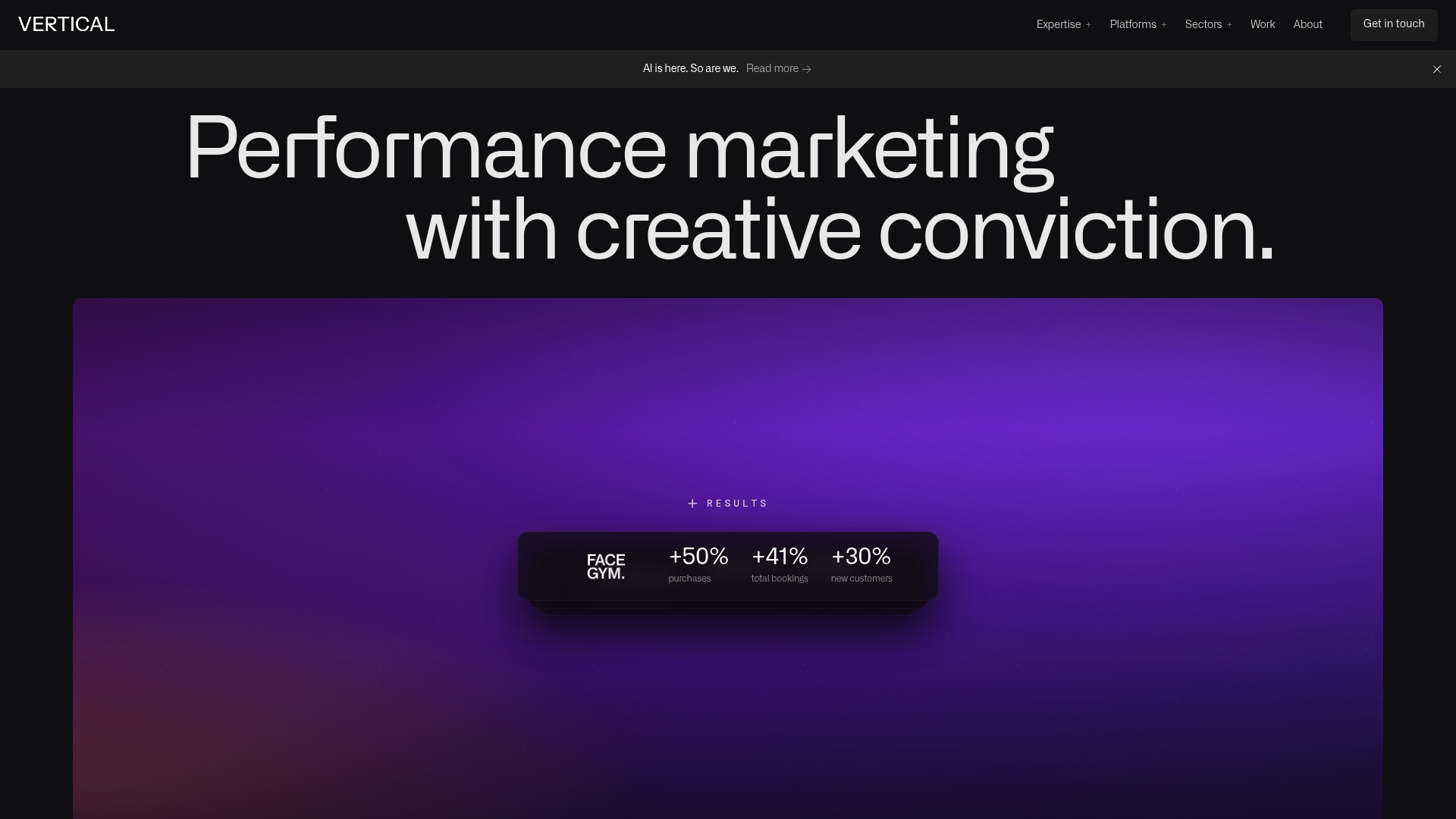
Consumer service businesses. Bookings are the goal. Local search, paid social and a frictionless booking page do most of the work. Our client FACEGYM reported a 50% increase in purchases and a 41% rise in bookings after working with us.
Why one integrated team shortens the path
Most acquisition plans fail in the gaps between suppliers. The strategist sets a target, the media buyer needs creative that does not exist yet, the web developer is working to a different brief, and the email platform sits in someone else’s account. Each party can report success on its own metric while cost per customer drifts up.
With one team across strategy, creative, performance marketing and web, one set of numbers governs all of it. That is the logic behind full funnel marketing, and it is why we describe our approach as clarity, nimble execution and data-driven decisions rather than separate service lines.
Our view
We start every acquisition conversation with the same question: what is a new customer worth to you? Once that is clear, the channel decisions get simpler. Budget goes where cost per customer and lifetime value make sense together, and creative, media and the website are briefed from the same page.
We built Vertical so that strategy, creative, performance marketing and web development sit under one roof. In our experience of the way brands buy agency support, the biggest drag is not a lack of ideas. It is the time lost passing a plan between vendors who each own one piece of it.
Our advice is to keep the plan small and measured. Two or three channels, one clear target cost, a testing rhythm the whole team follows, and a senior team that stays close to the numbers. That is how we aim to give business leaders structure and calm rather than a longer list of tactics.
Alex
Put the plan to work with Vertical
If you want a team to build and run this plan with you, our services cover digital marketing strategy, media planning, paid social, paid search, display, SEO, email marketing and CRM management, creative design, UGC content, website design and development, marketing funnels, tracking and eCommerce management. They are available as projects, retainers or advisory support.
Tell us who your best customers are and what a new one is worth, and we will help you turn that into a channel plan, a target cost and a testing schedule. For a strategic conversation before any build work, our consulting offer is the place to start.
FAQ
What is the best customer acquisition strategy?
The best one is the one built around your ideal customer and your margins. For most brands that means a capture channel such as paid search, a creation channel such as paid social or content, and email to convert and retain, all measured on cost per acquired customer. Add channels only once the first ones are tracked and performing.
How many acquisition channels should I use?
Start with two or three. Each channel needs creative, tracking and optimisation attention, and spreading a small budget thinly makes results impossible to read. Once a channel hits your target cost consistently, add the next one and test it against the same baseline.
How do I calculate customer acquisition cost?
Divide total sales and marketing spend for a period by the number of new customers won in that period. Calculate it per channel as well as blended. Then compare it with first-order margin and expected lifetime value to see whether the spend pays back within your window.
How long before a new acquisition strategy shows results?
Paid channels can show early signals within weeks, though platforms need time to settle before you judge them. SEO and content build over months. Set a review cycle in advance, such as 90 days, and agree what result means scaling, adjusting or stopping.
Sources
- What is Customer Acquisition? IBM
- Practical marketing planning, Business Wales
- How to create an effective marketing plan, FSB
- Online search: Consumer and firm behaviour, Competition and Markets Authority
- Customer Acquisition and Retention, IMRG
- Digital Marketing Campaign: Planning, Channels and Measurement, Adobe
- How to create a digital marketing strategy, Business.gov.uk