Photo by Daria Nepriakhina 🇺🇦 on Unsplash
A lifecycle marketing strategy plans what you say to a customer at every stage of their relationship with your brand, from first contact to repeat purchase and referral, and it connects paid media, email, CRM, social and your website so they carry one message. The brands that get the most from it treat it as one joined-up system, not a set of separate channel projects. At Vertical, we bring strategy, creative, performance marketing and web development together under one team for exactly that reason.
This guide explains the stages, how to build the strategy step by step, what UK campaigns have achieved with it, and how to measure it.
TL;DR
- Lifecycle marketing matches the message to where each customer is, so a new visitor, a first-time buyer and a lapsed customer each hear something different.
- Pick stages that fit how your customers actually behave, then set one goal, one trigger and one owner for each.
- Retention is where most UK teams underinvest, yet UK case studies show large returns from churn reduction, reactivation and post-purchase journeys.
- Coordinate channels with clear priority rules, and measure with holdouts and lifetime value, not only last-click revenue.
- One integrated team removes the hand-offs between strategy, creative, ads, email and web that usually break lifecycle programmes.
Table of Contents
- What a lifecycle marketing strategy is
- The stages of the customer lifecycle
- How to build a lifecycle marketing strategy
- Why retention deserves the larger share of attention
- Lifecycle campaign examples from the UK
- Lifecycle campaigns that earn their place
- How to measure lifecycle marketing
- Where an integrated team helps
- Lifecycle marketing with Vertical
- Our perspective
- FAQ
- Sources
What a lifecycle marketing strategy is
Lifecycle marketing is a managed contact strategy that joins up channels and experiences to support prospects and customers on their path to purchase and beyond, using personalised messages and retargeting. Smart Insights describes it as always on, studying the whole customer journey across devices and channels, with marketing teams working together so every channel pulls in the same direction.
Three ideas sit underneath that definition:
- A lifecycle is a loop, not a funnel. A funnel ends at the sale. A lifecycle treats the first purchase as the midpoint, because the second, third and fourth orders usually decide whether the brand is profitable.
- Context decides the message. A discount aimed at a lapsed customer is wasted on someone who joined yesterday. An onboarding tip is noise to a three-year customer.
- Every touchpoint has a job. An ad, an email, a product page and a delivery notification each move the customer toward the next stage, and they should not contradict each other.
For an eCommerce brand, that means your Meta campaign, your welcome flow, your post-purchase emails and your product pages are planned together. For a B2B company, it means lead generation, nurture, onboarding and renewal share one view of the account. For a course creator or a consumer service business, it means enquiries, bookings, repeat bookings and referrals are treated as one journey.
The stages of the customer lifecycle
Models differ in naming. Smart Insights uses four stages: Reach, Act, Convert and Engage. Others use five: awareness, acquisition, conversion, retention and advocacy. The labels matter less than the logic. A practical set for most brands looks like this:
| Stage | The customer is thinking | Your goal | Typical tactics |
|---|---|---|---|
| Awareness | “Who are these people?” | Reach the right audience | Paid social, paid search, SEO, influencer, UGC |
| Consideration | “Is this right for me?” | Earn trust and capture contact details | Landing pages, reviews, email sign-up, retargeting |
| Conversion | “Can I buy easily?” | Remove friction at purchase | Site speed, clear pricing and returns, abandoned cart emails |
| Onboarding and retention | “Did I choose well?” | Drive the second purchase or first success | Post-purchase flows, replenishment, cross-sell |
| Loyalty and advocacy | “I’d tell a friend.” | Turn customers into repeat buyers and referrers | Loyalty offers, reviews, referral prompts |
| Win-back | “I’d forgotten about them.” | Reactivate lapsed customers | Winback sequences, tailored offers |
The stage lengths vary by market. A fashion retailer may move a customer from first visit to purchase in minutes, while a B2B software sale can run for months with several stakeholders involved. Adobe’s UK analysis notes that in UK B2B enterprise journeys the Decision stage stretches dramatically, and that retention is the most underinvested stage across UK organisations. Your stage definitions should reflect your own sales cycle, not a template.
How to build a lifecycle marketing strategy
A working strategy follows six steps. At each one there is a common way it goes wrong.
1. Define stages from real behaviour
Start with your data, not a diagram. Look at how long customers take to buy, how many orders they place, when they go quiet and what they did before they left. Group customers into stages that match those patterns.
Where it goes wrong: copying a five-stage model from an article and forcing your business into it. A subscription brand and a one-off high-ticket brand need different stages.
2. Identify the signals that move people between stages
A signal is a behaviour you can detect: a first site visit, an email sign-up, a basket left behind, a delivered order, 60 days without a purchase. These signals become the triggers for your campaigns. Two kinds cover most needs:
- Event-based: something happens, such as a purchase, a basket abandonment or a booking, and a message follows.
- Time-based: something does not happen for a set period, such as no repeat order in 45 days, and a message follows.
Where it goes wrong: tracking is incomplete, so triggers fire late or not at all. Clean tracking and attribution come before clever creative.
3. Set one goal per stage
Each stage needs one measurable job: sign-ups at awareness, completed checkouts at conversion, a second order at retention, a reactivated account at win-back. If a stage has three goals, it has none.
4. Segment the audience
Segmentation decides who gets which message. Recency, frequency and monetary value (how recently, how often and how much a customer has bought, known as RFM) is a simple, proven starting point. A 2024 study of 495,478 UK retail customers used RFM segmentation to forecast customer lifetime value groups with 92.40% accuracy, which shows how much signal sits in basic purchase history.
Where it goes wrong: segments are so many and so fine that nobody can write messages for them. Begin with four to six segments you can act on.
5. Coordinate channels and set priority rules
Once several teams or suppliers run campaigns at the same time, customers get conflicting messages: a win-back discount email on the same day as a full-price ad for the item they just bought. Decide which message wins when two collide, and suppress ads and emails for the wrong stage.
Channel mix matters too. The IPA’s JICMAIL research found that new-customer acquisition effectiveness is optimised at 10 or more channels, while retention marketing effectiveness peaks at six or more channels, led by owned channels such as email and CRM. Acquisition needs breadth. Retention needs a smaller, well-run set of owned channels.

Where it goes wrong: every channel has its own agency or freelancer, each reporting its own numbers. Nobody owns the customer, so nobody sees the overlap. This is the situation an integrated team is built to remove.
6. Measure movement and refine
Track how many customers move from one stage to the next, and how quickly. Then adjust the stage definitions, audience logic and messages. The measurement section below covers how.
Why retention deserves the larger share of attention
Most brands pour budget into acquisition because it is easy to see: spend goes up, new customers appear. The return on the rest of the lifecycle is harder to see, which is why it is neglected.
Kantar’s BrandZ analysis found that brands that over-performed across exposure, experience and activation achieved a cumulative 48% growth over three years, and it concluded that brands must invest across the whole buyer lifecycle, not only in acquisition. Adobe’s UK team makes a similar observation: UK organisations over-index on acquisition while post-purchase retention gets little orchestration.
For practical next steps, these guides cover the main retention levers in detail: customer retention marketing strategies, how to increase repeat purchase rate and improving customer lifetime value.

Lifecycle campaign examples from the UK
These examples show what campaigns look like at different stages, and what they delivered. They come from large organisations, so treat the figures as evidence of the mechanism, not a forecast for your own results.
Retention at scale: British Gas
After the Planet Home campaign launched in 2009, churn fell from 2.6 million to 1.7 million customer accounts a year within two years. Econometric modelling attributed a five-year profit contribution of £82.7m to a £45.5m investment, a return of £1.82 for every pound spent. Keeping customers was worth more than the cost of the campaign.
Behaviour-triggered email: Fitness First
Fitness First sent a daily email to members who were more than 120 days into membership and had not visited in the last 27 days. In its case study, that email achieved a 34% open rate, a 7% click-through rate and 43% of recipients revisiting within seven days. The same programme cut digital cost per acquisition and cost per lead by 50% and raised core membership from 54% to 67% of the member base over 18 months.
The lesson: a precise trigger (days since joining, days since last visit) beat a general newsletter. It is a time-based trigger tied to a customer behaviour.
Moving budget from acquisition to retention: Three
Three’s GLOW loyalty campaign shifted brand acquisition spend into retention using paid and owned channels. High-risk groups exposed to it showed two to three points lower churn intent than controls, and the first two months prevented 15,500 customers from leaving.
Repeat purchase, reactivation and omnichannel: New Look
New Look used a customer data platform to size its lifecycle opportunities. It identified £2.1m from converting 5% of one-time buyers into repeat customers, £2.4m from reactivating 1% of lapsed customers and £8.1m from converting 1% of single-channel shoppers to omnichannel. It also found that 71% of its top customers shop across multiple channels, which shaped campaigns that move people between online and in-store.
The useful habit here is the arithmetic: small percentages of the customer base, moved one stage forward, translate into large sums.
Examples for your own sector
| Stage | eCommerce | B2B | Courses and services |
|---|---|---|---|
| Acquisition | Paid social with UGC, welcome series | Targeted outreach, lead magnets | Free lesson or trial booking |
| Onboarding | Post-purchase guide, usage tips | Kick-off sequence, setup checklist | Course start reminders, first-booking prep |
| Retention | Replenishment reminders, cross-sell | Check-ins, expansion offers | Next-module and rebooking prompts |
| Win-back | Lapsed-customer sequence | Re-engagement before renewal | Return offers after a missed booking |
For the email flows behind these, see our guides to post-purchase emails, abandoned cart emails and winback email sequences that protect deliverability.
Lifecycle campaigns that earn their place
You do not need dozens of campaigns. A well-run programme usually starts with five automated journeys, each tied to one stage:
- Welcome: introduces the brand to new subscribers and moves them toward a first purchase or enquiry.
- Abandoned basket or booking: recovers intent that was already there.
- Post-purchase: confirms the order, sets expectations, shows how to get value and asks for a review at the right time.
- Replenishment or repeat prompt: reaches the customer when they are likely to need you again.
- Win-back: reaches customers who have gone quiet, with a message that fits how long they have been away.
Build these in order of revenue impact, check each works, then add segmentation and extra branches. A small set of well-timed journeys outperforms a large set that overlaps. Our guide on reducing churn for high-growth D2C brands shows how to spot the customers most at risk before they lapse.
How to measure lifecycle marketing
Channel dashboards each tell a partial story. Lifecycle measurement should ask whether customers are moving through the stages and whether they are worth more over time.
EConsultancy advises that business metrics map back to campaign objectives: total campaign revenue, revenue per email, new leads, average order size, first-time versus repeat purchases and customer lifetime value. It also notes that accurate measurement needs the email platform to be closely integrated with the ecommerce or CRM system, and that metrics should be tracked over time to show trends.
A workable scorecard has three layers:
- Stage movement: the share of customers who progress to the next stage within a set time, such as first-time buyers placing a second order within 60 days.
- Value: repeat purchase rate, average order value and customer lifetime value by acquisition source and by segment.
- Incrementality: what would have happened without the campaign. Hold back a small random group from a flow and compare their behaviour with the group that received it.
Incrementality matters because automated flows often take credit for sales that would have happened anyway. A holdout group gives you a cleaner read on what the flow added.
Where an integrated team helps
Lifecycle programmes tend to fail at the joins: the ad team does not know what the email team promised, the web team changes the checkout without telling anyone, and the reporting does not match across tools. Marketing directors in eCommerce describe this pressure around costs, channels and ROI, and it is why we recommend one accountable team across the lifecycle.
If you are still weighing up agency options, these questions about results and collaboration are a useful checklist to work through.
Lifecycle marketing with Vertical
Vertical is a growth marketing agency that combines strategy, creative, performance marketing and web development under one roof, run by a nimble, experienced team. For lifecycle work, that means the people planning your stages are the same people running paid social, paid search, email marketing, CRM management, tracking and attribution, and the website where customers convert.
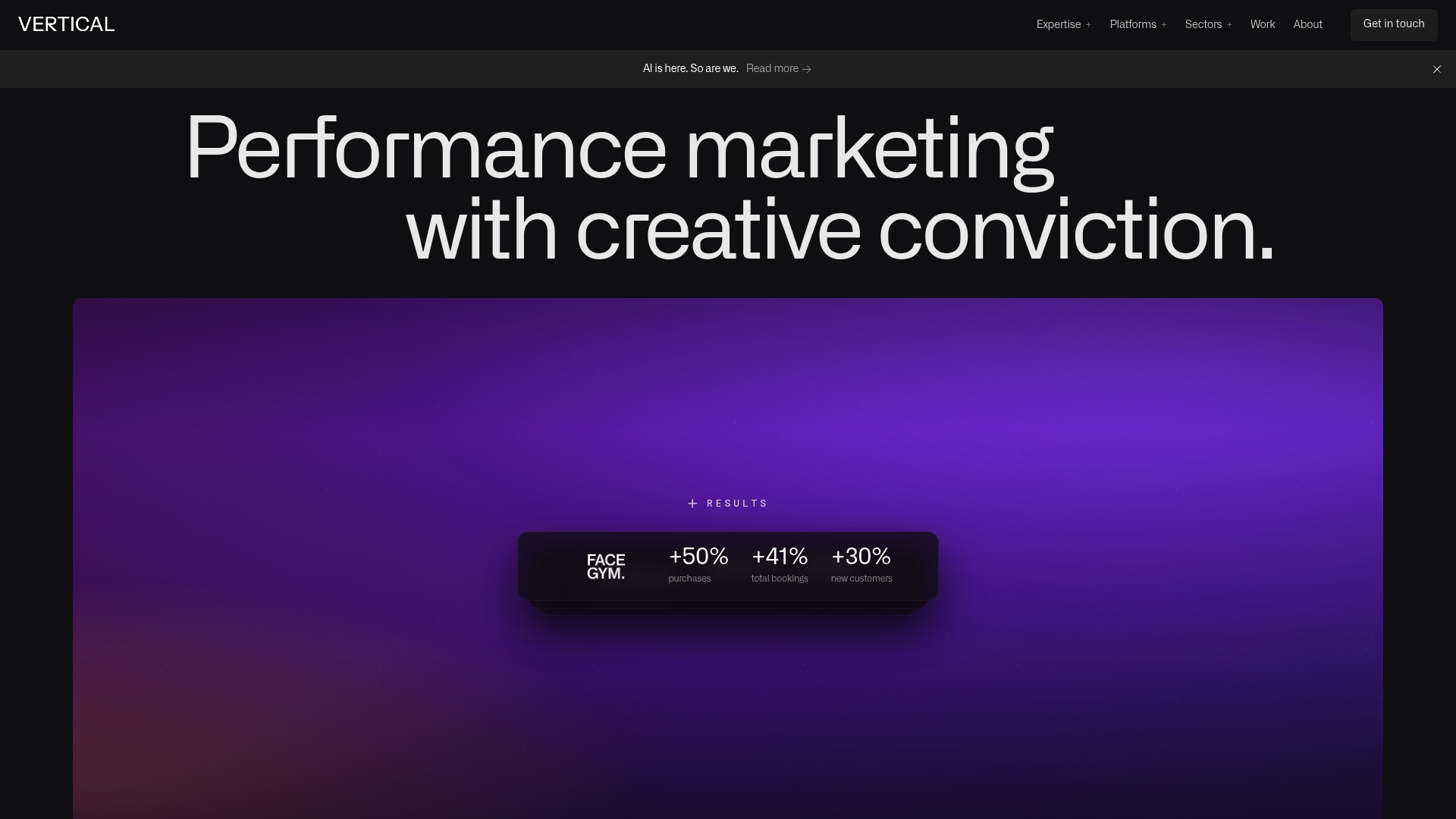
Clients have reported results. FACEGYM saw a 50% increase in purchases and a 41% rise in bookings. Our full range of services covers digital marketing strategy, email marketing, CRM management, marketing funnels and eCommerce management, with project, retainer or advisory engagements. If you want a lifecycle strategy mapped to your own customers, talk to us about growth consulting.
Our perspective
Most brands we speak to do not have a lifecycle problem. They have a hand-off problem. The ads say one thing, the emails say another, and the website says a third.
Our view is simple. Start with the customer data you already have, define the stages around real behaviour, and give each stage one goal. Then put one senior team across strategy, creative, paid media, email, CRM and the website, so nothing gets lost between suppliers.
That is the reason we built Vertical as an integrated agency. Clarity comes first, then consistent execution, then measurement that shows whether customers are worth more over time. Lifecycle marketing rewards that discipline.
Alex
FAQ
What is considered lifecycle marketing?
Lifecycle marketing is any planned communication that changes with the customer’s stage, from first awareness through purchase, repeat purchase and win-back. A welcome series, an abandoned cart email, a post-purchase guide and a lapsed-customer offer are all lifecycle marketing. What links them is that each is triggered by the customer’s behaviour and fits their stage.
What are the stages of a customer lifecycle?
The most common version has five stages: awareness, acquisition, conversion, retention and advocacy. Some models add win-back for lapsed customers, and Smart Insights uses four: Reach, Act, Convert and Engage. Choose stages that match how your own customers behave, because buying cycles differ between a retail brand and a B2B sale.
How is lifecycle marketing different from a sales funnel?
A funnel tracks people toward a single sale and stops there. A lifecycle treats the purchase as a midpoint and plans what happens next: onboarding, repeat purchase, loyalty and win-back. For brands that depend on repeat orders or renewals, that later part usually decides profitability.
How long does it take to see results from lifecycle campaigns?
Automated flows such as abandoned cart and welcome emails can show results within weeks, because they act on traffic you already have. Measures such as repeat purchase rate and lifetime value take longer, since they depend on how often customers buy. Setting a holdout group from the start lets you read the effect of each flow properly.
Sources
- What is Customer Lifecycle Marketing? Smart Insights
- Customer Journey: Principles, Stages, and Measurement, Adobe
- Retail Industry Analytics: Unraveling Consumer Behavior through RFM Segmentation and Machine Learning
- Unlock effectiveness across the customer journey, IPA
- To grow, brands must invest across the buyer lifecycle, Kantar
- Getting Back To Great And Staying There, The Marketing Society
- Putting Our Members First, The Marketing Society
- Glow, Data & Marketing Association
- New Look channels AI tool for CX strategy makeover, DecisionMarketing
- Email Marketing Best Practice: Setting Goals and Measuring Performance, Econsultancy
Recommended
- E-commerce Customer Lifecycle Marketing: The Strategic Growth Framework for 2026
- How to Scale a D2C Brand in the UK: A Practical Growth Framework for 2026
- How to Increase Repeat Purchase Rate: A Strategic 2026 Growth Framework
- Integrated Digital Marketing Strategy for E-commerce: The 2026 Operational Blueprint