Photo by Albert Stoynov on Unsplash
An omnichannel marketing strategy connects every place a customer meets your brand, such as ads, email, social, your website and any physical store, so that each one knows what the customer did in the others. It works when strategy, creative, paid media, email and web are planned together against one customer view. Brands that run those pieces through separate vendors tend to end up with several disconnected channels instead. We built Vertical around the first approach: one senior team across strategy, creative, performance marketing and web development.
This guide covers what omnichannel means in practice, how it differs from multichannel, how to map the customer journey, what UK retailers have done with it, and the steps to build your own plan.
TL;DR
- Omnichannel means channels share data and carry one customer’s context from first ad to repeat purchase. Multichannel means several channels running side by side.
- Start with the journey, not the channel list. Map how a real customer moves from discovery to repeat purchase, and fix the points where they have to start again.
- UK examples show the pattern: retail media, CRM, paid media and delivery data planned as one system rather than as separate campaigns.
- Measurement decides whether it works. Agree one attribution approach and one customer data source before you scale spend.
- One team across creative, paid, email and web removes the hand-offs where omnichannel plans usually break down.
Table of Contents
- What an omnichannel marketing strategy is
- Omnichannel vs multichannel
- Mapping the omnichannel customer journey
- Omnichannel marketing examples from UK retail
- How to build an omnichannel marketing strategy, step by step
- Measuring an omnichannel strategy
- Omnichannel beyond retail
- Our perspective
- Bring the channels under one plan
- FAQ
- Sources
What an omnichannel marketing strategy is
Omnichannel marketing is a plan for delivering a consistent experience across every channel and touchpoint, using what you know about the customer to decide what each channel says next. A touchpoint is any moment where a customer meets your brand: an ad, an email, a product page, a delivery notification, a store visit.
The common thread in good definitions is data. If a customer browses a pair of boots on your app, your email, your retargeting ads and your store staff should all be working from that fact. If they are not, you have channels, but not a strategy.
McKinsey describes three main types of omnichannel strategy:
- Commerce: prioritizing a smooth cross-channel shopping experience, in store and online.
- Personalization: tailored, targeted engagement across channels at scale.
- Ecosystem: rich cross-channel platforms built around the customer’s needs and lifestyle.
McKinsey also advises that the strongest companies start from their strategic ambition and the customer experience they want, and focus on creating value rather than rushing into the space. That is the right order for a brand of any size. Choose the outcome first, then the channels that serve it.
Six traits recur in most descriptions of the approach: consistent brand messaging, personalization from customer data, integration between touchpoints, a customer-first view, data-driven decisions and flexibility as behavior changes. Use them as a checklist when you review your current setup.
Omnichannel vs multichannel
The two terms are often used as if they were the same thing. They are not.
Multichannel means you are present on several channels: say, Meta ads, Google search, email and a website. Each channel usually has its own owner, its own goals and its own reporting. Reach is the aim.
Omnichannel means those channels are joined up. They share customer data, they follow one journey and they are measured against shared outcomes. Relevance and lifetime value are the aim.
Every omnichannel brand is multichannel, but a multichannel brand is not necessarily omnichannel. The difference is integration, not the number of channels.
| Multichannel | Omnichannel | |
|---|---|---|
| Starting point | The brand and its channels | The customer and their journey |
| Data | Held separately per channel | Shared across channels |
| Messaging | Set per channel | Consistent, adapted to context |
| Reporting | Channel metrics, often competing | Shared view of customer outcomes |
| Typical weakness | Customers repeat themselves or see irrelevant messages | Needs clean data and aligned teams |
The weakness in the last row is where most plans stall. Integration is an organizational problem as much as a technical one. When paid social sits with one agency, email with another and the website with a third, nobody owns the customer’s whole experience. Each team can hit its own targets while the customer sees an ad for a product they have already bought.
Mapping the omnichannel customer journey
A customer journey map lists every interaction from first awareness to repeat purchase, and shows which channel handles each. It is the working document of an omnichannel strategy.
Real journeys are rarely linear. Retail Gazette reports that Currys’ digital and omnichannel director described considered purchases such as TVs as taking three to four weeks of research, spread across AI tools, comparison sites, in-store demos and online price or credit checks. His point was that the retailer has to recognize the customer at each stage so they do not start again at every touchpoint.
The physical and digital sides are already tied together in the UK. A 2024 benchmark report covered by Business Wire found that £52 billion, nearly half of UK online non-food sales in 2023, interacted with physical touchpoints. The same report found 42% of UK consumers say delivery cost is the most important factor when shopping online, and 65% are less likely to buy from a brand because of high shipping costs. Delivery and fulfilment belong on the map, because they shape whether a customer comes back.
To build your own map:
- List the stages: discovery, consideration, purchase, delivery, post-purchase, repeat purchase.
- Place every channel you run against the stage where it does its job.
- Mark the hand-offs: where does a customer move from one channel to another, and what information should travel with them?
- Mark the breaks: where does the customer have to repeat information, see an irrelevant message or lose their basket?
- Rank the breaks by revenue at stake and fix the biggest first.
The breaks are almost always at the hand-offs: ad to landing page, browse to email, email to checkout, order to delivery update.
Omnichannel marketing examples from UK retail
The clearest evidence comes from UK retailers who have published what they did and what changed. Treat the figures as results for those businesses in their own circumstances, not as promises for yours. What transfers is the structure.
Cotswold Outdoor Group and HOKA
A four-week campaign for the HOKA Mach 7 combined in-store digital screens across 13 Runners Need shops with on-site placements, CRM activity and paid media on Meta and Google. Retail Gazette reports a 30% increase in HOKA’s share of revenue, a 28% rise in unit share, a 53% rise in homepage click-through rates and a 67% CRM email open rate. The lesson: one product, one message, every touchpoint from shop floor to inbox.
Ellis Brigham and delivery
The outdoor retailer re-platformed and added loyalty-tier delivery fees, real-time stock visibility for click-and-collect and automated order picking. Retail Gazette reports Where-is-My-Order complaints fell by 14%, and that Ship-From-Store delivery times dropped from up to 10 days to express options. The lesson: omnichannel is not only advertising. Stock and delivery information is part of the experience you market.

New Look and the data foundation
New Look’s chief executive told Drapers that the company secured a £30m shareholder investment in April 2025 to accelerate its omnichannel strategy, covering data, ecommerce optimization, loyalty and a streamlined journey. A cloud-based data platform holds data for 10 million active customers, and the goal is to double online orders to £1bn by 2030. Her view of the journey is worth keeping in mind: it barely matters where it starts or ends, what matters is how fluid it is.
You do not need a £30m budget to apply this. The principle scales down: one customer record, one set of audiences, one message plan. A smaller ecommerce brand can start with its store data, email platform and ad accounts, and join those up first. Our guide to building a first-party data strategy for personalization covers that foundation.
How to build an omnichannel marketing strategy, step by step
Here is the routine we would follow with a brand moving from separate channels to a joined-up plan.
1. Set the commercial goal
Pick one or two outcomes: repeat purchase rate, customer acquisition cost, bookings, qualified leads. Omnichannel plans without a goal turn into a technology project. Where it goes wrong: choosing a goal per channel, which brings back the silos. When we work on strategy, the goal sits above the channels, and every channel plan is written against it.
2. Audit the data you already have
List what you know about customers and where it lives: order history, email engagement, site behavior, ad audiences, store or booking data. Note what does not connect. Where it goes wrong: assuming a tool will fix messy data. Tracking and attribution is part of what we offer, so the audit and the tracking setup sit with the same team.
3. Define the segments
Group customers by behavior that should change what you say: first-time buyers, repeat buyers, lapsed customers, high-value customers, browsers who did not buy. Four to six segments is enough to start. Where it goes wrong: building twenty segments that nobody has the creative to serve.
4. Map the journey and assign the channels
Use the journey map above. For each segment and stage, decide which channel leads and what it says. Paid social might introduce, email might nurture, search might capture intent, the website might convert, and CRM might bring people back. Because creative, paid media, email and web development all sit in one place at Vertical, a plan like this is written once rather than negotiated between suppliers.
5. Build one creative system
Salesforce’s UK guide recommends brand guidelines covering logos, colors, typography, voice and tone so messaging stays consistent. Consistency does not mean identical. A TikTok-style UGC clip, a product email and a landing page should look like the same brand and carry the same offer, each shaped for its format. Creative design, UGC content and brand identity are services we run alongside the media and email work, so the creative reflects what the channels need.
6. Connect the platforms
Link your store, email or CRM platform, ad accounts and analytics so audiences and events pass between them. A purchase should suppress prospecting ads, trigger a post-purchase email flow and update the customer record. Our integrated digital marketing blueprint for e-commerce sets out the operating model in more detail. Email and CRM sit at the center of this step, so our Klaviyo performance metrics framework is a useful companion if Klaviyo is your platform.
7. Launch in one journey, then extend
Pick the journey with the most revenue at stake, often first purchase to second purchase, and run it end to end before you touch the rest. Retention is usually where the gain is clearest: customer retention marketing strategies and retargeting campaigns by funnel stage are good places to look for the first flows to build.
8. Test, measure, adjust
Run A/B tests across channels and segments, review results on a fixed rhythm, and move budget toward what moves the shared goal.
Measuring an omnichannel strategy
Measurement is where omnichannel plans are most often undermined. Each platform reports its own conversions and each claims credit for the same sale. Add them up and you have more sales than you made.
The fix is to agree one view of results outside the platforms. That means consistent tracking, an attribution approach everyone accepts and, for larger spend, modeling that looks at channels together. Our piece on data-driven marketing attribution models explains how platform models are changing, and our marketing analytics service covers marketing mix modeling.
If your sales process has a gap between enquiry and sale, the same discipline applies: tracing every lead to a sale shows what that looks like for a dealership, and the principle carries over to any business with a lead-to-sale pipeline.
Watch a small set of numbers together:
- Blended customer acquisition cost across all channels
- Repeat purchase rate and time to second order
- Revenue per customer over 6 to 12 months
- Email and CRM share of revenue
- Return on ad spend, read alongside the above rather than alone. Our post on ROAS as a north star metric explains why.
Omnichannel beyond retail
The same logic applies outside ecommerce stores.
- B2B companies: paid search, LinkedIn, cold email and CRM follow-up should work from one lead record, so sales knows what each prospect has already seen.
- Educators with online courses: ads, email nurture, a sales page and the learning platform should share enrollment data, so current students are not served acquisition ads.
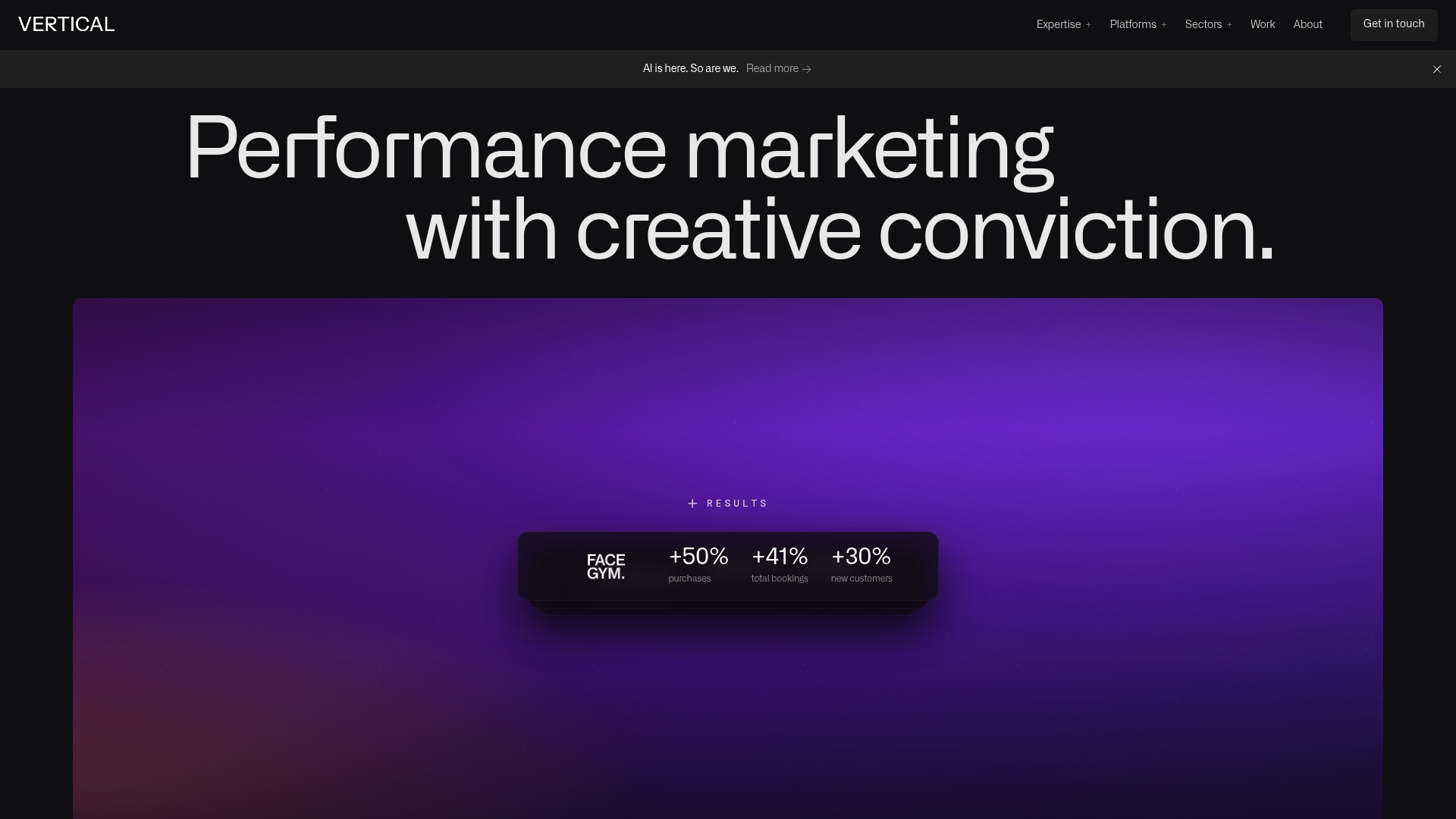
- Consumer service businesses: social, search, the booking flow and reminder emails should be tied together to raise bookings. FACEGYM saw a 50% increase in purchases and a 41% rise in bookings working with us.
- Agencies: an advisory partner can help you structure integrated offers for your own clients.
Our perspective
Most omnichannel problems we see are not technology problems. They are ownership problems. When strategy sits with one supplier, creative with another, paid media with a third and the website with a fourth, each does a competent job on its own piece and nobody owns the customer’s whole experience.
That is why we put strategy, creative, performance marketing and web development under one roof, with a senior team that stays close to the work. The journey map, the creative system, the ad audiences, the email flows and the site are planned together, so a change in one is reflected in the others.
Our advice is to start narrower than you think. Choose one journey, join up the data behind it, measure it honestly and extend from there. Clarity and consistency matter more than the number of channels you are on.
Alex
Bring the channels under one plan
If you are running paid, email, social and web through separate suppliers and want them working as one system, our team covers digital marketing strategy, paid social and search, email and CRM management, creative, website design and development, and tracking and attribution. See the full list on our services page.
We also work with food and drink brands and fashion and lifestyle brands, and you can read how we approach client results in ecommerce growth.
FAQ
What are the four pillars of an omnichannel strategy?
Descriptions vary, but four ideas recur: a unified customer view built from shared data, consistent messaging and brand identity, integration between channels and touchpoints, and measurement against shared outcomes. If you cover those four, you have the structure of a working strategy.
What is the difference between omnichannel and multichannel marketing?
Multichannel means you use several channels, each run on its own. Omnichannel means the channels share data and follow one customer journey. Every omnichannel strategy is multichannel, but the reverse is not true.
How much does it cost to start?
It depends on the platforms you already use and how many channels you want joined up. Most brands can begin by connecting the store, email platform and ad accounts they already have, then extend. We scope strategy, creative, media and web work as projects, retainers or advisory, so you can start with the journey that matters most.
Do small and mid-sized brands need omnichannel marketing?
Yes, at a scale that fits. A brand with a store, an email list and paid social can already create a connected journey: suppress ads after purchase, trigger a post-purchase flow, and use order data to shape audiences. The principle is the same as for large retailers.
Sources
- McKinsey: What is omnichannel marketing?
- Retail Gazette: Currys digital and omnichannel director interview
- Business Wire: £52 Billion of UK Online Sales Are Boosted by Omnichannel Experiences
- Retail Gazette: Cotswold Outdoor Group and HOKA
- Retail Gazette: Ellis Brigham reduces WISMO enquiries by 14%
- Drapers: New Look CEO on its £30m digital investment