For most growing brands, an integrated agency is the stronger first choice. One team covers strategy, creative, paid media, email and web, so you do not have to hire and manage each specialism yourself. In-house marketing means employing your own people. Agency marketing means outsourcing the work to an external team. The real question is which model gets you to measurable growth with the least friction. This article sets out what each model gives you, what the UK evidence says about in-housing, and how to decide.
TL;DR
- An agency gives you a full bench of specialists (strategy, creative, paid, email, web) without recruiting each one. An in-house team gives you daily proximity to the business.
- UK in-housing is common but mixed in outcome: ISBA’s 2023 research found only 53% of brands gained the greater control they expected from in-housing, and 40% the agility.
- Hiring costs go beyond salary: recruitment, benefits, tools, training and management time all count. Agency fees replace most of those with one agreed fee.
- Splitting work across several vendors is where results suffer most. One integrated team removes the hand-offs.
- A hybrid works well: a small internal owner of the brand, with an agency running the specialist channels.
Table of Contents
- What the two models actually mean
- What the evidence says about in-housing
- Where an agency gives you more
- Where in-house is attractive, and how to get it right
- What each model costs
- Which model suits which business
- How to decide: five questions
- A sensible way to combine the two
- Working with Vertical
- FAQ
- Sources
What the two models actually mean
In-house marketing is a team on your payroll. They know your products, your customers and your internal politics. They sit in your meetings and answer to your leadership.
Agency marketing is an external team that delivers a defined scope, either as a project, a monthly retainer or advisory support. They bring experience from many brands and a set of specialists you would otherwise have to hire one by one.
There is a third pattern many UK businesses end up with: both. The IoD and CIPR’s February 2023 report on public relations found that 47.52% of surveyed organisations had in-house support, 14.85% had agency support and 20.79% used both. That is PR rather than performance marketing, but it shows how common the blended model is.

What the evidence says about in-housing
In-housing has been a major trend among UK advertisers. ISBA, the body for UK advertisers, published its State of In-housing report in 2023. It found that more than 90% of its brand sample had an active in-housed operation, but the results were mixed across the benefits brands had hoped for.
Two figures matter most for a decision-maker:
- Only 53% achieved greater control.
- Only 40% achieved the agility they expected.
Control and agility are the two reasons most often given for bringing work in-house. Fewer than six in ten and fewer than half got them. The same report names the challenges: talent acquisition and retention, resources, technology and operational management.
That list is a useful checklist of what you take on when you build a team. You are not only buying marketing output. You are also running recruitment, tooling, line management and cover for holidays and departures.

Where an agency gives you more
Breadth of skills from day one
A growing ecommerce brand usually needs paid social, paid search, email and CRM, creative, a site that converts, and tracking that ties it together. Hiring all of that means a team of several people, each with a different salary expectation and career path. An agency brings those skills as one working unit.
At Vertical, the services cover brand strategy, digital marketing strategy, media planning, paid social, paid search, display, influencer marketing, social media management, SEO, email marketing, cold email, CRM management, creative design, UGC content, brand identity, website design and development, marketing funnels and ecommerce management. You can see the full list on our services page.
Speed to start
Recruiting a senior marketer takes time: writing the role, interviewing, notice periods, onboarding. An agency team can begin once scope is agreed. If you have a launch, a seasonal peak or a booking target to hit, that gap is real.
One team instead of several vendors
Many brands avoid the in-house build by hiring separate suppliers: one for ads, one for email, one for the website, one for creative. The problem is then coordination. The ad agency changes the landing page promise, the web developer was not told, and the email flows still say something different. Our approach is built on removing that: strategy, creative, performance marketing and web development under one roof, with a nimble, experienced team focused on clarity.
Results you can measure
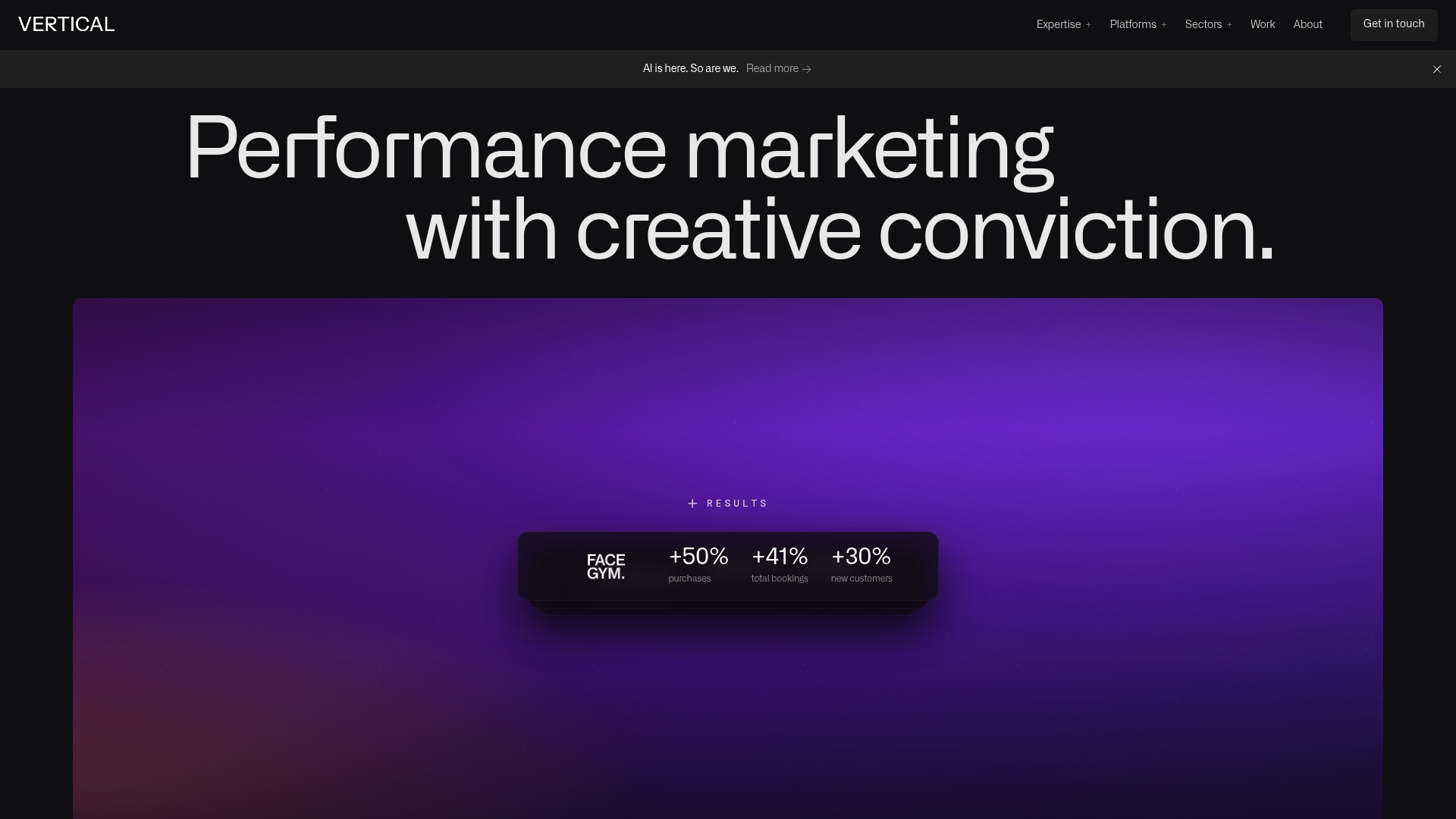
FACEGYM reported a 50% increase in purchases and a 41% rise in bookings after working with us. Results depend on the brand, the offer and the starting point, but they show what integrated delivery across creative, media and web is designed to do.
Where in-house is attractive, and how to get it right
An in-house team knows the business closely. They hear about stock issues, pricing changes and customer complaints the same day. That is valuable for brand voice and for fast internal decisions.
The ISBA findings suggest that the benefit is not automatic. Control and agility were achieved by a little over half and under half of brands respectively. Teams tend to do best when they are focused on what only an insider can do: owning the brand, the product knowledge and the priorities, while specialist channel work is supported externally.
That is why we often see the strongest setup as a small internal lead working alongside an agency. If you want that structure, our agency advisory and consulting support is built for exactly that kind of senior guidance.
What each model costs
The cost comparison is rarely as simple as one salary against one fee.
| Cost element | In-house | Agency |
|---|---|---|
| Salaries and benefits | Paid for every role you hire | Included in the agreed fee |
| Recruitment | Time and often fees for each hire | None |
| Tools and software | Licences you buy and maintain | Platform expertise brought by the team |
| Training | Your budget and your time | The agency’s responsibility |
| Management | Your leaders manage each person | One point of contact for the scope |
| Flexibility | Fixed headcount | Project, retainer or advisory billing |
Vertical’s services are fee-based, billed as projects, retainers or advisory work. We do not publish prices, because the right scope depends on your channels and goals. The point of comparison is the total: an in-house team of four or five specialists carries payroll, benefits, tools and management time every month whether the workload is heavy or light. A defined agency scope lets you match spend to the work. We also look at this in detail for one channel in our guide to in-house versus agency paid social costs and fees.
Which model suits which business
Ecommerce brands
Ecommerce growth depends on paid media, email and CRM, creative, the store and tracking all working together. If you are on Shopify Plus, the platform knowledge matters too, which we cover in our guide to choosing a Shopify Plus marketing agency. For brands that need Klaviyo or email marketing support, an agency that manages email, CRM and the paid channels feeding it keeps flows and campaigns consistent with what customers saw in the ad. A single hire rarely covers all of those areas well.
B2B companies
Efficient lead generation needs a funnel, not one tactic: positioning, paid search or paid social, cold email, landing pages and CRM follow-up. An agency can run those as one system. An in-house marketer is often a generalist who then needs outside specialists anyway.
Online education
Educators launching courses need an audience, a funnel, a site and email nurture, often in a short window ahead of a cohort or a launch. An integrated agency can build and run it all in one engagement, and your internal people can concentrate on the course itself.
Consumer service businesses
If the goal is more bookings, the work is local and channel-specific: paid search, paid social, a booking-focused site and follow-up. FACEGYM’s 41% rise in bookings is the sort of outcome this combination targets.
Agencies
Agencies themselves sometimes need strategic or advisory support on positioning, structure and growth. That is a different engagement from delivery, and it sits within our advisory offer.
How to decide: five questions
- How many specialisms do you need in the next 12 months? If the answer is more than two or three, an agency covers them more efficiently than hiring each one.
- How fast do you need to start? If a launch or peak is close, an agency can begin sooner than a recruitment process allows.
- Do you have someone who can manage specialists? Management is one of the burdens ISBA’s report highlights. If there is no senior marketing lead, an agency with senior people carries it.
- Is your workload steady or lumpy? Lumpy demand suits retainers and projects. Fixed headcount suits constant, predictable volume.
- Do you want one team accountable for the whole funnel? If yes, avoid splitting the work across separate suppliers.
If you choose an agency, a clear brief makes the first months far more productive. Our guide on writing a marketing agency brief with clear scope covers what to include. For selection criteria, see questions to ask a potential marketing agency, and for paid media specifically, our guide to choosing a performance marketing agency.
A sensible way to combine the two
When brands ask us about a hybrid, we suggest this split:
- Internal: a marketing lead who owns the brand, the commercial priorities and the relationship with the agency.
- Agency: strategy, creative, paid media, email and CRM, SEO and web, run as one plan.
- Shared: reporting. One set of tracking and attribution that both sides trust.
This keeps the insider knowledge in-house and puts specialist capacity where it is hardest to hire.
Our view
We built Vertical around one belief: most marketing problems are coordination problems. Brands rarely fail because one channel was weak. They struggle because strategy, creative, media and the website were handled by different people with different goals.
That is why we put senior strategists, creatives, performance specialists and developers in one team. You get clarity on what is being done and why, and a team that moves quickly because nobody is waiting on another supplier.
If you are weighing a hire against an agency, we would start with the outcome you need in the next year, then count the specialisms it takes to deliver it. For most growth-focused brands, one integrated team is the simplest route to it.
Alex
Working with Vertical
If you want strategy, creative, paid media, email and web delivered by one experienced team, start with our services or talk to us through the Vertical Brands site. We work on projects, retainers or advisory engagements, so the structure can fit your stage.
FAQ
Is an agency cheaper than an in-house team?
It depends on how many specialisms you need. An in-house team carries salaries, benefits, recruitment, tools and management time for every role. An agency fee covers a team of specialists against a defined scope. For brands that need several channels, one fee is usually simpler to plan than several payrolls.
Do in-house teams give you more control?
Not automatically. ISBA’s 2023 report found only 53% of brands achieved greater control from in-housing, and 40% the agility they expected. Clear scope, reporting and a senior contact on the agency side give you control without the overhead of a build.
Can I use both an in-house team and an agency?
Yes, and many UK organisations do. In the IoD and CIPR’s 2023 PR survey, 20.79% of organisations used both. A common split is an internal lead owning brand and priorities while the agency runs specialist channels.
What should I send an agency before we start?
A brief with your goals, audience, budget range, channels and what success looks like. A clear scope speeds up the first weeks and makes reporting easier to agree.
Sources
- ISBA, State of ‘in-housing’ report 2023
- IoD and CIPR, The Role of Public Relations in Strategic Planning and Crisis Preparedness, February 2023